In my new role as one of the associate editors at American Book Review, I'll be keeping my eyes peeled for significant just-published or (better yet) about-to-be-published innovative fiction, poetry, theory, and hybrid texts that should be reviewed in ABR.
If you ever know of one—by beginning or established authors, by yourself or others, from independent presses or corporate, in digital or dead-tree format—would you please email me (lmo AT lanceolsen DOT com) with an announcement that includes author, title, publisher, brief description, publication date, and contact information?
And if you're a publisher, would you please add me to your emailing list?
Many thanks, and please pass the meme.
18 November 2006


15 November 2006
Kent Johnson Speaks

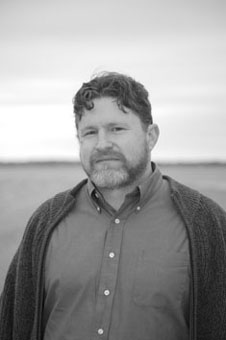
Kent Johnson himself was drawn our way by the recent discussion of his work. But since his comment was the 15th reply to a post that is now over a week old and well down the page, I offered to post it here for him. The image of Yasusada was found in a past issue of the great Australian online poetry mag, Jacket.
--
A belated commentary here.
There are some really interesting remarks in this discussion, and thanks to Ted for putting up the generous post.
Just to throw something into the mix, I thought I'd comment briefly on Joe Amato's thoughts on the "genre" location of the Yasusada writing. (By the way, please see, if you haven't, Joe's amazing new book, Industrial Poetics, just out from Iowa--what its genre should be called, I'm not quite sure! It's fabulous.)
Actually, I wouldn't necessarily see Doubled Flowering, etc. as closer to Poetry than to Fiction, nor would I make the vice versa claim. And I don't say this just because the two AY books have as much "prose" in them as "poetry": Generic identity, I think, is not so much a matter of textual form as it is of Authorial identity and identification (i.e., how does the Author frame the form and how does the Author frame herself or himself?). And of course, the Yasusada writings refuse, in important senses, to mark themselves in ways that provide for ready placement.
Clearly, though, Motokiyu's writing *is* fictional... But I'd say it's a fiction in a decidedly non-conventional sense, since it also--and this would be at the core of its controversy--gathers into its poetic-fictive space a number of "real" and relatively unquestioned paratextual categories: ones that are almost always kept distinct from the imaginative "essence," so to speak, of literary writing, traditional and experimental alike.
Most relevant here would be the Yasusada work's departure from the expected projections of Authorship and the standardizing rituals of taxonomy and axiology that flow from its function (as they do, no?). And it's the paratextual category of Authorship, in particular, innocuous and normal as it appears to be, that provides the character roles we all fill and which the Literature institution absolutely requires for its overall stage effects--including the ongoing tragicomic display of the "avant-garde's" auto-recuperation into the Culture industry (Ron Silliman's post on Barrett Watten the other day, by the way, seems blind to the fact that there could be nothing more *inside* High Museum culture than a tenured, academic [winner of the Rene Wellek Prize for Criticism, no less] writing in arcane theoretical language about the negative dialectics of poetic opposition!). Er, Ideology, meet Language Poetry...
Not that Yasusada totally succeeds in escaping those dynamics... Far from it, since one could argue it's a pretty provisional, even flawed gesture of resistance to what I mention above. And not that these kinds of "theoretical" considerations are the major impulse or meaning of its writing. In fact, what I've said in this comment seems more than a bit uptight and stilted, now that I read it over. Well, too late now, I guess. Maybe a briefer way of putting it is that I think Motokiyu's work wishes to unfold not only as a fiction on the page, but as a fiction within the world. A poetic fiction, I suppose, that hopes to enchant and confuse the scenery in some modest, but useful and unpredictable ways. In that, I think it's had, and is still having, some impact.
Kent
14 November 2006
interview : lidia yuknavitch
 Lance: I think of you as a major literary activist on the American scene with a history of engagement and community-mindedness that stretches back at least as far as two girls review and has come to full fruition with your founding of and involvement in Chiasmus Press. What lured you into the universe of activism, and how has your sense of it changed over the years?
Lidia: What lured me into the universe of literary activism was this: my heart hurt. As I began writing myself up and through the literary machine I found that some of the most vibrant, exciting, driven work was being done by people on the margins, particularly the margins of academia, of economy, of the mainstream—and that caused me angina.
I think I came of age as a writer when all that NEA funding was hacked to pieces—writers and artists such as Karen Finley and Andres Serrano and books like Doug Rice’s were being attacked and de-funded in ways which truly marked me.
Closer to home in Oregon I noticed a dismal repetition of awards and legitimacy landing on the heads of a very short list of writers whose work tends in the direction of … warm and cozy and comfortable. With very few exceptions.
The crossroads for writers like me looks like this: wait around to be accepted by authorizing systems and lofty literary communities that have little to no chance of claiming you as one of their own (thing of darkness), or, do what my favorite artists have done—the ones who have kept me alive all these years—invent, innovate, improvise, take action.
Because in the end making art and jamming the door open for other people to make art is more important to me than pretty much any form of culturally authorized party hat I can imagine.
The other thing that has moved me toward intention and action is my sense that women writers in America are endlessly in need of diversification. Don’t get me started. See my post A Prayer for Women’s Writing.
Right now I am most invested in helping to create a tribe—which is a word I prefer over community, because it signifies so differently. It carries with it ritual and warrior call, it touches both my mother’s Native American heritage and my father’s Lithuanian saga. It justly identifies intimate relationships born from a nomadic, shifting, de-centered energy, belonging more to the land and to other bodies than to society. It is plural and moving underneath power and order.
I love the tribe I belong to like I love my family.
Lance: "Chiasmus Press," the mission statement on your website reads, "is a Northwest, Portland-based literary collective intent on printing the most innovative emerging authors, those who have been excluded or have not yet been co-opted by the mainstream-print-industry or well established, often academically entrenched, forms of Avant-gardisms." Would you talk a little about how you arrived at the collective structure, what you've enjoyed most and least about running the press, your contest, and what advice you have for those thinking of launching their own alternative presses?
Lidia: You know, there is virtually no way I could be part of a press that was not at its heart a collaborative effort. I so seriously believe in collaboration that half the time in my own writing I can’t live with its mono-vocality. Chiasmus is thus a collective or collaborative entity because I can’t stand it any other way. Honest.
What I enjoy most is creating a space for writers and artists to just make.
One of my eternal frustrations is always how to keep everything funded.
The other is how much my “job” (15 courses a year) gets in my way.
$^%$*^%$*(^**##%$#&%$^%*&^%*&%^@#$%^&&*##*****!!!!!!!!
My advice to those thinking of launching their own alternative presses is: hurry, please. And: make it up. And: make it sing.
Lance: Whose voices—inside the world of fiction and out—have enabled you to write, and how, and why?
I actually came to writing through painting and music, which is to say that musicians such as Miles Davis, John Coltrane, Thelonius Monk, Laurie Anderson, Tom Waits, The Velvet Underground, the Sex Pistols and the Pixies made stories burn inside me. Painters who were also innovators like Jackson Pollock and Joan Mitchell and Francis Bacon and Willem de Kooning and Frida Kahlo brought the crouch of dreams to my very fingertips.
At one crucial point I was visited in a dream by Mary Shelly … that seems key. It was a long conversation. When I woke up I took very careful notes.
But it was three women writers in particular who burst the membrane of my imagination and brought me to writing: Kathy Acker, Marguerite Duras, and Gertrude Stein. In their work I felt less like a freak. And I felt as if my stories had mothers.
I am moved lately by writers like Carol Maso and Anne Carson, since they sail across genre lines so effortlessly and without apology.
I am moved by the writers we publish, their bravery, their risks.
And I don’t mean to make you blush, Lance, but in my present tense, it’s you—you enable me to write. Literally. Because being in literary relationship to you and Andi makes me feel tethered to real bodies and hearts. I honestly believe I’m alive as a writer in part from knowing you/your writing.
And I think people should say this kind of thing in public.
Because it is not enough to be profoundly intellectual or a wizard of artistic tricks or a spanky academic or an award winning author—as so many of my beloved fellow writers are—it’s the heart that matters to me.
Lance: Well, it's right back at you, and in spades. Seriously. You've taught me universes about everything from how communities should work to what a sentence can do. But since repressed Scandinavians blush more deeply than others, let me change the subject. Thomas Mann once commented that "A writer is somebody for whom writing is more difficult than it is for other people." What is most difficult about the art form for you?
Lidia: That it’s more real to me than people and the world.
Lance: You recently mentioned to me that you're in the process of finishing a new novel. How, if I may ask, does it converse with your former fictions and obsessions? How do you sense it moving beyond or transforming them?
Lidia: Well I’m profoundly shitty at trying to describe it, so I’ll just give over a bit—I think in a way the story is about all of us, and about making art, but this small bit is about a girl orphaned by war who will later become an American artist ... a painter.
There is not a word for what she is feeling, thinking, living. At least not for her; an as yet unformed lexicon rests between vertebrae in silent evolutionary swirls. It will take years for this word to emerge, and more time than that for consciousness to wrap its vines of comprehension around it.
Her hands carry the trace of a family like skin psalms.
Sometimes she does not know what to do with them.
Her hands.
She is a girl in a tribe of sorts—those who have suffered loss and grief inexplicably, through circumstance, environment, accident, karmic lurch, or for no reason in the least. This is what they must decide, no matter the age or level of wisdom, no matter what is at stake, who is around them, where they are geographically or spiritually or physically or intellectually or politically: live or not.
And if it is life they choose, then the road of their lives joins them with a secret society of sorts. Having lost their origins. Moving over land and soul. Living a life in which one must invent meaning perpetually.
Utterly.
Purely.
Passionately.
From the wreckage of a heart.
She places a hand to her own face.
This is art.
This is how she grew.
12 November 2006
Brooklyn Rail Anthology

Speaking of Brian Evenson, he's one of the contributors to what looks to be a terrific anthology edited by Donald Breckenridge, which has just come out from Hanging Loose Press, The Brooklyn Rail Fiction Anthology.
Breckenridge has been running a very strong reading series in Brooklyn for at least three years I've been aware of; plus, as Fiction Editor at Brooklyn Rail since 2002 he's made over what might be just another alternative arts weekly into one of the most interesting venues in the country to read new work by and about innovative fiction writers. Says Breckenridge in the introduction: "As a self-taught writer and ardent reader of formally experimental fiction, my goal as the Rail Fiction Editor has always been to highlight the talents of emerging writers, many of whom live in Brooklyn, as well as to showcase the current writing of established authors who have been marginalized by an increasingly risk-averse, profit-driven publishing industry."
The 432 page Anthology succeeds in its mixture of established and emerging writers, and is as good as any anthology available in marking the territory of new fiction.
List of contributors: Diane Williams, Brian Evenson, Caila Rossi, Lynda Schor, Sharon Mesmer, Susan Daitch, Jill Magi, Leslie Scalapino, Douglas Glover, Jonathan Baumbach, Jacques Roubaud (Translated by Guy Bennett), John Yau, Kenneth Bernard, Michael Martone, Barbara Henning, Lewis Warsh, Bart Cameron, Aaron Zimmerman , Jim Feast, Will Fleming, Evan Harris, Blake Radcliffe, Meredith Brosnan, Pat MacEnulty, Martha King, Carmen Firan (Translated by Dorin Motz), Elizabeth Reddin, Jeremy Sigler, Constanza Jaramillo Cathcart, Marie Carter, Lynn Crawford, Johannah Rodgers, Robert Pinget (Translated by Barbara Wright), Jean Fremon (Translated by Brian Evenson), Doug Nufer, R.M. Berry, Albert Mobilio, John Reed , Thomas D’Adamo, and Kurt Strahm.
09 November 2006
review:
brian evenson : the open curtain
 When I'm in a relatively optimistic mood, I start thinking maybe the last few years are proving that something fresh and important is going on in the precincts of innovative fiction. After all, several significant alternative writing celebrations—&NOW and The Writer's Edge among them—have sprung up and seem to be planning on staying around a while. Even the Associated Writing Programs conference, once the bastion of the bland leading the bland, kin to the Bowen essay Carol Novack cites below, has been hosting some energizing panels on innovative prose and some fine alt-readings.
Moreover, this past summer and fall have seen or will see—in addition to a number of exciting new texts from Now What contributors—publication of Thomas Pynchon's new novel, Against the Day (due out 21 November), which spans the two decades or so before World War I, the first titanic rupture of the 20th century; Mark Danielewski's ballsy followup to House of Leaves, called Only Revolutions (September), that takes the shape of a kind of wacked-out roadtrip in which the book (a sort of prose poem, of all things)—reminiscent of Milorad Pavic's love story, The Inner Side of the Wind—is printed on two sides, one telling the story from a male narrator's point of view, the other from a female's; and two of my recent favorites: Shelley Jackson's brilliant Half Life (August), the story of a 28-year-old bisexual, bi-headed narrator who, citing "irreconcilable differences," seeks divorce from her other self by decapitation, and Laird Hunt's wonderfully curious third novel, The Exquisite (September), which is both a response to 9/11 and paean to Manhattan—especially to its seedy, shadowy, cramped, and unhinged Lower East Side, where anything can and does happen. Set shortly after that rip in reality’s fabric half a decade ago, "when the gaping hole … was still fresh, and the air was still stinging everyone’s eyes," the novel conjures a universe that is as much feverscape as city. It is a zone, as one character comments, "of subtle simulacra, of deceptive surfaces, of glib and phantom shimmerings" that "falls under the rubric of the danse macabre."
Put that together with the advent or re-invention of a host of intriguing indie presses (including Chiasmus, Aqueduct, Starcherone, and the others listed to the right), and I start wanting to say, as I did a few days ago in my post about electronic book review's new thread, Fictions Present, that it's beginning to feel a little like a renaissance of experimentation in the U.S.
Brian Evenson's recent novel, The Open Curtain, which Coffee House brought out last month, adds fuel to this meme's fire. In it, a Mormon teenager named Rudd stumbles across three letters—two from a woman named Anne Korth, and one from his dad who recently committed suicide—that suggest the possibility of a half-brother from a liason between Korth and Rudd’s father. Rudd’s resulting research into that relationship, as well as for a high-school paper he's writing on a nineteenth-century murder of a young woman by the grandson of Brigham Young unfold into a narrative (as the novel’s title suggests) about deception, hidden things, the dark, blank, blurry spaces in meaning, identity, and, finally, existence itself that give the lie to the inflexible vision at the core of conventional religions that can’t bring themselves to accept, as Rudd realizes, that "nothing came unmixed."
Initially, The Open Curtain seems a mimetic departure from Evenson’s earlier avant-gothic fiction. Toward the end of the first of three sections that comprise the novel, however, Rudd begins to experience unnerving blackouts and temporal disruptions that unhinge the apparently traditional narrative tactics at play. The second section jarringly changes point of view to Lyndi, a teenager whose parents have been murdered in a gruesome ritual killing in which Rudd seems to be implicated. As Rudd and she move toward marriage, the narrative further disrupts, and by the third section it becomes clear that each movement in its architectonics has essentially troubled and unwritten the preceding one. The final section flickers between realities, histories, and cleaving selves, transforming what at first may have seemed a traditional murder mystery into a mystery of ontology and epistemology, a novel about undoing "realistic" novels, and an extended investigation into the inexorable violence and blindness shot through Mormon culture.
We have returned, in other words, to all that makes Evenson's fiction so engaging, accomplished, and consequential. In its impulse to investigate the rich possibility spaces between genres, that fiction transforms and extends our notion of what narrative is and what it can be and do. Its clean, understated, even rationalist prose is in constant tension with its transgressive content, its resonant irony and unexpected humor, its unblinking examination of psychological and narratological instability. Evenson's fiction rhymes with that of very few authors, living or dead. It perhaps shares the fierce and absurd stare of a Kafka, the existential and textual undoings of a Beckett, the critifictional and paraliterary engagement with its materials of a Delany.
But at the end of the day it is all its own sprightly menanced thing, and one of the most important projects currently being undertaken on what I want to say this evening seems to be the increasingly ascendant innovative scene.
08 November 2006
Notes on Writing a Novel - Essay by Elizabeth Bowen
I don't think you'll be able to access the essay I originally hot linked to narrative. They're removing the hot link.
The following were (obviously) comments concerning the now inaccessible essay.
What do you inventive novelists think of this essay, with its LAWS about novel writing? Pro's & con's?
The following were (obviously) comments concerning the now inaccessible essay.
What do you inventive novelists think of this essay, with its LAWS about novel writing? Pro's & con's?
07 November 2006
Mad Hatters' Review Reading 11/17 NYC
Mad Hatters' Review
(http://www.madehattersreview.com/)
Edgy & Enlightened Literature, Art & Music in the Age of Dementia
Poetry, Prose & Anything Goes Reading Series
Curated & Pickled by Publisher/Editor Carol Novack
4th Reading
Friday, November 17th, 7 – 9 pm
KGB Bar, 85 East 4th Street, N.Y.C.
*******************
Features:
Wanda Phipps, a writer living in Brooklyn, NY, and the author of Wake-Up Calls: 66 Morning Poems (Soft Skull Press), Your Last Illusion or Break Up Sonnets (Situations), Lunch Poems (Boog Literature), the e-chapbook After the Mishap and the CD-Rom Zither Mood (Faux Press). Her poems have been published over 100 times in publications such as the anthologies Verses that Hurt: Pleasure and Pain From the Poemfone Poets (St. Martin's Press) and The Boog Reader (Boog LIt). She's also curated several reading and performance series at the Poetry Project at St. Mark's Church as well as other venues and written about the arts for Time Out New York, Paper Magazine, and About.com.
Frederic Tuten studied pre-Columbian art history at the University of Mexico and later traveled through South America, writing on Brazilian cinema. He received his Ph.D. from New York University, concentrating on the Melville, Whitman period; for some years he taught courses in literature and America films at the University of Paris 8. For more than fifteen years he directed and taught in the City College of New York's Graduate Program in Creative Writing. He is currently giving graduate fiction workshops at The City College and offers classes on experimental writing at The New School University. He is the author of five novels: The Adventures of Mao on the Long March; Tallien: A Brief Romance; Tintin in the New World; Van Gogh's Bad Café; and most recently, The Green Hour. His short fiction has appeared in Tri-Quarterly, Fiction, Fence, The New Review of Literature, Conjunctions, and Granta. He has received a Guggenheim Fellowship for Creative Writing and in 2001 was given the Award for Distinguished Writing from the American Academy of Arts and Sciences.
Diane Williams, the author of six books of fiction. It Was Like My Trying to Have a Tender-Hearted Nature will be out from FC2 in Fall 2007. She is the founding editor of Noon.
A limited edition of signed “Homeland Security” posters (our cover artwork for Issue 5) created by contributing artist & writer Marty Duane Ison will be on sale, as will books by our featured authors.
For further info, email: mailto:madhattersreivew@gmail.com
(type READINGS in the subject line)
For further info, email: mailto:madhattersreivew@gmail.com
(type READINGS in the subject line)
Text on the installment plan
Dailylit.com, which I’ve just come across, offers mainly public domain novels serialized through daily e-mail installments.
Below are a few of the more interesting offerings—seems like a micro-sampling of the same material available through the 19,000 titles at Project Gutenberg, but the digest idea makes for a twist.
I’ve ordered Edwin Abbott, which I’m sure would please Steve Tomasula, and so can now spend even more time tethered to my computer. This is the idea, it seems.
I suspect I will scan when the first of 37 parts hits my email tomorrow morning. Got 332 days to do Ulysses?
Implications for literature? Sure. Would it work with the texts we often write about at NOW WHAT? Maybe.
If so, what novels should be made available by this method?
****
A SAMPLING:
Abbott, Edwin
Flatland: A Romance of Many Dimensions [37 parts]
Du Bois, W.E.B.
Souls of Black Folk, The [78 parts]
Joyce, James
Portrait of the Artist as a Young Man, A [103 parts]
Ulysses [332 parts]
Proust, Marcel
Swann's Way [206 parts]
Stein, Gertrude
Three Lives [96 parts]
*****
Davis
06 November 2006
Some Fictions of Kent Johnson
Election Eve, 2006 --
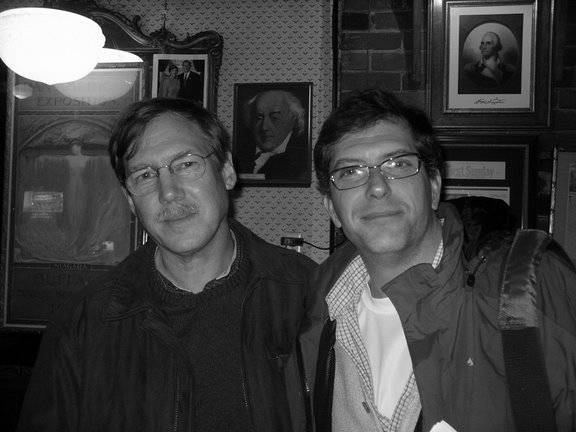
Kent Johnson (on the left, pictured with BlazeVox editor Geoffrey Gatza) was in Buffalo recently. He gave a great reading at Medaille College (my employer, which earlier this semester hosted our own Lance Olsen as well) -- work political, lyric, alternating langauges and moods, beautiful and full of truth. Johnson denominates himself a poet, but only because in the current world of poets "fiction" seems to have become a fallen, dirty word. Somehow experiments involving prose and narrative investigations, if conducted by poets, are being called poems these days -- as if, to bend the old saw, the dancer were now more essential than the dance. (I even had a writer recently tell me that she had written a book of prose poems, though she supposed that if we were in France it would be called a novel.)
Living in Buffalo, a city of poets, I am used to such (mis)constructions of fiction. But whatever Kent Johnson calls himself, he is partaking in the strategies and tactics of fiction writing.
Let me talk about his recent book in the ongoing Araki Yasusada project, Also with My Throat, I Shall Swallow Ten Thousand Swords: Araki Yasusada's Letters in English (Combo Books, 2005).
This work is a sequel publication to the alternately lauded & decried collection, Doubled Flowering ("the most controversial poetry book since Allen Ginsberg's Howl" - Forrest Gander), on whose title page Johnson appeared as editor (alongside Javier Alvarez) when the book was first published in 1997. What happened subsequently is the stuff of literary provocateur legend: Johnson was ultimately accused and (perhaps) revealed to have been himself the author of the poems which had been claimed to be the work of Yasusada, a survivor of atomic-bombed Hiroshima; accounts of the hoax appeared in Lingua Franca, The Nation, and elsewhere. The "perhaps" above ensues because Johnson has never (to my knowledge) fessed up, and instead we read such labyrinthine narrative positionings as this, from the more recent (2005) letters volume's introduction:
"In the poetry world, it is by now generally known that Doubled Flowering: From the Notebooks of Araki Yasusada is a fiction created by its 'primary translator' Tosa Motokiyu, the pseudonym of a writer who requested, before his passing in 1966, that his legal identity never be revealed."
Any attempt to try to stabilize statements of the authorship of Yasusada eternally encounters new self-cancelling fronts and evasions. Yasusada's Letters are likewise a maze of metacritical delights on the order of Nabokov's Pale Fire, which, of course, Yasusada and Motokiyu both have occasions to reference. The letters date from a year in Yasusada's early student career in the US, 1926, almost two decades before he was to be present in Hiroshima, and are written to a never-further-identified "Pal-Pen" named Richard. They are annotated throughout by the at-best pseudonymous and more likely entirely invented Motokiyu, as well as the sur-editors Johnson and Alvarez, with commentaries that are notable for almost invariably and frequently comically missing the most obvious significations of the lines they meant to elucidate. And the letters themselves are written in a deliciously imagistic and variously attenuated pidgin language which begins as naively attempted English before morphing into a gorgeous, if sometimes precious, poetic prose, over a period of months. Despite all of the circuities of Johnson’s framing device, one has the uncanny experience, confronted by the core textual materials, of seeing a young artist blossom, an accelerated, fragmentary, international 20th century kunstlerroman:
January 5, 1926. "I am writing the letter from this class of American English. I hope you are feeling lovely. Do you have a wife? Inside your nation I know there is hotness in months of August and July. Particularly there is hotness in my nation when in August. Now there is coolness. And much snow. I enjoy to travel upwards in mountains (yet especially downward on long clauses!) [...]and also the study of your tongue, English."
July 24, 1926. "Boiled tortoises are made to cool. Giggling geishas left bones with tweezers. Red dace make eggs in mussel shells. Eels are sliding in baskets of bamboo. A carp goes eaten by the bride. Inside Fujiwara and Manabe there are bandits. This is one silly song sung while tops are spinning."
November 7, 1926. "Each time I read Dr. Anzai's poem, 'Spring,'
A herring is about to be brought to the table, coming through a subway tunnel
I feel renewed and excited, as if I had been slapped awake by an Imperial courtesan with the thighs of a wrestler! [sic] And your own 'Horse,'
There is a naval port inside its intestines
reveals, if there ever was any doubt, that within a single turnip pulled up by a squatting man there are mountains, rivers, and a whole formation of rubber-capped subjects swimming across the Hokaido Strait! My death is coming; I am patient."
Sweetly, Yasusada signs each letter "I am sincere." Of course, the liar always sez he's telling the truth.
The slim volume closes with an essay and a personal reflection by yet two more characters, critic Mikhail Epstein and Hosea Hirata, the latter of whom claims lineage to another survivor of the atomic blasts. These people may be real, as Javier Alvarez also might or might not be; yet Araki Yasusada has an entry on Wikipedia and Johnson was asked and answered a question about the attempt to secure a University home for Yasusada's papers when I saw him in Buffalo, engaging now in a fictive game of such momentum that it has acquired players in his audiences. Where Johnson has been criticized (and I avoid here investigating further the blog wars in which Johnson and detractors evidently both descended to nastiness), it has been for exploiting the victims of this historical crime by authoring poems which are said to have issued from that time, place, and subject-position. There are both hard and soft critiques to be made from this perspective: Is Johnson’s Yasusada a reactionary “reverse-discrimination” experiment suggesting the limitations of “witness” poetry, that writings that would not have received such an audience when seen as written by a white American more valued when they are seen as the products of a now-dead Japanese writer, who perished as an indirect result of historical violence? Or, crediting Johnson with his own version of “I am sincere,” to what extent is the Asian “other” subject position rightfully claimable by one who has not lived in the society or had the experiences, but mimics identity for the purposes of art.
Johnson full body of work turns these types of questions inside out and every which way. A notable text in this debate is his story/poem, "Lyric Poetry After Auschwitz (Or, Get the Hood Back On)," which first appeared in Gatza’s online magazine BlazeVox and has subsequently appeared both in Johnson's collection, Lyric Poetry After Auschwitz: Eleven Submissions to the War (Effing Press) and in the anthology, PP/FF, published by my own Starcherone Books. Of these, the essential experience remains the BlazeVox publication, where Johnson’s text is presented under a montage of Abu Ghraib photos, musically scored and designed by Gatza to reinforce the contrast of casual colonial brutality and naive gringo enthusiasm that is a hallmark of Johnson’s text:
"What’s up, Ramal, I’m an American boy, a father, two children, graduate of Whitman High, where I was a member of the Science Club and Student Council, then I got to be the youngest elected officer ever in the history of my town’s Rotary Chapter, I’m in charge of fund-raising, which hasn’t been easy the past few years, what with the economy and all, but we’re hanging in there. I hope you won’t take this the wrong way, because I don’t want to assault your sensibilities, or anything like that, but I want to be up front with you because I believe that honesty is the best policy: So, I’m going to put a pointed plastic hood on your black and blue head, and then I’m going to stand your caped body on a milk box, with live wires taped to your outstretched hands, and then I’m going to count to ten, you witch-like Arab freak, and maybe I’ll flip the switch and maybe not, it all kind of depends."
“I think Lyric Poetry after Auschwitz is by far the most relevant poem for/in/about this War,” poet Ethan Paquin has about this text (about 15% of which is excerpted above). Paquin’s statement is one with which I am in wholehearted agreement, except perhaps for the part about “poem.” But whatever kind of text one wants to call this, the sense in which Johnson has made himself an actor in the service of national conscience should be emphasized. Always in Kent Johnson's work is the linger of American war violence -- whether it is the haunting flash-backward and forward to Hiroshima in the Yasusada letters, our devastation of Baghdad or the incomprehensible (and radically uncomprehended by its perps) tortures of Abu Ghraib. Johnson loves the interplay between the devastations wrought by US superpower and the naifs (young soldiers, young Yasusada) entangled in any deciphering of their meaning. Gander makes much the same point, in talking about Doubled Flowering:
"Using Modernist strategies, the author(s) [Johnson and Alvarez], steeped in translations of Japanese literature and feeling uneasy, even -- if they are Americans -- complicit with the U.S. foreign policy that generated such mass destruction, invented an imaginative, political and poetical act of empathy. To write poems concerning Hiroshima, they felt it necessary to imagine themselves as the other, 'the enemy.' They relinquished their own identities as authors and became invisible, as the Hiroshima victims themselves disappeared. It is an impossible gesture of solidarity, since one cannot truly imagine one's way into an actual culture considerably different from one's own."
I am interested in and sensitive to questions concerning the ethics of representation as similar questions as pertain to the Yasusada project may well be raised about my own novel, Malcolm & Jack, particularly where I fashion artificial constructions of the subject positions of such figures as Malcolm X and Billie Holiday. In answering these concerns myself, I would underline the sense that narratives are always constructions, and any verisimilitude created by fiction is an effect of the art form, in no way a speaking for the absent subject: verisimilitude is not verity. At the same time, what fiction writers DO is represent. That is the essential form of the art: it is an art of lying, invention, artificial construction, mimicry, semblance. I think it is a limitation on the practice of the art to say that there is some aspect of discourse, experience, or history that one should refrain from representing, as a hard and fast rule. Of course, one should not go into the minefields of representation unadvised or without respect for the significances of histories of racism, oppression, violence and the like. We should also expect the representations of others from assumed and masqueraded subject positions will be problematic -- that is the nature of experimental art. Fiction, by its very nature, is a practice which self-consciously presents itself as lies, thus leads us to reflect upon lying, both within deliberately designed aesthetic creations and upon the at-large practices of fictionalization at work in all walks of our lives. Fiction is that discourse that calls into question the truth-telling strategies of language even as it employs them. Airtight, airbrushed, sanitized lies are the ones we really have to worry about. I am a fiction writer, and so I lie, but my lies haven't been killing people. This distinguishes Kent Johnson and I and y’all (who’s out there?) from Bush and Rumsfeld and Cheney, who lie and kill people, or who lie and make people killers. Fiction is lies that do not lie about lying. That distinguishes the art of lies that is fiction from the lies of power we are so much in the grip of in our national discourse today. We are distrusted and feared by the world and we have alienated our own youth so much that a majority have opted out of democratic agency even as we claim to be bringing this great gift to the rest of the world.
To summarize, then: Kent Johnson is (and is not) Araki Yasusada. Geoffrey Gatza is Superman. I am Jack Chapeau. George Bush is Bozo the Clown with 100 million vials of poison. And I guess tomorrow we'll start to find out if we can trust our voting booths.
"There was never a mistake in addition," Gertrude Stein once wrote. Or was that Antonin Scalia?
the electronic book review
& fictions present
 ebr, edited by Joe Tabbi, has just gone live with a new thread that should be of real interest to the Now What tribe.
Entitled fictions present, it includes, among other things, a summary of and engagement with the last &NOW conference by Ted Pelton, a narrative disruption by Rob Swigart, and a collection of sharp essays by and about edge writers (including Raymond Federman, Michael Martone, R. M. Berry, Lucy Corin, Harry Mathews, Lidia Yuknavitch, and others) that I've been gathering over the last couple of years.
In his introductory statement to the thread, Tabbi writes:
Everything that happens, happens now. The essays, narratives, and essay-narratives gathered under the thread title, Fictions Present, reaffirm the "presentist" bias in electronic publishing and in ebr particularly: our non-periodical, continuous publication is designed to keep the archive current and to present critical writing not as an afterthought, but as an integral element in the creation of literary fictions.
ebr has been relatively quiet for a while as it's been reinventing itself. The outcome is well worth waiting for—a digital venue at once beautiful, theoretically and aesthetically and politically engaged, and yet more proof (should any of us need it) that there's been an exciting renaissance going on in American avant-garde fiction over the course of the last four or five years online and off.
To check it all out, click here.
29 October 2006
Notes from an Eastern Front
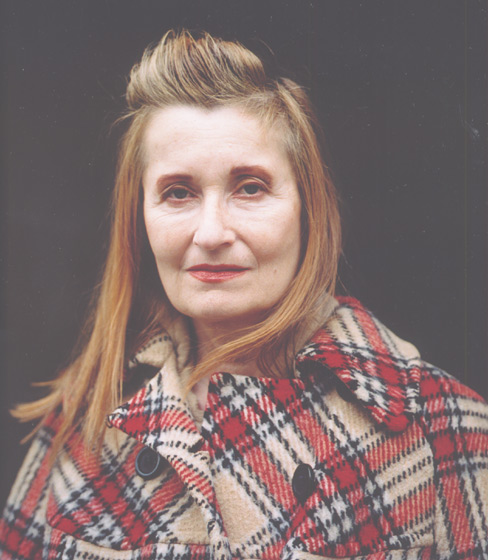
It seems Elfriede Jelinek had some trouble publishing her latest novel, Greed (in English translation). Once she did publish it, well, it got savaged:
A story of some sort emerges, but the thrust of the novel is really the most vulgar and stupid commentary imaginable about the murderous misogyny of men, the environment, the appalling taste of the kleinburgerlicher and so on. It is a novel to warm the heart of Viz's Millie Tant. Densely unreadable as it is, there is something terribly banal about every one of its intellectual propositions; as hopelessly banal in its attempted chic as its predominant present tense (The Telegraph). Read the entire review here.
I would love a review like that. Still, I don't think she has an American publisher. Her books are only available from Serpent's Tail, and Greed hasn't yet been released in this country. Lance, Ted, Lidia: this is our chance. Give her people a call, maybe Chiasmus, FC2 or Starcherone can pick up a Nobel Prize winner. Actually, I just wrote this as an excuse to post that photo.
27 October 2006
why it is hard to have the conversation we're having
Apropos—at least in an oblique, if dazzling way—of our ongoing conversations about which texts to read and which to teach and which to write, this statistic I stumbled across today in the latest issue of Poets & Writers:
Last year a total of 172,000 books were published in the United States, a number that represents a ten percent decrease from the year before.
Last year a total of 172,000 books were published in the United States, a number that represents a ten percent decrease from the year before.
cam tatham :
from the trenches : teaching pomo fiction
Hi, all.
Lance here.
Cam Tatham was having some difficulties posting the following response to our discussion about teaching contemporary fiction, so I'm doing the honors.
And, given how much food for thought is housed here, I didn't want it to get lost in the tadpole's tail of comments to Matt's provocative post below.
And so, without further ado . . .
=========
1. Unlike most (all?) of you guys, I’m coming at the issue with the p.o.v. of a teacher, not a writer. Maybe more accurately: while I’ve written critifiction, I’m not a fictionist. And as Lance points out, I’m no longer even a ‘real’ teacher, being retired, only coming back for the occasional course. Context is all.
2. One of the first courses I ever taught (going back to 1969) I titled ‘Anti-Fiction.’ Ihab Hassan hadn’t yet joined our faculty and nor coined the term ‘postmodernism.’ As I recall, I was teaching writers like Barth, Cortázar, Borges, Nabokov et al; quite soon, I began to become obsessed with the Fiction Collective gang: Federman, Sukenick, Katz, Abish, etc. Since then, I’ve tried to ‘keep up,’ regularly teaching a course I simply called ‘Postmodern Fiction.’ And in one version or another, it’s included some of you bloggers here: Lance, Lidia, Matt, Steve, and Jeff.
3. What draws me to you guys was and remains the emphasis placed on the telling of the story – self-reflexive metafiction: looking in a mirror as you compose the story of yourself composing the story while watching yourself in a mirror. etcetera.
4. Another frame I’ve brought to pomo fiction: existential phenomenology (esp. Merleau-Ponty, Derrida, and especially Deleuze/Guattari), which reminds us that reality is always, in part but only in part, a matter of point of view. How large that part is is precisely the issue.
5. Mainly: I’m fascinated by the knife-edge between innovation that is ‘authentically’ (hear Sartre, Camus, Merleau-Ponty) imaginative, and something that’s ‘excessive’ (hear Morrison). Isn’t there a point at which we have to say, to Federman (or Ron or Lance or Steve or whomever): oh, come on, that’s going too far! Morrison again: the terribly difficult gray area between that which is “too thick” and that which is “too thin” (Beloved).
6. This is linked to the struggle you guys constantly enact between the shaping power of the imagination and the pressure of intrusive ‘reality.’ Federman perpetually wonders: can pomo fiction address the holocaust? Okay, but what about his beloved daughter’s life-threatening cancer? Or even his own bout with cancer? On one level, you celebrate the release brought about by ‘innovation’; on another, you dance faster and faster, more and more desperately, over what you fear may be an alltooreal abyss. (Wallace Stevens as early postmodernist.)
7. That said, for me, the issue is less which texts to insert into a grad, or even an undergrad, course in pomo fiction, but rather how to insert the issues of pomo into a more ‘expansive’ syllabus likely to infect larger numbers of students. Like Matt (and, I suspect, a lot of you guys), I’m at this moment tinkering with my syllabus for a course next semester titled ‘American Literature: 1965 – the Present.’ Unlike Matt’s, however, this is an undergrad survey course, one that’s required of our English-Ed majors (future high school teachers), and because anything connected with “the Present” interests young students looking for what they hope is an easy elective, it draws from a variety of disciplines, not just English majors. Which means, to be blunt: I couldn’t include Steve’s VAS (which ‘worked’ wonderfully in a pomo fiction course) but I could use Lance’s 10:01. The socalled real world intrudes once again. For a Business student, VAS is regrettably too thick. In the trenches, compromises are also real.
8. Also influencing the selection process: it’s a survey course, we all have them in our departments, and we’ve all probably taught them at some point or another. And ‘survey’ usually means something linear: you start at 1965 and come up to yesterday, if possible. But I’m using that other sense of ‘survey’: to look over a field to see what’s there (epistemological issue: making v. finding ‘what’s there’). So whether I include this decade or that becomes irrelevant; more important: am I raising the issues of this vague block of time in a way that has an ‘authentic’ impact on the students? As Pynchon said of Robbins: I want to change their brainscapes, but it has to be done with a scalpel, not a broadsword.
9. And of course, another real world intrusion is simply the number of texts you can assign: I find that Matt and I pretty much agree on nine. So someone is always being excluded – as Jeff says, you can’t teach ‘em all.
10. So I start with war stories and end with 9/11 and terrorism, because I think that’s maybe the most important issue of our moment. But throughout is a preoccupation with perspective, p.o.v., in terms of narrative devices as well as mixed media.
11. So here’s the current version of my version of Matt’s course, in the order I plan to teach them:
Tim O’Brien, The Things They Carried
George Clark, The Small Bees’ Honey
Chuck Palahniuk, Fight Club
Margaret Atwood, The Handmaid’s Tale
Carole Maso, The Art Lover
Art Spiegelman, Maus I
Toni Morrison, Jazz
Lance Olsen, 10:01
Jonathan Foer, Extremely Loud & Incredibly Close
I mean, it’s all pomo fiction, right?
Lance here.
Cam Tatham was having some difficulties posting the following response to our discussion about teaching contemporary fiction, so I'm doing the honors.
And, given how much food for thought is housed here, I didn't want it to get lost in the tadpole's tail of comments to Matt's provocative post below.
And so, without further ado . . .
=========
1. Unlike most (all?) of you guys, I’m coming at the issue with the p.o.v. of a teacher, not a writer. Maybe more accurately: while I’ve written critifiction, I’m not a fictionist. And as Lance points out, I’m no longer even a ‘real’ teacher, being retired, only coming back for the occasional course. Context is all.
2. One of the first courses I ever taught (going back to 1969) I titled ‘Anti-Fiction.’ Ihab Hassan hadn’t yet joined our faculty and nor coined the term ‘postmodernism.’ As I recall, I was teaching writers like Barth, Cortázar, Borges, Nabokov et al; quite soon, I began to become obsessed with the Fiction Collective gang: Federman, Sukenick, Katz, Abish, etc. Since then, I’ve tried to ‘keep up,’ regularly teaching a course I simply called ‘Postmodern Fiction.’ And in one version or another, it’s included some of you bloggers here: Lance, Lidia, Matt, Steve, and Jeff.
3. What draws me to you guys was and remains the emphasis placed on the telling of the story – self-reflexive metafiction: looking in a mirror as you compose the story of yourself composing the story while watching yourself in a mirror. etcetera.
4. Another frame I’ve brought to pomo fiction: existential phenomenology (esp. Merleau-Ponty, Derrida, and especially Deleuze/Guattari), which reminds us that reality is always, in part but only in part, a matter of point of view. How large that part is is precisely the issue.
5. Mainly: I’m fascinated by the knife-edge between innovation that is ‘authentically’ (hear Sartre, Camus, Merleau-Ponty) imaginative, and something that’s ‘excessive’ (hear Morrison). Isn’t there a point at which we have to say, to Federman (or Ron or Lance or Steve or whomever): oh, come on, that’s going too far! Morrison again: the terribly difficult gray area between that which is “too thick” and that which is “too thin” (Beloved).
6. This is linked to the struggle you guys constantly enact between the shaping power of the imagination and the pressure of intrusive ‘reality.’ Federman perpetually wonders: can pomo fiction address the holocaust? Okay, but what about his beloved daughter’s life-threatening cancer? Or even his own bout with cancer? On one level, you celebrate the release brought about by ‘innovation’; on another, you dance faster and faster, more and more desperately, over what you fear may be an alltooreal abyss. (Wallace Stevens as early postmodernist.)
7. That said, for me, the issue is less which texts to insert into a grad, or even an undergrad, course in pomo fiction, but rather how to insert the issues of pomo into a more ‘expansive’ syllabus likely to infect larger numbers of students. Like Matt (and, I suspect, a lot of you guys), I’m at this moment tinkering with my syllabus for a course next semester titled ‘American Literature: 1965 – the Present.’ Unlike Matt’s, however, this is an undergrad survey course, one that’s required of our English-Ed majors (future high school teachers), and because anything connected with “the Present” interests young students looking for what they hope is an easy elective, it draws from a variety of disciplines, not just English majors. Which means, to be blunt: I couldn’t include Steve’s VAS (which ‘worked’ wonderfully in a pomo fiction course) but I could use Lance’s 10:01. The socalled real world intrudes once again. For a Business student, VAS is regrettably too thick. In the trenches, compromises are also real.
8. Also influencing the selection process: it’s a survey course, we all have them in our departments, and we’ve all probably taught them at some point or another. And ‘survey’ usually means something linear: you start at 1965 and come up to yesterday, if possible. But I’m using that other sense of ‘survey’: to look over a field to see what’s there (epistemological issue: making v. finding ‘what’s there’). So whether I include this decade or that becomes irrelevant; more important: am I raising the issues of this vague block of time in a way that has an ‘authentic’ impact on the students? As Pynchon said of Robbins: I want to change their brainscapes, but it has to be done with a scalpel, not a broadsword.
9. And of course, another real world intrusion is simply the number of texts you can assign: I find that Matt and I pretty much agree on nine. So someone is always being excluded – as Jeff says, you can’t teach ‘em all.
10. So I start with war stories and end with 9/11 and terrorism, because I think that’s maybe the most important issue of our moment. But throughout is a preoccupation with perspective, p.o.v., in terms of narrative devices as well as mixed media.
11. So here’s the current version of my version of Matt’s course, in the order I plan to teach them:
Tim O’Brien, The Things They Carried
George Clark, The Small Bees’ Honey
Chuck Palahniuk, Fight Club
Margaret Atwood, The Handmaid’s Tale
Carole Maso, The Art Lover
Art Spiegelman, Maus I
Toni Morrison, Jazz
Lance Olsen, 10:01
Jonathan Foer, Extremely Loud & Incredibly Close
I mean, it’s all pomo fiction, right?
26 October 2006
Seminar in Contemporary Fiction
I'm thinking through what I'll teach in my spring grad seminar in contemporary fiction. My department's felt--up til now--that the course should introduce students to a variety of texts from 1945 to present, and that this variety should let them taste some realism, some minimalism, some postmodernism, some feminist literature, etc. Pretty standard, from what I've seen.
Certainly I want my students (mostly our creative writing MAs) to sample a range of texts. I feel they need this.
On the other hand, as I wrote in a recent email to Cam Tatham, I also feel that contemporary literature can no longer, in any context, mean post-1945, and I'm leaning toward thinking it doesn't even have to involve the 60s-80s.
And I don't feel like it's terribly contemporary unless it's in some ways innovative.
But I worry that I'm narrowing my students' views too greatly if I have a syllabus made up of Carole Maso and Lance Olsen and Kass Fleisher and Steve Tomasula and Shelley Jackson and Lidia Yuknavitch (my list to this point).
Certainly I want my students (mostly our creative writing MAs) to sample a range of texts. I feel they need this.
On the other hand, as I wrote in a recent email to Cam Tatham, I also feel that contemporary literature can no longer, in any context, mean post-1945, and I'm leaning toward thinking it doesn't even have to involve the 60s-80s.
And I don't feel like it's terribly contemporary unless it's in some ways innovative.
But I worry that I'm narrowing my students' views too greatly if I have a syllabus made up of Carole Maso and Lance Olsen and Kass Fleisher and Steve Tomasula and Shelley Jackson and Lidia Yuknavitch (my list to this point).
25 October 2006
L. Timmel Duchamp reads at UCSD
Celebrating ParaSpheres,
fabulist and new wave fabulist stories
Wednesday, November 1 (4:30 - 6 PM)
University of California at San Diego
UCSD Campus in the Visual Arts Facility Performance Space, "The VAF"
San Diego, California
Readings by these contributors:
L. Timmel Duchamp
William Luvaas
Carol Schwalberg
Noelle Sickels
Mark Wallace
MCs: Rusty Morrison & Ken Keegan
Free hors d'oeuvres and sparkling water
**************************************
I'll be reading from "The Tears of Niobe."
fabulist and new wave fabulist stories
Wednesday, November 1 (4:30 - 6 PM)
University of California at San Diego
UCSD Campus in the Visual Arts Facility Performance Space, "The VAF"
San Diego, California
Readings by these contributors:
L. Timmel Duchamp
William Luvaas
Carol Schwalberg
Noelle Sickels
Mark Wallace
MCs: Rusty Morrison & Ken Keegan
Free hors d'oeuvres and sparkling water
**************************************
I'll be reading from "The Tears of Niobe."
Subscribe to:
Posts (Atom)
