Showing posts sorted by relevance for query writer's edge. Sort by date Show all posts

01 September 2008

the writer's edge 2009

Please help pass the word that we are accepting applications for the fourth annual Fiction Collective 2 (FC2) Writer's Edge workshop, held March 19-21, 2009, in Cuernavaca, Mexico, at the Universidad International. This year, the FC2 Writer's Edge will be held in conjunction with the American Book Review (ABR) Writer's Conference, held March 16-18.

Sponsored by FC2 and ABR, the conference will feature workshops on innovative fiction, panels, a faculty reading, open mics for participants, and myriad conversations about experimental prose.

Below are descriptions for the FC2 Writer's Edge workshops, as well as a list of the faculty teaching them. For more information on both the FC2 Writer's Edge and ABR Writer's Conference, including information on how to apply, please click here.


======

REALITY FICTION
Alexandra Chasin

Creativity, we may imagine, resides in the imagination of the new. It’s cheating to use found texts and other objects. Yet at the same time the body of already-existing texts and artifacts is a vast archive too fantastic to consign to the dustbin of literary (and extra-literary) history. In fact, there is already a rich tradition of literature that imports bits of the world. And those bits needn’t be limited to literary texts. Newspapers, songs, legal documents, textbooks from any number of disciplines, medical records, maps, photos, and other images—not only is it not cheating to use such materials, but it opens up a new set of possibilities for writing into, out of, and/or about the historical record. For writers interested in investigating techniques of representing and referring to the phenomenal world and its infinite pasts and presents—techniques of incorporating its material effects into fictional work—this workshop will offer examples of, discussion of, and exercises in salvage, rereading, quotation, recycling, imitation, cut and paste, (re)appropriation, repetition, reproduction, revision, parody, hoax, and other acts of unoriginality. In preparation, you may want to acquaint yourself with the following fictions: Don Quixote, Kathy Acker; “Pierre Menard, Author of the Quixote,” Jorge Luis Borges; A Humument, Tom Philips; Mumbo Jumbo, Ishmael Reed.


STEALING BEAUTY: “TRANSLATING” FROM THE SISTER ARTS
Jeffrey DeShell

“Mediocre Writers Borrow; Great Writers Steal.” —T. S. Eliot
“Bad artists copy. Great artists steal.” —Pablo Picasso

Writing is never done in a vacuum; it occurs always in context. Often fiction writing is provoked by contact with other art forms like painting, music and film. If composition is a series of decisions about what goes where, shouldn’t the translating of decisions from painting, music and film into narrative language be possible? And if it is possible, how can we go about it? Or, to start from the other direction: how can we weave our obsessions with music, painting and film into our fiction writing? The Greek word for this translating is ekphrasis (which usually refers to poetry), and in the contemporary world we often speak of allegory and mimesis. We’ll try to bracket the theoretical discussions and center our discussion on practical larcenous techniques. Participants are asked to bring a representation (postcard, photocopy, photograph, mp3, film, video, etc.) or actual object of something they’d like to translate into prose. Students may also wish to read Gertrude Stein’s portraits of Cezanne, Matisse and Picasso.


ANAEROBICIZE YOUR PROSE
Stephen Graham Jones

So one argument and I don’t necessarily disbelieve it is that punctuation is just a parasite that all it is is the side effect of writing words down in these lines that it’s just a clumsy visual approximation of the natural rhythms of speech that in prose fiction are pretty much exactly what’s supposed to lull the reader into a state where the story can work or or a better way to say it maybe is that that unbroken patter and burble and spike of words is what transports the reader not off the page but into it face first ankle deep and evermore. But yeah, sometimes a comma sure is nice, right? Here we’ll talk about this, both in terse, nervous, over-punctuated sentences we try to laugh off and in long unbroken fragments that wander and forget themselves and then find each other in surprising ways. And we’ll do some writing as well. And never stop


THE CALIFORNICATION OF HISTORY
Lance Olsen

Despite frequent (and frequently naïve) claims to the contrary, innovative fiction is neither necessarily ahistorical nor dehistoricized. Rather, it continually questions our culture’s suppositions about what constitutes historical knowledge, embracing the counter-intuitive recognition that texts are simultaneously self-conscious linguistic and formal systems shut off from the world and active participants in larger sociopolitical contexts. In this workshop, which will consist of mini-lecture, conversation, and two exercises, we shall explore the practical and theoretical joys, problemitizations, assumptions, and possibilities in engaging with the past(s)—“real” and imagined—inventively in writing. In preparation, you may want to acquaint yourself with the following fictions: Da Vinci’s Bicycle, Guy Davenport; History of the Imagination, Norman Locke; Cloud Atlas, David Mitchell; Nietzsche’s Kisses, Lance Olsen.


BORDER CROSSINGS
Lidia Yuknavitch

One of Gloria Anzaldúa's major contributions to United States academic and creative writing and discussion was the term mestizaje, meaning a state of being beyond binary (either-or) conception. In her theoretical works, Anzaldúa calls for a “new mestiza,” which she describes as an individual aware of her conflicting and meshing identities who uses these “new angles of vision” to challenge old ways of thinking, being and writing. The work of Guillermo Gómez-Peña concerns the U.S.-Mexican border itself, immigration, cross-cultural identity, and the confrontation and misunderstandings between cultures and races. His artwork and literature also explores the politics of language, the side effects of globalization, “extreme culture,” and new technologies from a Latino perspective. Unlike what might happen at an academic conference, as creative writers we will be “inhabiting the territory” of their texts, and moving through their language as citizens of an unnamed country with identities forming at a border of language and geography. We will push ourselves through two major writing exercises meant to reinvent identity stories. In some ways we will be deconstructing whiteness and the position of the “U.S.” writer. We will also create a blog that “performs” our “texts” as an extension of the workshop. In preparation, you may want to acquaint yourself with the following: Borderlands/La Frontera: The New Mestiza, Anzuldua; The New World Border and Dangerous Border Crossers, Gómez-Peña. You may also want to check out some of Gómez-Peña’s performance work at the Video Artist Database: http://www.vdb.org/

10 February 2008

the writer's edge :
1 march application deadline

Please note that the application deadline for the third annual Writer's Edge conference is 1 March.

Sponsored by FC2 and hosted by Portland State University, The Writer's Edge will be held Friday through Sunday, 25-27 July, in downtown Portland, Oregon, and feature five workshops on innovative fiction, two panels, a faculty reading, two open mics for participants, and myriad conversations about experimental prose.

For more information, please click here.

22 October 2006

the writer's edge : 2007


fiction collective 2, in partnership with portland state university, presents:

the writer's edge
Second Annual Innovative Writing Conference
All Day: July 27, 28, 29 2007
Portland State University

includes
–Workshops on Innovative Writing
–One-on-One Conferences
–Panels on Multimedia Experiments, the State of Contemporary Fiction & Publishing, & More
–Readings
–Books & DVDs

applications
http://fc2.org/edge/edge.htm

deadline for applications
1 March 2007

registration
$275

credit available

the workshops

CREATIVE NONFICTION AS HYBRID MONSTER
Karen Brennan

In the 18th century, Henry Fielding famously observed that "the novel is a baggy monster." This class will assert that creative nonfiction is the "baggy monster" of the 21st century. To that end, we will explore hybridity in creative nonfiction; that is to say, we will read nonfictions that intersect with other genres--poetry, criticism, fiction--and generally explore (by reading and writing) the capaciousness of the nongenre of creative nonfiction.

SMALL FICTIONS IN A ROW
Lucy Corin

Our interest will be in small numbers of exquisitely and surprisingly arranged words. By limiting the number of words we use and consciously treating passages of text as blocks of sculptural material we can begin to relinquish certain forms of authority that tend to strangle prose. We’ll ask questions like: How many different ways can a writer, who supposedly has one “voice,” distill narrative and language within limited space? How “big” can you make a small thing? How is and is not a small thing a microcosm of some bigger thing? Is it interesting or not to deviate from standard paragraph form? Do we care or not what is prose fiction and what is some other genre like poetry or diary? How does patterning a number of pieces in a sequence create or change meaning? Does such a form have anything to do with wholeness or completeness? If not, then what’s the point or the pleasure? We’ll look at very short stories by writers like Lydia Davis, Diane Williams, and Kafka, write and revise several of our own small pieces, and explore a variety of sequential arrangements of the pieces we compose.


COLLABORATING WITH THE PAST:
INNOVATION VERSUS TRADITION
Brian Evenson

This workshop explores the variety of ways in which contemporary writers can and do respond to writers who have come before them. We'll discuss the way writers appropriate earlier traditions--for instance, the way Angela Carter or Robert Coover or Rikki Ducornet respond to fairy tales or the way Kathy Acker responds to canonical books such as Don Quixote--and think about how they simultaneously preserve and subvert past literary ideas. How can we both learn from the writers who precede us and still be working in an original space? Is Harold Bloom's notion of Anxiety of Influence something that still holds in today's postmodern literary field? We'll also do some exercises of our own, thinking about how retelling and reinscribing earlier ideas and tales can transform them and make them our own.


FICTION AS ARCHITECTURE
Lance Olsen

Usually the metaphor of architecture is applied to writing, if it is applied to it at all, in order to italicize the "craft" employed in its creation. Occasionally one might find mention of the use of architecture in fiction—the metalogical libraries, for instance, described in Jorge Luis Borges's stories. But what I'm interested in exploring in this workshop is the following question: how it is both illuminating and stimulating to conceptualize fiction's structures and discourses as spaces one lives in and moves through as one might, for instance, a Bauhaus building, a tenement, an emergency room, a funhouse, a cathedral? We shall look at how author William Gass and his architect-spouse Mary collaborate to find harmonies between sentences by Hemingway and houses by Frank Lloyd Wright, on the one hand, and those by Henry James and baroque palaces, on the other. We shall think about Milorad Pavic's distinction between nonreversible art (like music and conventional narrative, which can and must only fall forward) and reversible art (like architecture, some innovative prose, and hypertext, which can and must be entered through various portals at various times to various effects). We shall ponder what new-media author and theorist Michael Joyce means by saying that every innovative text is a liquid city. And then we shall try to imagine, via several writing exercises, new architectures for our own fiction.


CORPOREAL TEXT:
THE BODY & WRITING
Lidia Yuknavitch

There is an interstice between the body and writing where meaning is always in flux. When writers and artists attempt to render that space, their work slips quickly from the mainstream into its more dangerous, sensuous and hidden tributaries. But that kind of writing and art articulates perhaps the most exciting new forms available for writers hoping to liberate narrative from market and genre-bound static products. In this workshop we will explore the territory between writing and the body through mixed genre work by others, through now-time writing exercises, and through a bit of multimedia experimentation. participants will leave with new ideas and texts to inhabit and grow.

16 February 2007

the writer's edge : a final reminder


A quick friendly reminder that the application deadline for The Writer's Edge Second Annual Innovative Writing Conference (27-29 July, 2007) in Portland, Oregon, is 1 March.

For more information on the workshops, panels, one-on-one conferences, multimedia room, and more, please click here.

26 July 2008

Writer's Edge 2008 Day One

Things I noticed on Day One from this year's Writer's Edge conference in Portland:

1) There are a lot of guys named Andy attending. Cool guys named Andy. So much so that I am thinking about changing my name to Andy now.

2) Lily Hoang is a filthy overachiever but she gives awesome hugs so it is impossible to hold anything against her for more than a picosecond.

3) Steve Tomasula and Shane Hinton are handy guys to have around if you cut your foot on a rusty nail and want to avoid a staph infection. Steve carries bandages in his wallet and Shane rolls with a tube of Neosporin.

4) Lidia Yuknavitch has the coolest students up at UW-Bothell. One of them is named Selena. I think I am going to try to adopt her before the conference is over, whether she wants to be adopted or not.

5) Andi and Lance Olsen are losing sleep over their inability to score a 3G iPhone and getting to the Apple Store way too late. It's a vicious cycle and I am praying Steve Jobs takes mercy on them tomorrow at Pioneer Square.

6) Mia De Bono is still the most awesome writer name I've heard in a long, long time.

Here are some photos I snapped earlier today. I'll post more to the set as the weekend progresses.

07 August 2007

writer's edge readings

Someone crammed a camera into the room during the Writer's Edge faculty readings in Portland last weekend...

Lucy Corin: YouTube | iPod/MV4

Brian Evenson: YouTube | iPod/MV4

Lance Olsen: YouTube | iPod/MV4

Lidia Yuknavitch: YouTube | iPod/MV4

Trevor Dodge: YouTube | iPod/MV4

04 August 2007

the writer's edge 2007

I've just returned, settled in, and got my brain back on straight after the awesome second annual Writer's Edge conference held Friday through Sunday, 27-29 July, in downtown Portland, Oregon. Sponsored by FC2 and hosted by Portland State University, the gathering was composed of five workshops, two panels, a faculty reading, two open mics for participants, and myriad conversations about innovative prose. Last year 50 participants from around the country attended. I'm happy to report that this year the number was 65 and we fully expect to see 75 next.

Lidia Yuknavitch and I served as co-sponsors, and our overwhelming impression was one of creative and intellectual good-spiritedness, invigorating energy, and a thoroughgoing committment to the notion of collectivity. We've already begun working on next year's conference, whose faculty will include, in addition to Lidia and me, the remarkable Kate Bernheimer, Noy Holland, and Steve Tomasula. Even as I write this, cyberguru Aaron Waychoff is proving himself divine by setting up a discussion space for past and present participants to come together to talk about their interests. More on all of this and more soon, but right now just a few of the highlights from this year's gathering of the tribe:


At the core of the get-together were those five workshops I mentioned. Lidia Yuknavitch led one on "Corporeal Texts," exploring the interstices between the body and writing where meaning is always in flux. Trevor Dodge focused on hybridity in creative nonfiction. In "Small Fictions in a Row," Lucy Corin posed such questions as: "How many different ways can a writer, who supposedly has one 'voice,' distill narrative and language within limited space?" and "How 'big' can you make a small thing?" Brian Evenson invesitgated the variety of ways in which contemporary writers can and do respond to writers who have come before them in "Collaborating with the Past." "Fiction as Architecture," the workshop I led, interested itself in the question: "How it is both illuminating and stimulating to conceptualize fiction's structures and discourses as spaces one lives in and moves through as one might, for instance, a Bauhaus building, a tenement, an emergency room, a funhouse, a cathedral?"


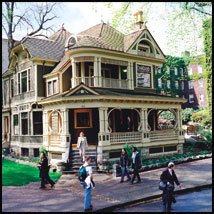
The Simon Benson House, site of our communal dinner on Saturday evening, as well as a snippet of the Portland State University campus.


Faculty reading: Lidia Yuknavitch.


Faculty reading: Lucy Corin.


Faculty reading: Brian Evenson.


The above panel, featuring Trevor Dodge, Lidia Yuknavitch, Lucy Corin, Brian Evenson, and me, addressed trends in experimental writing. A second panel, featuring innovative film makers Holly Andres, Grace Carter, Karl Lind, Andy Blubaugh, and Andi Olsen, addressed experimental film and narratology.


A photo of faculty who seem puzzled when a camera is pointing at them: Trevor Dodge and Lance Olsen.

And a gargantuan thanks to one and all for helping make this year's coming together startling and thrilling and warm and reengergizing, but most of all the epitome of what an intentional community can and should be.

02 August 2006

the writer's edge : part two

Thanks to the inimitable Trevor Dodge, here are some audio and video files documenting the first annual Writer's Edge conference held in Portland, Oregon, last weekend. For those who might be interested, Lidia Yuknavitch and I have already begun planning next year's Second Act.

:: faculty reading : audio : mp3 format ::
Compilation Reading (59.8 MB)
R.M. Berry (15.8 MB)
Michael Martone (11.6 MB)
Lance Olsen (13.6 MB)
Susan Steinberg (15.8 MB)
Lidia Yuknavitch (16.2 MB)

:: faculty reading : video : .mov format ::
R.M. Berry (16.2 MB)
Michael Martone (10.8 MB)
Lance Olsen (14.4 MB)
Susan Steinberg (16.4 MB)
Lidia Yuknavitch (16 MB)


:: small-press panel : audio : .mp3 format ::

Click here to download a recording of the small-press panel that included R. M. Berry (Fiction Collective Two), David Cowsert (Ink and Paper Group), Richard Jensen (Clear Cut), Lidia Yuknavitch (Chiasmus) and Kevin Sampsell (Future Tense). The last four panelists appear in the photo (courtesy to Andi Olsen) above. The audio isn’t the greatest quality, but it is complete (1 hour 44 minutes) and in stereo. Filesize: 92.2 mb.

the writer's edge : part one

Sponsored by FC2 and hosted by Portland State University, the first annual Writer's Edge conference—a series of workshops, panels, readings, and conversations about innovative prose—was held 28-30 July in downtown Portland, Oregon. Over 50 participants from around the country and as far away as Australia attended. Early feedback has been extraordinarily positive. My sense is that something very special happened at this gathering of the tribe.

At the core of the get-together were five workshops. Lidia Yuknavitch led "Five Easy Pieces: How to Form, Deform, and Reform Narrative Using the Fictional Fragment" that posed the question: "What happens if we turn away from the idea that narrative form must be unified in traditional ways?" Susan Steinberg taught "Writing Obsession, Writing As If Obsessed" that explored "the ways in which various modern and contemporary authors effectively writing obsession/obsessively consider the inextricable relationship of form and content, paying particular attention to (often unconsciously chosen) rhetorical and experimental devices: repetition, recursion, ranting, listing, among many others." R. M. Berry's "What Is Writing?" grew "out of the idea that the principle mark of radically innovative writing is its somehow posing the question of its own nature and existence." Michael Martone led a workshop on appropriation entitled "Nixon Remix," and I led one entitled "Fiction as Possibility Space" that asked participants to think and rethink the metaphors workshops usually employ when talking about writing fiction.

The faculty read from their work on campus the second evening, while around 9:00 p.m. each night everyone descended on a different local bar, thanks to Garrett Strickland and the Phase One Reading Series, for an open mic and sampling of avant-garde music. Each afternoon offered participants, among other possibilities, a Multimedia Exhibition Room featuring experimental films, hypertexts, and collage-texts by Andi Olsen, Tim Guthrie, Trevor Dodge, Andy Mingo, myself, and others. A great panel on the past, present, and future of small-press publishing (with FC2, Chiasmus, Clear Cut, Future Tense, & the Ink & Paper Group) rounded things out.

Courtesy of Andi Olsen, here are a few photos from The Event:


lidia yuknavitch & r. m. berry planning

lance olsen signing
& author kris saknussemm imagining

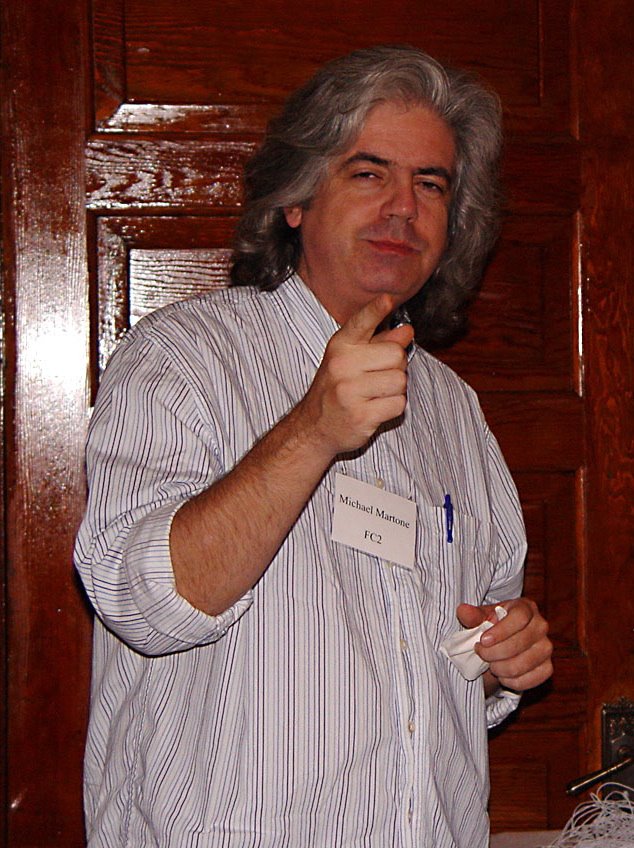
michael martone threatening

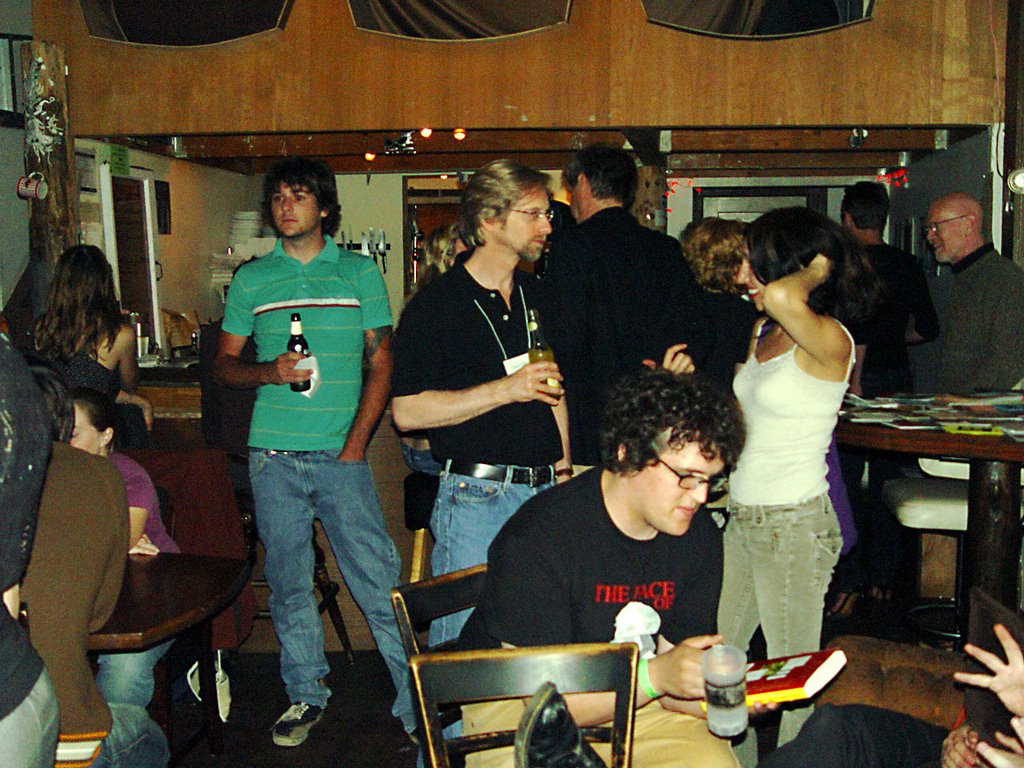
susan steinberg & others partying
at an open mic

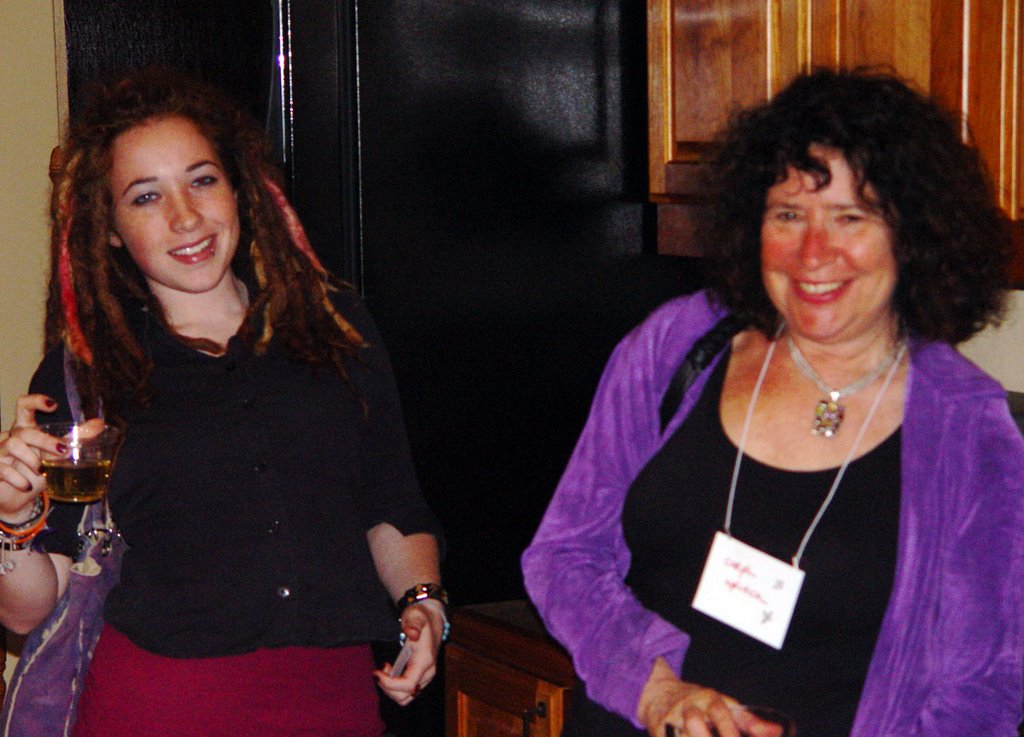
madhatter review editor carol novack (right)
& laura enjoying

chiasmus press authors
andy mingo & trevor dodge
looking self-conscious

16 September 2007

the writer's edge 2008

Please take note, and please help pass that word: the third annual Writer's Edge conference will be held Friday through Sunday, 25-27 July, in downtown Portland, Oregon.

Sponsored by FC2 and hosted by Portland State University, it will feature five workshops on innovative fiction, two panels, a faculty reading, two open mics for participants, and myriad conversations about experimental prose.

Here are descriptions for next year's workshops, as well as a list of the faculty teaching them. For more information, please click here.

Fairy Tales Almost Blue
Kate Bernheimer
“At an early age, children are weaned on the marvelous, and later on they fail to retain a sufficient virginity of mind to enjoy fairy tales,” André Breton wrote in 1924. “There are fairy tales to be written for adults,” he continued. “Fairy tales almost blue.” (Perhaps not coincidentally, Andrew Lang’s first fairy-tale collection, published in 1884, was The Blue Fairy Book.) This workshop will ask us to transform our minds into virginal ones, to seek the marvelous, to be almost blue, to discover what almost blue means. We will read short fairy tales, with an eye toward abstraction, from Hans Christian Andersen, Angela Carter, the Brothers Grimm, Mohammed Mrabet, and others. We will inspect their language, their motifs. We will discuss intuition and form in fairy tales. We will seek to be weaned on the marvelous, to see where it takes us in writing. We will leave the workshop having written a short fairy tale for adults, and, hopefully, an appreciation for the avant-garde nature of fairy tales.

Usage is More Powerful than Reason
Noy Holland
“Now is the night one blue dew,” James Agee wrote in A Death in the Family. We are urged by many to choose the right word, but, having chosen it, where do we put it? This is a class about syntax and sound—it’s about the music of sentences, the visceral effect of the language. We’ll exercise a poet’s attentiveness to cadence, to where the stresses of syllables fall, to the beauties of repetition. Some of the most glorious sentences in the language are composed of humble and familiar words. Some of the most glorious paragraphs and pages in the language are composed of humble and familiar words. The labor, then, is in the arranging, in the rightly misplaced adjective, in the dissonance produced by concentrations of sound and stress as with “one blue dew”—which, while it describes the loveliness of twilight, surges with something terrible and portentous. The chemical affinities between words are greatly altered by distance and proximity; that is, we manipulate those affinities via syntax, and by this do our work on the body of the (bless you) receptive reader.

The Mosaic Mind: Fiction as Collage
Lance Olsen
Collage is an aesthetic and theoretical gesture committed to liberation through juxtaposition, conflation, fusion, confusion, patchwork imaginations, cyborg scripts, centaur texts, narratologically amphibious writings, the mosaic mind that embrace a poetics of beautiful monstrosity. Through mini-lecture, conversation, and three writing exercises, we shall examine the history of this form in the arts, then visit several theories of the collage, including those posed by Picasso, Duchamp, Lévi-Strauss, Derrida, Burroughs, Ronald Sukenick, Donna Haraway, and Shelley Jackson, exploring how, through the very process of cutting up and cutting off, collage in fiction (and painting, and body modification, and . . .) opens up and out, often calling attention to the sensuality of the page, the canvas, the skin, the surfaces it inhabits. In preparation for this workshop, please read the following: Blood & Guts in High School, Kathy Acker; Snow White, Donald Barthelme; My Body, Shelley Jackson (a hypertext available online); The Last Novel, David Markson.

M(M)MW: Multi(Modal)Media Writing
Steve Tomsula
Anytime a medium goes through a time of flux, exciting possibilities open up. This is certainly the case with writing today where authors can employ visuals or sound as never before. M(M)MW will take up what can be called multimedia, or multimodal, writing: fiction, poetry, e- and hybrid works, both print and electronic, that incorporate visual and/or audio elements, and yet still foreground language as their main material, and are experienced primarily through reading. When is an image gratuitous or only an illustration and when is it part of the fabric of a story? How is a graphic novel different from a film? That is, why write at all? Why not just make an animation? The goal is for everyone to formulate their own M(M)MW poetics: What makes a word-image text good? Bad? Ugly? How can you incorporate this poetics into your own writing? Before the workshop convenes, students will be asked to become familiar with several M(M)MW works, and arrive with a completed, short M(M)MW writing exercise.

Wrestling the Novel
Lidia Yuknavitch
It’s 2008-9. The novel in America has reached an unfortunate kind of product pinnacle, in that what gets named and legitimized as a "novel" either wins a buncha academic prizes, makes a lot of money through its entertainment value and mind-numbing massagery, or makes it onto Oprah. My question is this: what else can the novel be, right now, right here? Using the novels listed below as case-studies, we will explore NOT what is killing the novel, but what IS MADE POSSIBLE by the formation, deformation, and reformation of the novel in America. We will discuss the hardships/challenges of longer work, and we will put ourselves through three writing crucibles in an effort to rescue and engage novelistic writing strategies, the last of which we will use to create a collaborative undoing of the novel by the end of the weekend. Using a framework I am borrowing from the collaborative novel I co-wrote with Ken Kesey and the grad students of the University of Oregon, we will create an undoing of the novel. Our collaborative undoing of the novel will be published by Chiasmus Press. To prep: get your hands on and read around in these books:

VAS/Steve Tomasula
Anxious Pleasures/ Lance Olsen
AVA/Carole Maso
Dra-/Stacey Levine

07 July 2008

chiasmus press podcast #6

Episode #06 marks the return of the Chiasmus Press podcast after a lengthy absence. You tell us if it was worth the wait:
:: Conference recaps from AWP and &NOW :: 2008 releases by Lou Rowan, Kevin Sampsell and Lily Hoang :: Looking forward to Writer's Edge :: Teaser preview of our upcoming release from Stephen Graham Jones :: First Book Contest :: Post-production update on The Iconographer :: Lidia's healthy skepticism towards Barack Obama :: WE LOVE STEVE TOMASULA!! :: Andy's love affair with Big Oil :: Trevor drinks Andy's milkshake P.T. Anderson style :: Chiasmus mascots Rusty and Chomsky get it on :: Flashmob of kids threatens to destroy the Milwaukie mothership ::

You can shout back by email (contact@chiasmusmedia.net), or leave us voicemail through Skype (username: chiasmuspress). Don't forget that the podcast is listed on iTunes, which makes subscribing to our RSS feed easy enough that even a U.S. president could do it.

19 August 2007

chiasmus podcast, take two

Pimped/name-dropped/discussed in episode #02 of the Chiasmus Press podcast:
:: Chiasmus on Facebook, MySpace and iTunes :: Chiasmus Battle Hymn Contest :: Writer's Edge redux :: Lance Olsen :: Andy's film shoot at Magic Gardens (Lidia=aroused!) :: Andy Blubaugh's Scaredycat :: Trevor's shirt that didn't get him laid :: Fiction Collective Two :: Lily Hoang's glittering genius :: Steve Tomasula's raging egomania :: Notre Dame's prima donna MFA program :: King Mingo holds court :: Colette Phair sells her body :: Eraserhead Press :: How a college education = meh :: Hal Jaffe :: How Andy romanticizes Eugene lumber yards :: Ken Kesey's debt :: Creative economies :: Lidia and Michelle totally ruin the Harry Potter books for us all :: Aesthetics =/ Market :: How 300 was "totally not gay" :: Brian Evenson :: Graphic novels =/ Films =/ Sentence and Paragraph novels :: Top Shelf :: Dark Horse :: Oni Press :: VAS: An Opera in Flatland :: Anxious Pleasures :: Do filmmakers get to have sex with their novelist wives? :: Alan Moore :: Trevor frustrates Andy with The Big Vocabulary :: The blessings and curses of the 48-hour Film Project :: Oulipo :: Andy frustrates himself with his own double-talk :: Willem de Kooning :: Lidia's codeine-fueled flatulence and spankin' new blog :: Authorship as fiction :: This podcast emulates stupid college radio ::

Let us know what you think and what you want to hear in future episodes by commenting on this post or sending us an email at contact@chiasmusmedia.net. You can also leave us voice feedback via Skype; our username there is chiasmuspress.

09 November 2006

review:
brian evenson : the open curtain

When I'm in a relatively optimistic mood, I start thinking maybe the last few years are proving that something fresh and important is going on in the precincts of innovative fiction. After all, several significant alternative writing celebrations—&NOW and The Writer's Edge among them—have sprung up and seem to be planning on staying around a while. Even the Associated Writing Programs conference, once the bastion of the bland leading the bland, kin to the Bowen essay Carol Novack cites below, has been hosting some energizing panels on innovative prose and some fine alt-readings.

Moreover, this past summer and fall have seen or will see—in addition to a number of exciting new texts from Now What contributors—publication of Thomas Pynchon's new novel, Against the Day (due out 21 November), which spans the two decades or so before World War I, the first titanic rupture of the 20th century; Mark Danielewski's ballsy followup to House of Leaves, called Only Revolutions (September), that takes the shape of a kind of wacked-out roadtrip in which the book (a sort of prose poem, of all things)—reminiscent of Milorad Pavic's love story, The Inner Side of the Wind—is printed on two sides, one telling the story from a male narrator's point of view, the other from a female's; and two of my recent favorites: Shelley Jackson's brilliant Half Life (August), the story of a 28-year-old bisexual, bi-headed narrator who, citing "irreconcilable differences," seeks divorce from her other self by decapitation, and Laird Hunt's wonderfully curious third novel, The Exquisite (September), which is both a response to 9/11 and paean to Manhattan—especially to its seedy, shadowy, cramped, and unhinged Lower East Side, where anything can and does happen. Set shortly after that rip in reality’s fabric half a decade ago, "when the gaping hole … was still fresh, and the air was still stinging everyone’s eyes," the novel conjures a universe that is as much feverscape as city. It is a zone, as one character comments, "of subtle simulacra, of deceptive surfaces, of glib and phantom shimmerings" that "falls under the rubric of the danse macabre."

Put that together with the advent or re-invention of a host of intriguing indie presses (including Chiasmus, Aqueduct, Starcherone, and the others listed to the right), and I start wanting to say, as I did a few days ago in my post about electronic book review's new thread, Fictions Present, that it's beginning to feel a little like a renaissance of experimentation in the U.S.

Brian Evenson's recent novel, The Open Curtain, which Coffee House brought out last month, adds fuel to this meme's fire. In it, a Mormon teenager named Rudd stumbles across three letters—two from a woman named Anne Korth, and one from his dad who recently committed suicide—that suggest the possibility of a half-brother from a liason between Korth and Rudd’s father. Rudd’s resulting research into that relationship, as well as for a high-school paper he's writing on a nineteenth-century murder of a young woman by the grandson of Brigham Young unfold into a narrative (as the novel’s title suggests) about deception, hidden things, the dark, blank, blurry spaces in meaning, identity, and, finally, existence itself that give the lie to the inflexible vision at the core of conventional religions that can’t bring themselves to accept, as Rudd realizes, that "nothing came unmixed."

Initially, The Open Curtain seems a mimetic departure from Evenson’s earlier avant-gothic fiction. Toward the end of the first of three sections that comprise the novel, however, Rudd begins to experience unnerving blackouts and temporal disruptions that unhinge the apparently traditional narrative tactics at play. The second section jarringly changes point of view to Lyndi, a teenager whose parents have been murdered in a gruesome ritual killing in which Rudd seems to be implicated. As Rudd and she move toward marriage, the narrative further disrupts, and by the third section it becomes clear that each movement in its architectonics has essentially troubled and unwritten the preceding one. The final section flickers between realities, histories, and cleaving selves, transforming what at first may have seemed a traditional murder mystery into a mystery of ontology and epistemology, a novel about undoing "realistic" novels, and an extended investigation into the inexorable violence and blindness shot through Mormon culture.

We have returned, in other words, to all that makes Evenson's fiction so engaging, accomplished, and consequential. In its impulse to investigate the rich possibility spaces between genres, that fiction transforms and extends our notion of what narrative is and what it can be and do. Its clean, understated, even rationalist prose is in constant tension with its transgressive content, its resonant irony and unexpected humor, its unblinking examination of psychological and narratological instability. Evenson's fiction rhymes with that of very few authors, living or dead. It perhaps shares the fierce and absurd stare of a Kafka, the existential and textual undoings of a Beckett, the critifictional and paraliterary engagement with its materials of a Delany.

But at the end of the day it is all its own sprightly menanced thing, and one of the most important projects currently being undertaken on what I want to say this evening seems to be the increasingly ascendant innovative scene.