The current Newsweek picks up on a story reported earlier this summer (Galleycat.com, for instance), reporting that HarperCollins is hocking a Sept 12 release of 300,000 copies without revealing title or author. The scoop, from the sales release to booksellers:
QUOTE
* The subject matter of this book will make news all over the world - with details and information never-before-revealed from a proven author who will the story everyone wants to hear. This is the book everyone will be talking about!
* Major national publicity will be confirmed - and as soon as the details of this sensational story are officially released, there will be much more to follow!
Title to be Revealed
By Author
ISBN: 0-06-113895-9
Price: $25.95 ($31.95 Can.)
320 pages; 6 x 9
3 8-page color inserts
One-Day Laydown September 12, 2006
UNQUOTE
Oh yes, and this will be a “true story” of the “mesmerizing” and “provocative” stripe.
Not quite the death of the author—just another rail in the long track of truth-in-prose we’ve been discussing.
Truthiness issues aside, savvy marketing or over-boiled hype?
-Davis
29 August 2006


The Novel as a Hobby for Women
More on the decomposition of "fiction," aka "the novel." [Whatever happened to short stories? Proceed to the back of the bus, svp.] Always blame the mothers.
This should raise some feisty responses. :-)
From In These Times
Why Hemingway Is Chick-Lit
By Lakshmi Chaudhry
“When women stop reading, the novel will be dead,” declared Ian McEwan in the Guardian last year. The British novelist reached this rather dire conclusion after venturing into a nearby park in an attempt to give away free novels. The result?
Only one “sensitive male soul” took up his offer, while every woman he approached was “eager and grateful” to do the same.
Unscientific as McEwan’s experiment may be, its thesis is borne out by a number of surveys conducted in Britain, the United States and Canada, where men account for a paltry 20 percent of the market for fiction. Unlike the gods of the literary establishment who remain predominantly male—both as writers and critics—their humble readers are overwhelmingly female.
In recent years, various pundits have used this so-called “fiction gap” as an opportunity to trot out their pet theories on what makes men and women tick. The most recent is New York Times columnist David Brooks, who jumped at the chance to peddle his special brand of gender essentialism. His June 11 column arbitrarily divided all books into neat boy/girl categories—”In the men’s sections of the bookstore, there are books describing masterly men conquering evil. In the women’s sections there are novels about … well, I guess feelings and stuff.” His sweeping assertion flies in the face of publishing industry research, which shows that if “chick-lit” were defined as what women read, the term would have to include most novels, including those considered macho territory. A 2000 survey found that women comprised a greater percentage of readers than men across all genres: Espionage/thriller (69 percent); General (88 percent); Mystery/Detective (86 percent); and even Science Fiction (52 percent).
Brooks’ real agenda, however, is not to deride women’s fiction, but to promote the latest conservative talking point: blaming politically correct liberals for a “feminized” school curriculum that turns young boys “into high school and college dropouts who hate reading.” According to Brooks, we have burdened little boys with “new-wave” novels about “introspectively morose young women,” when they would be better served by suitably masculine writers like Ernest Hemingway. “It could be, in short, that biological factors influence reading tastes, even after accounting for culture,” Brooks claims. “The problem is that even after the recent flurry of attention about why boys are falling behind, there is still intense social pressure not to talk about biological differences between boys and girls (ask Larry Summers).”
It takes a bizarre leap of logic to connect current school curricula to the reading habits of adult men. Moreover, there is no indication that men “hate reading”—women just read more fiction. Men out-read women by at least ten percentage points when it comes to nonfiction books—surely good news for the bestselling author of Bobos in Paradise.
To be fair, conservatives like Brooks are not the only talking-heads to resort to biological determinism in explaining the “fiction gap.” Psychologist Dorothy Rowe told the Observer that women like fiction because they have richer and more complex imaginations. “Women have always had to try to understand what other people are doing because women have always had to negotiate their way through the family,” she said. “They have always had to get their power by having a pretty good idea of what’s going on inside other people and using that knowledge to get them to do things.” Quite apart from the unintended implication that feminism is likely to fulfill McEwan’s worst fears—i.e., kill the novel—such arguments reproduce the worst kind of gender stereotypes: Women as sensitive, emotionally intelligent creatures; men as unreflective dolts.
Cognitive literary critic Lisa Zunshine, whose multidisciplinary field integrates the insights offered by cognitive science to better understand fiction, offers a more modest and nuanced hypothesis. Her book, Why We Read Fiction, argues that fiction as a literary form offers us pleasure because it engages our ability to mind-read, “a term used by cognitive psychologists, interchangeably with ‘Theory of Mind,’ to describe our ability to explain people’s behavior in terms of their thoughts, feelings, beliefs, and desires.” Fiction, therefore, “lets us try on different mental states.”
Women are more likely than men to enjoy reading fiction, period (as opposed to just reading about “feelings and stuff”), because “they generally want more input for their Theory-of-Mind adaptations,” says Zunshine. “They want to experience other ‘minds in action’—which is another way of defining ‘empathy’—much more than men do.”
Zunshine underscores the fact that such cognitive research is based on “average statistical scores,” and offers no guidance as to what individual men or women may read. Moreover, the biological difference between male and female Theory-of-Mind is small, and likely only accounts for a “somewhat greater” predilection for fiction among women.
But in a culture infused with polarizing messages about gender, such small differences can be magnified into vast disparities. If the act of reading novels today seems more “girly”—because of female-dominated book clubs or a publishing industry increasingly geared toward its most loyal customers, i.e., women—then men are less likely to do so. That’s partly why Jonathan Franzen worried about being endorsed by Oprah. Franzen told NPR, “I had some hope of actually reaching a male audience [for The Corrections] and I’ve heard more than one [male] reader in signing lines now at bookstores say ‘If I hadn’t heard you, I would have been put off by the fact that it is an Oprah pick. I figure those books are for women. I would never touch it.’ “
Desperate efforts to “macho” up the novel include Penguin’s “Good Booking” campaign, which sent out—who else?—beautiful models to award prizes of £1,000 each month to any British man under 25 caught in flagrante with one of its testosterone-friendly titles. The advertising tag line? “What women really want is a man with a Penguin.”
Apart from sex with beautiful models, men are also socialized to seek out activities that confer status—which, these days, sadly doesn’t include reading novels. According to novelist Walter Kirn, “If novelists have become culturally invisible—at least to today’s men—it’s partly because the life of a novelist offers few rewards to the traditional male ego. It’s not about power, glory and money,” unlike the adulation our culture reserves for rap stars, athletes and movie actors.
Don’t look now, but we may be headed back to the 19th century, when the novel was considered a low-status, frivolous, pastime of ladies of leisure, unfit for real men. As Margaret Atwood pointed out in a 1998 speech, “To trace the trajectory of the novel is to follow the struggle of the novelist—even, perhaps especially, the male novelist—to be taken seriously—that is, to raise the perception of his chosen form from that of a piece of silly frou-frou to the higher, more male realm of capital-A Art.” This project kicked into high gear in the 20th century—so much so that by 1935 Ernest Hemingway could blithely declare, “All modern American literature comes from one book by Mark Twain called Huckleberry Finn.”—and reached its peak during the chest-thumping Beat movement.
But were men more likely to read novels when Jack Kerouac ruled the literary world? The answer is unclear, primarily because industry research in this area has been erratic until recent decades. So, it’s hard to establish a definitive link between the size of male readership and the status accorded fiction in society—at least over the past 100 years. Nor do we know if these trends hold true in other, non-English speaking cultures.
What is clear is that the novel seems to be reverting to its origins as a feminine hobby, and hence is in danger of being toppled off its high artistic perch. Explaining his newspaper’s decision to radically cut down on fiction reviews, New York Times editor Bill Keller told a Poynter columnist, “The most compelling ideas tend to be in the non-fiction world.” Others, like Toronto Star book columnist Phillip Marchand, are happy to quote their 19th century forbears like poet Samuel Taylor Coleridge—”Where the reading of novels prevails as a habit, it occasions in time the entire destruction of the powers of the mind.”—to conclude, “And if non-fiction can provide examples of fresh and precise use of language, and enlargement of our powers of sympathy and imagination, there’s no reason to insist, in the case of male readers, that it make way for fiction.”
It’s a good thing, then, that the great male novelists can still rely on us girls to finance their literary careers.
Lakshmi Chaudhry has been a reporter and an editor for independent publications for more than six years, and is a senior editor at In These Times, where she covers the cross-section of culture and politics.
This should raise some feisty responses. :-)
From In These Times
Why Hemingway Is Chick-Lit
By Lakshmi Chaudhry
“When women stop reading, the novel will be dead,” declared Ian McEwan in the Guardian last year. The British novelist reached this rather dire conclusion after venturing into a nearby park in an attempt to give away free novels. The result?
Only one “sensitive male soul” took up his offer, while every woman he approached was “eager and grateful” to do the same.
Unscientific as McEwan’s experiment may be, its thesis is borne out by a number of surveys conducted in Britain, the United States and Canada, where men account for a paltry 20 percent of the market for fiction. Unlike the gods of the literary establishment who remain predominantly male—both as writers and critics—their humble readers are overwhelmingly female.
In recent years, various pundits have used this so-called “fiction gap” as an opportunity to trot out their pet theories on what makes men and women tick. The most recent is New York Times columnist David Brooks, who jumped at the chance to peddle his special brand of gender essentialism. His June 11 column arbitrarily divided all books into neat boy/girl categories—”In the men’s sections of the bookstore, there are books describing masterly men conquering evil. In the women’s sections there are novels about … well, I guess feelings and stuff.” His sweeping assertion flies in the face of publishing industry research, which shows that if “chick-lit” were defined as what women read, the term would have to include most novels, including those considered macho territory. A 2000 survey found that women comprised a greater percentage of readers than men across all genres: Espionage/thriller (69 percent); General (88 percent); Mystery/Detective (86 percent); and even Science Fiction (52 percent).
Brooks’ real agenda, however, is not to deride women’s fiction, but to promote the latest conservative talking point: blaming politically correct liberals for a “feminized” school curriculum that turns young boys “into high school and college dropouts who hate reading.” According to Brooks, we have burdened little boys with “new-wave” novels about “introspectively morose young women,” when they would be better served by suitably masculine writers like Ernest Hemingway. “It could be, in short, that biological factors influence reading tastes, even after accounting for culture,” Brooks claims. “The problem is that even after the recent flurry of attention about why boys are falling behind, there is still intense social pressure not to talk about biological differences between boys and girls (ask Larry Summers).”
It takes a bizarre leap of logic to connect current school curricula to the reading habits of adult men. Moreover, there is no indication that men “hate reading”—women just read more fiction. Men out-read women by at least ten percentage points when it comes to nonfiction books—surely good news for the bestselling author of Bobos in Paradise.
To be fair, conservatives like Brooks are not the only talking-heads to resort to biological determinism in explaining the “fiction gap.” Psychologist Dorothy Rowe told the Observer that women like fiction because they have richer and more complex imaginations. “Women have always had to try to understand what other people are doing because women have always had to negotiate their way through the family,” she said. “They have always had to get their power by having a pretty good idea of what’s going on inside other people and using that knowledge to get them to do things.” Quite apart from the unintended implication that feminism is likely to fulfill McEwan’s worst fears—i.e., kill the novel—such arguments reproduce the worst kind of gender stereotypes: Women as sensitive, emotionally intelligent creatures; men as unreflective dolts.
Cognitive literary critic Lisa Zunshine, whose multidisciplinary field integrates the insights offered by cognitive science to better understand fiction, offers a more modest and nuanced hypothesis. Her book, Why We Read Fiction, argues that fiction as a literary form offers us pleasure because it engages our ability to mind-read, “a term used by cognitive psychologists, interchangeably with ‘Theory of Mind,’ to describe our ability to explain people’s behavior in terms of their thoughts, feelings, beliefs, and desires.” Fiction, therefore, “lets us try on different mental states.”
Women are more likely than men to enjoy reading fiction, period (as opposed to just reading about “feelings and stuff”), because “they generally want more input for their Theory-of-Mind adaptations,” says Zunshine. “They want to experience other ‘minds in action’—which is another way of defining ‘empathy’—much more than men do.”
Zunshine underscores the fact that such cognitive research is based on “average statistical scores,” and offers no guidance as to what individual men or women may read. Moreover, the biological difference between male and female Theory-of-Mind is small, and likely only accounts for a “somewhat greater” predilection for fiction among women.
But in a culture infused with polarizing messages about gender, such small differences can be magnified into vast disparities. If the act of reading novels today seems more “girly”—because of female-dominated book clubs or a publishing industry increasingly geared toward its most loyal customers, i.e., women—then men are less likely to do so. That’s partly why Jonathan Franzen worried about being endorsed by Oprah. Franzen told NPR, “I had some hope of actually reaching a male audience [for The Corrections] and I’ve heard more than one [male] reader in signing lines now at bookstores say ‘If I hadn’t heard you, I would have been put off by the fact that it is an Oprah pick. I figure those books are for women. I would never touch it.’ “
Desperate efforts to “macho” up the novel include Penguin’s “Good Booking” campaign, which sent out—who else?—beautiful models to award prizes of £1,000 each month to any British man under 25 caught in flagrante with one of its testosterone-friendly titles. The advertising tag line? “What women really want is a man with a Penguin.”
Apart from sex with beautiful models, men are also socialized to seek out activities that confer status—which, these days, sadly doesn’t include reading novels. According to novelist Walter Kirn, “If novelists have become culturally invisible—at least to today’s men—it’s partly because the life of a novelist offers few rewards to the traditional male ego. It’s not about power, glory and money,” unlike the adulation our culture reserves for rap stars, athletes and movie actors.
Don’t look now, but we may be headed back to the 19th century, when the novel was considered a low-status, frivolous, pastime of ladies of leisure, unfit for real men. As Margaret Atwood pointed out in a 1998 speech, “To trace the trajectory of the novel is to follow the struggle of the novelist—even, perhaps especially, the male novelist—to be taken seriously—that is, to raise the perception of his chosen form from that of a piece of silly frou-frou to the higher, more male realm of capital-A Art.” This project kicked into high gear in the 20th century—so much so that by 1935 Ernest Hemingway could blithely declare, “All modern American literature comes from one book by Mark Twain called Huckleberry Finn.”—and reached its peak during the chest-thumping Beat movement.
But were men more likely to read novels when Jack Kerouac ruled the literary world? The answer is unclear, primarily because industry research in this area has been erratic until recent decades. So, it’s hard to establish a definitive link between the size of male readership and the status accorded fiction in society—at least over the past 100 years. Nor do we know if these trends hold true in other, non-English speaking cultures.
What is clear is that the novel seems to be reverting to its origins as a feminine hobby, and hence is in danger of being toppled off its high artistic perch. Explaining his newspaper’s decision to radically cut down on fiction reviews, New York Times editor Bill Keller told a Poynter columnist, “The most compelling ideas tend to be in the non-fiction world.” Others, like Toronto Star book columnist Phillip Marchand, are happy to quote their 19th century forbears like poet Samuel Taylor Coleridge—”Where the reading of novels prevails as a habit, it occasions in time the entire destruction of the powers of the mind.”—to conclude, “And if non-fiction can provide examples of fresh and precise use of language, and enlargement of our powers of sympathy and imagination, there’s no reason to insist, in the case of male readers, that it make way for fiction.”
It’s a good thing, then, that the great male novelists can still rely on us girls to finance their literary careers.
Lakshmi Chaudhry has been a reporter and an editor for independent publications for more than six years, and is a senior editor at In These Times, where she covers the cross-section of culture and politics.
25 August 2006
the future of american book review & difficulty
Many of us depend on American Book Review to give us an interesting and intelligent window onto what's worth reading and thinking about in the world of innovative prose, poetry, and publishing. Yet, as I mentioned here a few months ago, ABR was recently close to folding after nearly three decades of business for a number of reasons, most of them economic in nature.
Well, I'm happy to report that's no longer the case. ABR has relocated its editorial offices to the University of Houston-Victoria, and Jeffrey Di Leo is its new editor-in-chief and co-publisher. He's in the process of establishing a pool of Associate Editors, myself included, who will help shape the new editorial focus of the magazine and see it into the future. Production, layout, printing, advertising and distribution will remain at Illinois State University under the guidance of co-publisher Charlie Harris and ISU Publications Unit Director Tara Reeser.
"The administration of UHV has been fully supportive of this relocation and has backed their words with a generous financial commitment," Di Leo wrote in a recent letter. "I am confident that ABR is once again on firm footing and is looking forward to a long and promising association with UH-V."
Just as I was celebrating this coup for difficult, demanding texts, I opened the current issue of Scientific American to discover a report by the U. S. Department of Education on literacy in the United States. In a 1992 study, it asked 26,091 Americans to read several texts, and several types of texts—prose, document, and quantitative—and then to demonstrate that they understood them. The study was repeated in 2003.
The news, as you might imagine, isn't good. While scores for African-Americans and women went up, those for many other groups went down. Scores for men, for instance, dropped in the document category by nearly 2%. Scores for Hispanics dropped 7.4%. Scores for high school graduates dropped 2.3%, for college graduates 3.5%, and for those with graduate degrees 3.8%.
"The 2003 study found that at least 12 percent of those surveyed were classified as having, in the terminology of the report, 'below basic' skills,'" the article in SA concluded, "meaning that they could perform no more than the most simple and concrete literacy tasks, such as locating information in short, commonplace texts."
"Those in the next highest literacy group," the article went on, "who were labeled as having 'basic' skills, account for 22 percent of adults. Though somewhat more literate, they are still ill-equipped to compete with the better educated. Together, the two groups–the 'below basic' and 'basic'—make up 34 percent of all adult Americans and should be counted as illiterate by the standards of the information economy. Their illiteracy not only bars them from the better jobs but also limits their participation in political and social life and so contributes to the divisiveness of American society."
Such sobering news leaves me wondering: What do we mean, in this context, when we use such terms as "innovative," "difficult," and "elite"? To and for whom? When? Where? And what does this tell us about the present and future of the innovative project in the States?
In one of his last posts, Jeffrey Deshell asked: "Is it any different now than it has always been? Have we ever been a predominantly literary culture?" Perhaps, given the above report, the answer to the first question is yes, the answer to the second no, but it seems it's going to get a lot worse before it gets a lot worse.
Well, I'm happy to report that's no longer the case. ABR has relocated its editorial offices to the University of Houston-Victoria, and Jeffrey Di Leo is its new editor-in-chief and co-publisher. He's in the process of establishing a pool of Associate Editors, myself included, who will help shape the new editorial focus of the magazine and see it into the future. Production, layout, printing, advertising and distribution will remain at Illinois State University under the guidance of co-publisher Charlie Harris and ISU Publications Unit Director Tara Reeser.
"The administration of UHV has been fully supportive of this relocation and has backed their words with a generous financial commitment," Di Leo wrote in a recent letter. "I am confident that ABR is once again on firm footing and is looking forward to a long and promising association with UH-V."
Just as I was celebrating this coup for difficult, demanding texts, I opened the current issue of Scientific American to discover a report by the U. S. Department of Education on literacy in the United States. In a 1992 study, it asked 26,091 Americans to read several texts, and several types of texts—prose, document, and quantitative—and then to demonstrate that they understood them. The study was repeated in 2003.
The news, as you might imagine, isn't good. While scores for African-Americans and women went up, those for many other groups went down. Scores for men, for instance, dropped in the document category by nearly 2%. Scores for Hispanics dropped 7.4%. Scores for high school graduates dropped 2.3%, for college graduates 3.5%, and for those with graduate degrees 3.8%.
"The 2003 study found that at least 12 percent of those surveyed were classified as having, in the terminology of the report, 'below basic' skills,'" the article in SA concluded, "meaning that they could perform no more than the most simple and concrete literacy tasks, such as locating information in short, commonplace texts."
"Those in the next highest literacy group," the article went on, "who were labeled as having 'basic' skills, account for 22 percent of adults. Though somewhat more literate, they are still ill-equipped to compete with the better educated. Together, the two groups–the 'below basic' and 'basic'—make up 34 percent of all adult Americans and should be counted as illiterate by the standards of the information economy. Their illiteracy not only bars them from the better jobs but also limits their participation in political and social life and so contributes to the divisiveness of American society."
Such sobering news leaves me wondering: What do we mean, in this context, when we use such terms as "innovative," "difficult," and "elite"? To and for whom? When? Where? And what does this tell us about the present and future of the innovative project in the States?
In one of his last posts, Jeffrey Deshell asked: "Is it any different now than it has always been? Have we ever been a predominantly literary culture?" Perhaps, given the above report, the answer to the first question is yes, the answer to the second no, but it seems it's going to get a lot worse before it gets a lot worse.
20 August 2006
A Review of A Fool's Paradise by Anita Konkka
Anita Konkka, A Fool’s Paradise, tr. A.D. Haun and Owen Witesman. Dalkey Archive Press, Normal, Illinois, 2006. tpb. 133 pages. $12.95
Dalkey Archive’s back-cover copy for A Fool’s Paradise places the novel “in the great tradition of Jean Rhys and Violette Leduc.” That’s fair enough, if one chooses to classify novels according to the socio-economic status, lifestyle, and character of their protagonists. But the description fails to recognize that stylistically, the novel bears a greater affinity to work by Anna Kavan, Jane Bowles, and Lenore Carrington than to Leduc and Rhys. Although… Certainly, for the first several chapters of the book (all of them short), the clarity and spareness of the prose gives the illusion to first-time readers that the novel is offering a straightforward (albeit psychologically) subjective realist story. As I case in point, consider a passage on the fourth page of the text that I mistook for the usual excursion into playful imagery that ornaments current “literary” fiction:
The statement that her alarm clock “shifted over to the time of some unknown planet” is not the narrator’s playful way of noting that her alarm clock malfunctioned sometime after she went to sleep and before she awoke: likely, she imagines she is actually offering an explanation for how the clock could give 53:90 as the time and why it moves ahead in ten-minute increments. By the end of the novel, the phrase “During the night” has become a familiar cue for the reader; the events in the narrator’s dreams, which are key, are not always distinct from the events of her waking life. And so the description of her dream (which I’ve cut from the quote, for length) is not incidental, as it would be for another narrator; rather, the narrator accords what happens in her dreams the same degree of importance and reality as she does her waking experience. Moreover, the narrator’s statement that the “storm changed its mind” is not a figurative anthropomorphism, but a literal (to her) statement of why the storm did not materialize in the city. As for the narrator’s noting the turning of the globe on its axis, the southward journey of the sun, solar systems in space, and the presence of Jupiter and the Big Dipper in the night sky: these are not random details that happen to have occurred to the narrator as she visualized what happened (outside her dreams) in the night just passed, but what she takes as significant facts, clues for explaining the past and predicting the future. And just so, in the very next sentence, the narrator notes that the banks in Japan “have their own astrologers, who predict changes in the relationship between the dollar and the yen from the movements of Mercury and Uranus.”
The narrator, that is, emerges as an interesting if sometimes irritating combination of New Age folderol and incisive insight:
*She is defiant in her guilt-free enjoyment of being unemployed (which is apparently not the correct attitude for a proper Finn to have);
*She believes in astrology, reincarnation, signs and portents, diverse forms of divination, ghosts, angels, animism, prophecies, oracles, sorcery, and the power of dreams;
*She devotes a great deal of time and energy to keeping herself permanently unemployed;
*She endears herself to her natural audience (viz., readers like me) when she says of Claude Simon’s Georgics, which she checks out of the library: “Judging by its stiffness, it had never been opened. People are peculiar about wanting to borrow the same books as everybody else…Whenever I see someone reject a book, I hurry over to it. That’s how I found Rilke’s Notebooks of Malte Lauridis Brigge, Yeats’s memoirs, and, most recently, Ceare Pavese’s diary”(33);
*We can surmise that the most formative experience for the person she has become was being rejected at the age of 18 by the boy she fell in love with, who wrote poetry. Certain he was lonely and too shy to call her, she called him; because this annoyed him, he told her she wasn’t his type and was “too forward.” And so now, at the age of 38, she passively waits—for her lover to divorce his wife; for her destiny to find her; for revelations to guide her. “After researching fate, I’ve come to the conclusion that it works every seventh year. It waits in every person for its moment, like egg cells waiting in a woman, but not every cell produces a child. You can prevent your fate from being fulfilled if you live an orderly life, walk along the same streets you’ve always walked, don’t change jobs, stamp your time card, eat and go to sleep at the same time, spend your vacations in the same place, and avoid talking with strangers.”(39)
The narrator often talks about her dreams as though they actually happened. “Last night I tried to make love to my father, but he ran away from me, terrified.”(45) “During the night, Anneli fired me from my job.”(48) “Now I’ve changed into a man completely. I walk through the village and drag behind me a bundle of twigs.”(56) Although she occasionally adds a cue (“Three women in black hats visited me in a dream”(104), most of the time the tone and the lack of preface or contextualization she uses to relate dreams are exactly those she uses to relate her waking experience: “The world has been saved again. The people who did it were standing side by side on television, telling jokes and smiling, pleased with themselves”(86); or “On Father’s Day I walked from one end to the other of a road that I call West Street, but which no longer has that name on the map.”(59)
For many chapters I experienced no difficulty picking up on the difference between the narrator’s dream-life and waking-life. But after reading three sentences at the beginning of Ch. 16, I realized that what I’d taken for a dream was waking life and found myself backtracking to start the chapter over, after which I continued smoothly, without hitch. But it was at this point at which I began to be unsure of the difference between dream- and waking-life for the narrator, even when she offers clear indications. “My heart is knotted up and things fall out of my hands all day,” the narrator says. “A glass of milk crashed to the floor and shattered, a knife escaped under the table, and I sat down on a frying pan with spaghetti sauce in it. I’d left it on my chair. Dreams confuse my feelings. During the night I participated in a swimming competition and came in first… but the judges didn’t certify the result; instead they announced that the winner was a woman who’d come to the finish line after me.” (73) The woman who was announced the winner “swam diagonally across the pool, breaking all the rules.” On waking in the morning, the narrator knows that the woman who unfairly won was Vera, the wife of her lover, Alexander. After she tells him, a book falls from his shelf, and he tells her that the sentence it opens to is meant for her: “A thousand reasons to worry, a thousand reasons to be shy—they bind the fool, not the wise man.”(74) Though the narrator generally assumes such “signs” bear powerful significance, in this case she rejects the “wisdom.”
Significantly, the distinction between dream and waking reality blurs most often when the narrator is talking about Vera, the estranged wife of the her lover, Alexander. Perhaps this is why I haven’t been able to believe that a long narrative that begins with the sentences “Last summer I visited Melnikova Street. I had Vera’s telephone number, but didn’t care to call her and I thought that I’d go and see what kind of building she lives in”(82) is something the narrator actually did, especially since first, her account of it is interrupted by a fantasy she has while riding the subway to Melnikova Street about what will happen when she arrives at Vera’s building, and second, she experiences dream-like difficulty in finding the building, and finally, she describes a pedestrian walking past her and fantasizes that the pedestrian is Vera. How, reading the words of a narrator whose personal ontology and epistemology places as much emphasis on dreams as waking, can signs and portents, dreams and reveries be distinguished sharply and clearly from “real” events and “facts”? And yet, at that particular point in the novel I continued to think that probably the narrator did go to Melnikova Street and that however dream-like the narrator’s life had become, careful reading would uphold the boundary between the externally real (“facts”) and the internally real (thoughts, dreams, fantasies).
My ability to do this, however, broke down about twenty-five pages from the end. The narrator says that she “looked at the future by pouring melted tin in cold water on New Year’s Eve.”(109) She then describes seeing Vera and says she didn’t believe what she saw, but that Alexander’s son “confirmed it.” And for two pages she not only speculates about what she saw, but also notes “Alexander blames himself” (110). I reread the passage several times, trying to find the place where what the narrator “saw” in the cold water ended and “reality” began. When I realized that I’d never be able to do it, that the text refused to separate the two, I read on, hoping for more “facts” about Vera’s condition—& found nothing definitive. The narrator’s (inexplicit) conversation with Alexander on p.127 could be taken as corroboration that her vision was true. But other passages allow the reader to infer that she might be projecting her own condition onto her detested rival. In short, the narrative forces the reader to teeter between the two interpretations.
“Surrealism,” Penelope Rosemont observes, “begins with the recognition that the real (the real real, one might say, opposed to the fragmented, one-dimensional pseudo-real upheld by narrow realisms and rationalisms) includes many diverse elements that are ordinarily repressed or suppressed…. [S]urrealism is an immeasurably expanded awareness”(Penelope Rosemont, “Introduction: All My Names Know Your Leap: Surrealist Women and Their Challenge” in Penelope Rosemont, ed. Surrealist Women: An International Anthology, University of Texas Press, Austin, 1998, pp.xxix-lvii at xxxiii). The conventions of realism, which put a rationalist spin on the lives it portrays, haven’t a chance in the world of portraying the reality of someone like Konkka’s narrator. In a realist version of A Fool’s Paradise, the narrative would unambiguously distinguish conscious experience from unconscious experience, New Age prognostications and signs separate from facts, the subjective from the objective—and thereby render the “reality” thin and either pathetic or derisory. The life described in A Fool’s Paradise is neither.
Dalkey Archive’s back-cover copy for A Fool’s Paradise places the novel “in the great tradition of Jean Rhys and Violette Leduc.” That’s fair enough, if one chooses to classify novels according to the socio-economic status, lifestyle, and character of their protagonists. But the description fails to recognize that stylistically, the novel bears a greater affinity to work by Anna Kavan, Jane Bowles, and Lenore Carrington than to Leduc and Rhys. Although… Certainly, for the first several chapters of the book (all of them short), the clarity and spareness of the prose gives the illusion to first-time readers that the novel is offering a straightforward (albeit psychologically) subjective realist story. As I case in point, consider a passage on the fourth page of the text that I mistook for the usual excursion into playful imagery that ornaments current “literary” fiction:
During the night my alarm clock shifted over to the time of some unknown planet. It’s 53:90 and the news is on the radio. The population of mother rabbits has increased and unemployment has decreased. The clock moves ahead ten minutes at a time. Maybe it’s showing the time on Mercury. The light on the wall grows stronger. The colors in the picture start to come alive; the yellow gladioli glow for a moment. The sun is on its way toward the south; the globe turns on its axis, and in space the solar systems rush toward unknown destinations. It’s already 74:20. I woke up in the middle of an exciting dream...[description of dream cut, for length] They gave a special storm warning for the Gulf of Finland on the radio during the day. They said that there would be dangerously powerful gusts of wind. But the storm changed its mind and went somewhere else. The sky was clear. Jupiter shone above the trashcans and the Big Dipper was dimly visible behind the insurance company building.(10-11)
The statement that her alarm clock “shifted over to the time of some unknown planet” is not the narrator’s playful way of noting that her alarm clock malfunctioned sometime after she went to sleep and before she awoke: likely, she imagines she is actually offering an explanation for how the clock could give 53:90 as the time and why it moves ahead in ten-minute increments. By the end of the novel, the phrase “During the night” has become a familiar cue for the reader; the events in the narrator’s dreams, which are key, are not always distinct from the events of her waking life. And so the description of her dream (which I’ve cut from the quote, for length) is not incidental, as it would be for another narrator; rather, the narrator accords what happens in her dreams the same degree of importance and reality as she does her waking experience. Moreover, the narrator’s statement that the “storm changed its mind” is not a figurative anthropomorphism, but a literal (to her) statement of why the storm did not materialize in the city. As for the narrator’s noting the turning of the globe on its axis, the southward journey of the sun, solar systems in space, and the presence of Jupiter and the Big Dipper in the night sky: these are not random details that happen to have occurred to the narrator as she visualized what happened (outside her dreams) in the night just passed, but what she takes as significant facts, clues for explaining the past and predicting the future. And just so, in the very next sentence, the narrator notes that the banks in Japan “have their own astrologers, who predict changes in the relationship between the dollar and the yen from the movements of Mercury and Uranus.”
The narrator, that is, emerges as an interesting if sometimes irritating combination of New Age folderol and incisive insight:
*She is defiant in her guilt-free enjoyment of being unemployed (which is apparently not the correct attitude for a proper Finn to have);
*She believes in astrology, reincarnation, signs and portents, diverse forms of divination, ghosts, angels, animism, prophecies, oracles, sorcery, and the power of dreams;
*She devotes a great deal of time and energy to keeping herself permanently unemployed;
*She endears herself to her natural audience (viz., readers like me) when she says of Claude Simon’s Georgics, which she checks out of the library: “Judging by its stiffness, it had never been opened. People are peculiar about wanting to borrow the same books as everybody else…Whenever I see someone reject a book, I hurry over to it. That’s how I found Rilke’s Notebooks of Malte Lauridis Brigge, Yeats’s memoirs, and, most recently, Ceare Pavese’s diary”(33);
*We can surmise that the most formative experience for the person she has become was being rejected at the age of 18 by the boy she fell in love with, who wrote poetry. Certain he was lonely and too shy to call her, she called him; because this annoyed him, he told her she wasn’t his type and was “too forward.” And so now, at the age of 38, she passively waits—for her lover to divorce his wife; for her destiny to find her; for revelations to guide her. “After researching fate, I’ve come to the conclusion that it works every seventh year. It waits in every person for its moment, like egg cells waiting in a woman, but not every cell produces a child. You can prevent your fate from being fulfilled if you live an orderly life, walk along the same streets you’ve always walked, don’t change jobs, stamp your time card, eat and go to sleep at the same time, spend your vacations in the same place, and avoid talking with strangers.”(39)
The narrator often talks about her dreams as though they actually happened. “Last night I tried to make love to my father, but he ran away from me, terrified.”(45) “During the night, Anneli fired me from my job.”(48) “Now I’ve changed into a man completely. I walk through the village and drag behind me a bundle of twigs.”(56) Although she occasionally adds a cue (“Three women in black hats visited me in a dream”(104), most of the time the tone and the lack of preface or contextualization she uses to relate dreams are exactly those she uses to relate her waking experience: “The world has been saved again. The people who did it were standing side by side on television, telling jokes and smiling, pleased with themselves”(86); or “On Father’s Day I walked from one end to the other of a road that I call West Street, but which no longer has that name on the map.”(59)
For many chapters I experienced no difficulty picking up on the difference between the narrator’s dream-life and waking-life. But after reading three sentences at the beginning of Ch. 16, I realized that what I’d taken for a dream was waking life and found myself backtracking to start the chapter over, after which I continued smoothly, without hitch. But it was at this point at which I began to be unsure of the difference between dream- and waking-life for the narrator, even when she offers clear indications. “My heart is knotted up and things fall out of my hands all day,” the narrator says. “A glass of milk crashed to the floor and shattered, a knife escaped under the table, and I sat down on a frying pan with spaghetti sauce in it. I’d left it on my chair. Dreams confuse my feelings. During the night I participated in a swimming competition and came in first… but the judges didn’t certify the result; instead they announced that the winner was a woman who’d come to the finish line after me.” (73) The woman who was announced the winner “swam diagonally across the pool, breaking all the rules.” On waking in the morning, the narrator knows that the woman who unfairly won was Vera, the wife of her lover, Alexander. After she tells him, a book falls from his shelf, and he tells her that the sentence it opens to is meant for her: “A thousand reasons to worry, a thousand reasons to be shy—they bind the fool, not the wise man.”(74) Though the narrator generally assumes such “signs” bear powerful significance, in this case she rejects the “wisdom.”
Significantly, the distinction between dream and waking reality blurs most often when the narrator is talking about Vera, the estranged wife of the her lover, Alexander. Perhaps this is why I haven’t been able to believe that a long narrative that begins with the sentences “Last summer I visited Melnikova Street. I had Vera’s telephone number, but didn’t care to call her and I thought that I’d go and see what kind of building she lives in”(82) is something the narrator actually did, especially since first, her account of it is interrupted by a fantasy she has while riding the subway to Melnikova Street about what will happen when she arrives at Vera’s building, and second, she experiences dream-like difficulty in finding the building, and finally, she describes a pedestrian walking past her and fantasizes that the pedestrian is Vera. How, reading the words of a narrator whose personal ontology and epistemology places as much emphasis on dreams as waking, can signs and portents, dreams and reveries be distinguished sharply and clearly from “real” events and “facts”? And yet, at that particular point in the novel I continued to think that probably the narrator did go to Melnikova Street and that however dream-like the narrator’s life had become, careful reading would uphold the boundary between the externally real (“facts”) and the internally real (thoughts, dreams, fantasies).
My ability to do this, however, broke down about twenty-five pages from the end. The narrator says that she “looked at the future by pouring melted tin in cold water on New Year’s Eve.”(109) She then describes seeing Vera and says she didn’t believe what she saw, but that Alexander’s son “confirmed it.” And for two pages she not only speculates about what she saw, but also notes “Alexander blames himself” (110). I reread the passage several times, trying to find the place where what the narrator “saw” in the cold water ended and “reality” began. When I realized that I’d never be able to do it, that the text refused to separate the two, I read on, hoping for more “facts” about Vera’s condition—& found nothing definitive. The narrator’s (inexplicit) conversation with Alexander on p.127 could be taken as corroboration that her vision was true. But other passages allow the reader to infer that she might be projecting her own condition onto her detested rival. In short, the narrative forces the reader to teeter between the two interpretations.
“Surrealism,” Penelope Rosemont observes, “begins with the recognition that the real (the real real, one might say, opposed to the fragmented, one-dimensional pseudo-real upheld by narrow realisms and rationalisms) includes many diverse elements that are ordinarily repressed or suppressed…. [S]urrealism is an immeasurably expanded awareness”(Penelope Rosemont, “Introduction: All My Names Know Your Leap: Surrealist Women and Their Challenge” in Penelope Rosemont, ed. Surrealist Women: An International Anthology, University of Texas Press, Austin, 1998, pp.xxix-lvii at xxxiii). The conventions of realism, which put a rationalist spin on the lives it portrays, haven’t a chance in the world of portraying the reality of someone like Konkka’s narrator. In a realist version of A Fool’s Paradise, the narrative would unambiguously distinguish conscious experience from unconscious experience, New Age prognostications and signs separate from facts, the subjective from the objective—and thereby render the “reality” thin and either pathetic or derisory. The life described in A Fool’s Paradise is neither.
10 August 2006
God is dead? No!
A zombie, resuscitated by factmongers,
he terrorizes Americans who are caught reading “shit!”
Dimtri Anastasopoulos asked me to post the following piece on the state of so-called fiction and "non-fiction" in the U.S., and, well, it's all my pleasure.
Lance
==
This is a long diary (part of my ranting of late on non-fiction) which casts an eye at differences in genres and reading in the US and Europe.
Recently I’ve been god-talking with a lot of friends, and we’ve been wondering, why is it a huge swath of Americans seem more intent on propping up God than ever before? The fact that this is happening alongside the dominance of non-fiction in the publishing world is NOT a coincidence, I offered. And then I set to trying to explain what the hell I could possibly mean by this. So I decided to write a diary.
Religion is not really a problem, nor are the religious a problem, nor is God a problem. Instead it's our certitude in the knowledge produced by religion that is a problem. When God is a zombie, when he's been resuscitated and forced to feed on our brains, he’s a problem. As well, I’d venture to say, if religions or religious beliefs didn't exist, we would very likely have groups of people who gravitated toward the kind of “certified” knowledge that religion produces anyway. I'm talking about dogmas of all kinds, ideologies, cold hard facts, man. I'm talking about politicians, gurus, hell even historians.
I'll try to bring together a lot of my reading over the last few months into this one diary to explain a cultural difference regarding how Americans deal with information (or facts) in comparison to others, notably Europeans.
Last summer, the novelists VS Naipaul and Ian McEwan were quoted in the NY Times as saying that fiction is dead, that they no longer read fiction, that they always turn to non-fiction first because in this day and age--post 9/11, Iraqi War--what we need most is to come to grips with facts, with the truth, we need knowledge, and delving into unreal fictional realms is just a waste of time. All counterarguments to these statements in letters-to-the-editor (from some well known American literary types) took the Naipaul/McEwan argument head-on. In other words, they tried to preserve a space for fiction even in these harrowing times. Me, my response was to take VSN/IM at face value, and ask, “OK, just what KIND of information are you interested in? In other words, what do you want to know? And why?”
The basic idea behind the recent assaults on fiction and poetry in America (more on this below) is that, in terms of facts and information, fiction and poetry are valueless. They provide very little of either. Clearly, even famous novelists like VSN/IE were looking for a little certitude, knowledge of the so-called world. So, I asked myself, is there a kind of knowledge that fiction can be responsible for? What kind of information can fiction provide us? Does it fill the gaps that other disciplines can't? Surely, I’ve never read a case study as intriguing as the psychoanalysis of Richard Nixon I found in Robert Coover’s “A Public Burning,” or the look into Hitler’s young adulthood that I discovered in Beryl Bainbridge’s “Young Adolf.” This was a form of knowledge, wasn’t it?
And what of Bruno Latour’s “Aramis, or the Love of Technology”? What was this book? I saw memos cobbled together into a weird narrative about a personalized subway system for Paris. This is science-fiction, no? What kind of information does this “novel” provide me? What about JG Ballard and his use of a medical paper on plastic surgery? Ballard’s plastic surgery chapter in “The Atrocity Exhibition” produced a truly gruesome and horrific fiction that sets the horror genre on its ears.
Mostly I asked myself, what is this so-called category “non-fiction” which has usurped the province of fiction in America?
JM Coetzee was in my town recently and he offered an anecdote about the American literary scene which was very telling. He informed the audience (well, his intention wasn’t to inform, he was just talking) that “non-fiction” is a very unnatural and strange genre indeed. Coetzee said that the trilogy that was being marketed in the US as his autobiography was being sold elsewhere around the world as his novels. Fictions, in other words, or autofictions as some in the literary world have come to know them. His explanation for this was simple. The non-fiction category as a genre doesn’t exist anywhere else.
There’s a very good reason for this. The category of “non-fiction” writing is an academic category born in the MFA creative writing programs in American universities in the 1960s. When fiction writers and poets moved into the academy after the GI Bill, they were immediately accosted with the demand that they had to have at least one “toe” in the real world. The Harvard critic, Roman Jakobson, upon hearing that Harvard was hiring a writer to teach writing, remarked, “What’s next? Are we going to hire elephants to run the zoo?” Writers quickly discovered that the newborn genre “non-fiction” would satisfy the academic powers that be. In my opinion, this move vouchsafed our reason for being at all. You can’t employ people who are only good at making “shit” up. In fact, the very designation derives from Truman Capote’s pronouncement that “In Cold Blood,” his recounting of the horrific slaughter of a Kansas family by two drifters, was a Non-Fiction Novel. The writing programs in the US took this idea and ran with it. 40 years later, the publishing industry in the US is dominated by so-called non-fiction works. The term has become naturalized in the US. No one remembers the time before non-fiction, no one remembers its roots. Non-fiction is a kind of new religion here. No one even questions its very awkward designation. Non-what? Just come out with it man, what is your genre all about? Don’t pussyfoot around by telling me what you are NOT. Tell me who you are. You see, behind this Non, there’s a very subtle deceit which has come to dominate American culture, and that deceit is that someone has a certitude of knowledge which--while it can’t be called the “truth,”--we can just the same pretend that it’s very close to the God-awful truth, simply because--at the very least--it’s NOT a lie. That’s what this category of non-fiction reading has become in the US. A sly way of saying, this is not a lie. Initially, it was only supposed to designate a form of writing that presented real events through the use of literary writing techniques which were until then limited to the genre of fiction. If you look at American writing pre-Capote and post-Capote, there’s a sea change in style. There is no history, essay, or news reporting that incorporated fictional techniques the way that Capote’s form of non-fiction did. Here and there we might find such narrative techniques being used in literatures around the world, but elsewhere such writing is never categorized as “history” or “news.” Genet’s “Miracle of the Rose” or Von Rezzori’s “Memoirs of an Anti-Semite” or even Henry Miller’s “Tropic of Cancer” are treated as works of literature. Not “real events.” This, in a nutshell, is the categorical mistake the publishing world is making in the US.
This must be significant, no? That Coetzee is publishing his trilogy in Europe as a novelist but in the US he’s writing about himself, supposedly? Two continents of people are reading the same text differently, apparently, or so I’m told by the marketing/publishing industries on either continent. I imagine this is true of a lot of books. For instance, an American who reads Peter Handke’s “A Sorrow Beyond Dreams” (a fiction about Handke’s mother’s real-life suicide) may have a very different understanding from it than a reader who is not repeatedly asking the question--in knee-jerk fashion as an American probably would--“did this really happen?” Instead, the latter reader would probably be more interested in the question, “how does a sensitive writer like Handke perceive his mother’s suicide?” Another example: in the late 1940s, a small novel was published in Italy titled “Kaputt.” It was written by Curzio Malaparte, pseudonym of one Kurt Erich Suckert, the Italian Ambassador to Croatia during the Ustashe period. In the novel, several gruesome events were described, events which would resound in the Balkans as historical facts for the next 50 years. Suckert used the real names of leaders and generals he encountered in Croatia, and thus, the events in this novel--as it is labeled--bore the weight of a form of evidence to atrocity. Clearly, given the experiences of Yugoslavians under the Nazis, no one was really in a mood to ask about genre differences, whether the events described were fictional or not. Instead, “Kaputt” became a form of testimony to all the brutalities that had actually occurred, a general record of the era, rather than a record of specific events.
Again, compare this manner of reading to recent scandals and controversies in the USA. The Oprah-Frey scandal in which an autobiographer on the Oprah show, James Frey (author/victim of “A Million Tiny Pieces”) was found to have lied about a great many events in his book. JT Ellroy, the author of an autobiography of his life as an abused young boy, was discovered to be a female author in her latter years. Oprah’s initial response to the scandal, “So what, it’s still a great story,” was, in my opinion, the proper one. She quickly backtracked, however, as the scandal caught fire. America would have none of it. You do not LIE to Americans when you are telling your personal story, apparently. You see, despite our cognitive dissonance when it comes to WMDs, we don’t want evidence that we are being lied to exposed so baldly. At least with WMD, there’s still a chance Saddam hid them somewhere near the earth’s core. But with Frey, he lied to us. So, we have incident after incident in which Americans are hung up on the question, “Is it real?” “Is it real?” “Is it real?” That’s all we care about. That events happen is an uncontested fact (or, as Pynchon recently put it, “Contrary-to-the-fact occurrences occur.”) But the retelling of these events proves problematic again and again, and the constant refrain of “Is it real?” quickly becomes an obstruction to our critical capabilities, one that prevents us from examining the literary work for its information content. In fact, the question prevents us from examining any set of information at all. We are quickly satisfied with the certitude of the real. And we forget to ask, Is this logical? Does it educate? Is it probable? Who is the source? Or, even, what are the counterarguments to this theory?
No, I’m an American, I can’t ask these questions until I get to the bottom of the one and only God: “is it real?” I’m guessing that Naipaul and McEwan can’t get over that question. “Is it real?” I argue that this quest for certitude prevents us from examining information for what is. It prevents us from putting the information before us to the test of logic and functionality, and it exposes us to certain propagandistic beliefs which become dogma all too quickly.
The NYTimes Sunday Book Review recently announced that it will no longer review works of literary fiction. Instead, the new editor has been tasked with reviewing works of “non-fiction” only. Autobiography, Biography, History, News Reporting, etc. The new editor, in fact, was asked what he had against fiction. His reply, “Fiction is shit.” The new editor is Steven Erlanger. Erlanger, a veteran reporter in the Balkans during the 90s (I remember, as someone who read daily about Balkan events, Erlanger’s reports as being excellently balanced, with plenty of anecdotes, he had a real energy toward getting the full story, he and Kinzer, both were really good reporters). Obviously, his statement opened up a firestorm since the NYT is the biggest paper for fiction reviewing in the USA. Many writers bombarded his rather sensational statement without realizing the game was over. When the editor says, “You are Shit,” that pretty much says it all, no? Me, I was happy as hell because the New York Times was suddenly putting an emphasis on reporting, on getting to know more about other countries, in the culling of balanced information, and it was my hope that this trend begun by the Arts Editor would quickly catch fire to the rest of the paper. The hope was that ethics in journalism would return to the home of Judy Miller, David Brooks, Jason Blair, and the like. Maybe the NYT would become the paper of record again, instead of behaving like a propaganda organ.
You see what I’m getting at? The lowest level of reportage seems to be generalizing and propaganda. If this important newspaper wants to improve its reporting by getting rid of the review of a literary genre I love, then I’m all for it. Improve thyself.
But the fact is, Erlanger’s insistence that the non-fictive is more valued than the fictive can only lead to trouble. It propagates the same categorical mistake which inevitably makes American readers highly susceptible to propaganda. It emphasizes the “this happened” over the specific significance of the actual event itself, the power of an event to chasten us and realize our place in the world. As William H. Gass puts it (I’m paraphrasing), it’s not good enough to write about things because they actually happened. “People stand in lines at the bank and they cut cabbage.” But Gass doesn’t want to read about it. It happened. So what?
I have to clarify: I’m not at all arguing against news reporting, histories, etc., I’m merely criticizing the mania for them. The mania for certified knowledge, the mania for the real.
Most of all, I’m concerned that the USA is trashing a genre of writing which I find immensely valuable for building critical thinking skills. I’m worried that we’re replacing it with a genre that will easily become a vessel for propaganda, and the public will have disarmed itself of critical capabilities to know the difference. Genres are good things, I love them. They tell me how to read, they tell me which reading skills I need to bring to any particular text, they save me time even when I’m reading the Now What Blog! But when genres become dictatorial habits, the reader is in trouble. Why must we make a tyranny of our knowledge? Why must the category always wag the tail of the specific? God is not dead. He’s the lazy being in my head that says, you don’t have to read that shit. Read this instead.
Lance
==
This is a long diary (part of my ranting of late on non-fiction) which casts an eye at differences in genres and reading in the US and Europe.
Recently I’ve been god-talking with a lot of friends, and we’ve been wondering, why is it a huge swath of Americans seem more intent on propping up God than ever before? The fact that this is happening alongside the dominance of non-fiction in the publishing world is NOT a coincidence, I offered. And then I set to trying to explain what the hell I could possibly mean by this. So I decided to write a diary.
Religion is not really a problem, nor are the religious a problem, nor is God a problem. Instead it's our certitude in the knowledge produced by religion that is a problem. When God is a zombie, when he's been resuscitated and forced to feed on our brains, he’s a problem. As well, I’d venture to say, if religions or religious beliefs didn't exist, we would very likely have groups of people who gravitated toward the kind of “certified” knowledge that religion produces anyway. I'm talking about dogmas of all kinds, ideologies, cold hard facts, man. I'm talking about politicians, gurus, hell even historians.
I'll try to bring together a lot of my reading over the last few months into this one diary to explain a cultural difference regarding how Americans deal with information (or facts) in comparison to others, notably Europeans.
Last summer, the novelists VS Naipaul and Ian McEwan were quoted in the NY Times as saying that fiction is dead, that they no longer read fiction, that they always turn to non-fiction first because in this day and age--post 9/11, Iraqi War--what we need most is to come to grips with facts, with the truth, we need knowledge, and delving into unreal fictional realms is just a waste of time. All counterarguments to these statements in letters-to-the-editor (from some well known American literary types) took the Naipaul/McEwan argument head-on. In other words, they tried to preserve a space for fiction even in these harrowing times. Me, my response was to take VSN/IM at face value, and ask, “OK, just what KIND of information are you interested in? In other words, what do you want to know? And why?”
The basic idea behind the recent assaults on fiction and poetry in America (more on this below) is that, in terms of facts and information, fiction and poetry are valueless. They provide very little of either. Clearly, even famous novelists like VSN/IE were looking for a little certitude, knowledge of the so-called world. So, I asked myself, is there a kind of knowledge that fiction can be responsible for? What kind of information can fiction provide us? Does it fill the gaps that other disciplines can't? Surely, I’ve never read a case study as intriguing as the psychoanalysis of Richard Nixon I found in Robert Coover’s “A Public Burning,” or the look into Hitler’s young adulthood that I discovered in Beryl Bainbridge’s “Young Adolf.” This was a form of knowledge, wasn’t it?
And what of Bruno Latour’s “Aramis, or the Love of Technology”? What was this book? I saw memos cobbled together into a weird narrative about a personalized subway system for Paris. This is science-fiction, no? What kind of information does this “novel” provide me? What about JG Ballard and his use of a medical paper on plastic surgery? Ballard’s plastic surgery chapter in “The Atrocity Exhibition” produced a truly gruesome and horrific fiction that sets the horror genre on its ears.
Mostly I asked myself, what is this so-called category “non-fiction” which has usurped the province of fiction in America?
JM Coetzee was in my town recently and he offered an anecdote about the American literary scene which was very telling. He informed the audience (well, his intention wasn’t to inform, he was just talking) that “non-fiction” is a very unnatural and strange genre indeed. Coetzee said that the trilogy that was being marketed in the US as his autobiography was being sold elsewhere around the world as his novels. Fictions, in other words, or autofictions as some in the literary world have come to know them. His explanation for this was simple. The non-fiction category as a genre doesn’t exist anywhere else.
There’s a very good reason for this. The category of “non-fiction” writing is an academic category born in the MFA creative writing programs in American universities in the 1960s. When fiction writers and poets moved into the academy after the GI Bill, they were immediately accosted with the demand that they had to have at least one “toe” in the real world. The Harvard critic, Roman Jakobson, upon hearing that Harvard was hiring a writer to teach writing, remarked, “What’s next? Are we going to hire elephants to run the zoo?” Writers quickly discovered that the newborn genre “non-fiction” would satisfy the academic powers that be. In my opinion, this move vouchsafed our reason for being at all. You can’t employ people who are only good at making “shit” up. In fact, the very designation derives from Truman Capote’s pronouncement that “In Cold Blood,” his recounting of the horrific slaughter of a Kansas family by two drifters, was a Non-Fiction Novel. The writing programs in the US took this idea and ran with it. 40 years later, the publishing industry in the US is dominated by so-called non-fiction works. The term has become naturalized in the US. No one remembers the time before non-fiction, no one remembers its roots. Non-fiction is a kind of new religion here. No one even questions its very awkward designation. Non-what? Just come out with it man, what is your genre all about? Don’t pussyfoot around by telling me what you are NOT. Tell me who you are. You see, behind this Non, there’s a very subtle deceit which has come to dominate American culture, and that deceit is that someone has a certitude of knowledge which--while it can’t be called the “truth,”--we can just the same pretend that it’s very close to the God-awful truth, simply because--at the very least--it’s NOT a lie. That’s what this category of non-fiction reading has become in the US. A sly way of saying, this is not a lie. Initially, it was only supposed to designate a form of writing that presented real events through the use of literary writing techniques which were until then limited to the genre of fiction. If you look at American writing pre-Capote and post-Capote, there’s a sea change in style. There is no history, essay, or news reporting that incorporated fictional techniques the way that Capote’s form of non-fiction did. Here and there we might find such narrative techniques being used in literatures around the world, but elsewhere such writing is never categorized as “history” or “news.” Genet’s “Miracle of the Rose” or Von Rezzori’s “Memoirs of an Anti-Semite” or even Henry Miller’s “Tropic of Cancer” are treated as works of literature. Not “real events.” This, in a nutshell, is the categorical mistake the publishing world is making in the US.
This must be significant, no? That Coetzee is publishing his trilogy in Europe as a novelist but in the US he’s writing about himself, supposedly? Two continents of people are reading the same text differently, apparently, or so I’m told by the marketing/publishing industries on either continent. I imagine this is true of a lot of books. For instance, an American who reads Peter Handke’s “A Sorrow Beyond Dreams” (a fiction about Handke’s mother’s real-life suicide) may have a very different understanding from it than a reader who is not repeatedly asking the question--in knee-jerk fashion as an American probably would--“did this really happen?” Instead, the latter reader would probably be more interested in the question, “how does a sensitive writer like Handke perceive his mother’s suicide?” Another example: in the late 1940s, a small novel was published in Italy titled “Kaputt.” It was written by Curzio Malaparte, pseudonym of one Kurt Erich Suckert, the Italian Ambassador to Croatia during the Ustashe period. In the novel, several gruesome events were described, events which would resound in the Balkans as historical facts for the next 50 years. Suckert used the real names of leaders and generals he encountered in Croatia, and thus, the events in this novel--as it is labeled--bore the weight of a form of evidence to atrocity. Clearly, given the experiences of Yugoslavians under the Nazis, no one was really in a mood to ask about genre differences, whether the events described were fictional or not. Instead, “Kaputt” became a form of testimony to all the brutalities that had actually occurred, a general record of the era, rather than a record of specific events.
Again, compare this manner of reading to recent scandals and controversies in the USA. The Oprah-Frey scandal in which an autobiographer on the Oprah show, James Frey (author/victim of “A Million Tiny Pieces”) was found to have lied about a great many events in his book. JT Ellroy, the author of an autobiography of his life as an abused young boy, was discovered to be a female author in her latter years. Oprah’s initial response to the scandal, “So what, it’s still a great story,” was, in my opinion, the proper one. She quickly backtracked, however, as the scandal caught fire. America would have none of it. You do not LIE to Americans when you are telling your personal story, apparently. You see, despite our cognitive dissonance when it comes to WMDs, we don’t want evidence that we are being lied to exposed so baldly. At least with WMD, there’s still a chance Saddam hid them somewhere near the earth’s core. But with Frey, he lied to us. So, we have incident after incident in which Americans are hung up on the question, “Is it real?” “Is it real?” “Is it real?” That’s all we care about. That events happen is an uncontested fact (or, as Pynchon recently put it, “Contrary-to-the-fact occurrences occur.”) But the retelling of these events proves problematic again and again, and the constant refrain of “Is it real?” quickly becomes an obstruction to our critical capabilities, one that prevents us from examining the literary work for its information content. In fact, the question prevents us from examining any set of information at all. We are quickly satisfied with the certitude of the real. And we forget to ask, Is this logical? Does it educate? Is it probable? Who is the source? Or, even, what are the counterarguments to this theory?
No, I’m an American, I can’t ask these questions until I get to the bottom of the one and only God: “is it real?” I’m guessing that Naipaul and McEwan can’t get over that question. “Is it real?” I argue that this quest for certitude prevents us from examining information for what is. It prevents us from putting the information before us to the test of logic and functionality, and it exposes us to certain propagandistic beliefs which become dogma all too quickly.
The NYTimes Sunday Book Review recently announced that it will no longer review works of literary fiction. Instead, the new editor has been tasked with reviewing works of “non-fiction” only. Autobiography, Biography, History, News Reporting, etc. The new editor, in fact, was asked what he had against fiction. His reply, “Fiction is shit.” The new editor is Steven Erlanger. Erlanger, a veteran reporter in the Balkans during the 90s (I remember, as someone who read daily about Balkan events, Erlanger’s reports as being excellently balanced, with plenty of anecdotes, he had a real energy toward getting the full story, he and Kinzer, both were really good reporters). Obviously, his statement opened up a firestorm since the NYT is the biggest paper for fiction reviewing in the USA. Many writers bombarded his rather sensational statement without realizing the game was over. When the editor says, “You are Shit,” that pretty much says it all, no? Me, I was happy as hell because the New York Times was suddenly putting an emphasis on reporting, on getting to know more about other countries, in the culling of balanced information, and it was my hope that this trend begun by the Arts Editor would quickly catch fire to the rest of the paper. The hope was that ethics in journalism would return to the home of Judy Miller, David Brooks, Jason Blair, and the like. Maybe the NYT would become the paper of record again, instead of behaving like a propaganda organ.
You see what I’m getting at? The lowest level of reportage seems to be generalizing and propaganda. If this important newspaper wants to improve its reporting by getting rid of the review of a literary genre I love, then I’m all for it. Improve thyself.
But the fact is, Erlanger’s insistence that the non-fictive is more valued than the fictive can only lead to trouble. It propagates the same categorical mistake which inevitably makes American readers highly susceptible to propaganda. It emphasizes the “this happened” over the specific significance of the actual event itself, the power of an event to chasten us and realize our place in the world. As William H. Gass puts it (I’m paraphrasing), it’s not good enough to write about things because they actually happened. “People stand in lines at the bank and they cut cabbage.” But Gass doesn’t want to read about it. It happened. So what?
I have to clarify: I’m not at all arguing against news reporting, histories, etc., I’m merely criticizing the mania for them. The mania for certified knowledge, the mania for the real.
Most of all, I’m concerned that the USA is trashing a genre of writing which I find immensely valuable for building critical thinking skills. I’m worried that we’re replacing it with a genre that will easily become a vessel for propaganda, and the public will have disarmed itself of critical capabilities to know the difference. Genres are good things, I love them. They tell me how to read, they tell me which reading skills I need to bring to any particular text, they save me time even when I’m reading the Now What Blog! But when genres become dictatorial habits, the reader is in trouble. Why must we make a tyranny of our knowledge? Why must the category always wag the tail of the specific? God is not dead. He’s the lazy being in my head that says, you don’t have to read that shit. Read this instead.
08 August 2006
“The Writer on Holiday”: A Lament in August
What proves the wonderful singularity of the writer, is that during the holiday in question, which he takes alongside factory workers and shop assistants, he unlike them does not stop, if not actually working, at least producing. So that he is a false worker, and a false holiday-maker as well.
--Roland Barthes
I always look at August as the international month of vacation, should one want it and have that as a possibility.
--Ted Pelton
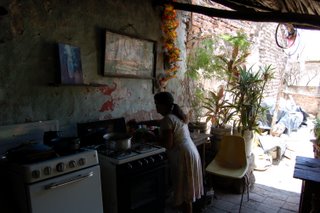
Vacaciones. This is the term that we agree upon, that is I and the two cousins, F and M. The Spanish term we agree upon in a kind of Spanish as I sit in the enclosure that is their kitchen, in Tequila, Jalisco, Mexico, is vacaciones. That is their term, our term, for my current state as I sit in the kitchen. In opposition, that is, to my wife, who is trabajaring in Georgia, as I explain in the infinitive. I do not speak Spanish and the cousins do not speak English. We are unlanguaged together. Prelanguaged? Relanguaging? I am searching for another word, a word for a sort of work, a sort of writing. The search is accompanied by gestures. This is good and archaic. Vacaciones, F suggests. Vacaciones is modern and nude. Vacaciones, M insists. It is a disguise, sleek as a 737, and I vanish. Si. Vacaciones. Sure, yes, porque no? And as far as they are concerned, and for simplicity’s sake, I am spending my vacaciones in their kitchen. I am spending counterfeit American vacaciones.
It is true, what Barthes said, that I, as a writer, am a false worker (rolled sleeves and dungarees) and a false holiday-maker (sunscreen and aloe). I have no word for me in their kitchen and I no longer have vacaciones. I am wondering if I am not also a false relative. False not in the sense of an impostor (though, for me, this remains in doubt until the cousins produce a 30-year-old photograph of my parents, F and M, lodged in a spiral bound notebook, producing also a not unpleasant vertigo), but in the sense of another order of deception: that I cannot, or have not tried hard enough to make it understood why exactly I am in this kitchen, what I will do to it and to these cousins. Cómo se dice “my institution has paid for me to come here?” I confess that they will be written, transcribed; confess, but not in those terms, nor in their Spanish approximations.
It is very hot, F says.
Immanent transcription is a peccadillo that understandably carries little weight in Tequila. Apparently this is not really a confession. Apparently they believe I could do much worse, and they aren’t wrong. Even if they understood what that transcription might be, they have no notion of what that transcription might be. In any case, that I will write them isn’t really true either, isn’t really even the half of it. The entire encounter is a series of misunderstandings, exactly as I’d planned.
And even this lament is false because it is not about vacaciones at all. There were never intended to be any vacaciones and so there were none whose end or loss can be lamented. That is true. There have been no vacaciones all summer long and no one planned it otherwise. The summer has not been planned at all. The summer has not been a summer. The summer has not been vacaciones. I am thieving and mutilating, fulfilling my role as an American. I am shopping stolen goods and you are my fence.
F and M curse me with their vacaciones. Vacaciones is a lesson. Here is a word to take with you on the bus back to GDL, on the 737 back to ATL. Repeat it: vacaciones. Now andale, cabron. Vaya bien. Vacaciones is the mobile state of the extranjero. Who in Tequila, where there is no trabaje, who in this enclosure has time for vacaciones? Only me, sitting around with his click in his hand, QWERTY under fingertips, eye to the keyhole, exactly as I’d planned. But there is time for my vacaciones (whatever that means) because there is no work and we are cousins. And there is sun and it is Monday. And there is tequila.
--Roland Barthes
I always look at August as the international month of vacation, should one want it and have that as a possibility.
--Ted Pelton

Vacaciones. This is the term that we agree upon, that is I and the two cousins, F and M. The Spanish term we agree upon in a kind of Spanish as I sit in the enclosure that is their kitchen, in Tequila, Jalisco, Mexico, is vacaciones. That is their term, our term, for my current state as I sit in the kitchen. In opposition, that is, to my wife, who is trabajaring in Georgia, as I explain in the infinitive. I do not speak Spanish and the cousins do not speak English. We are unlanguaged together. Prelanguaged? Relanguaging? I am searching for another word, a word for a sort of work, a sort of writing. The search is accompanied by gestures. This is good and archaic. Vacaciones, F suggests. Vacaciones is modern and nude. Vacaciones, M insists. It is a disguise, sleek as a 737, and I vanish. Si. Vacaciones. Sure, yes, porque no? And as far as they are concerned, and for simplicity’s sake, I am spending my vacaciones in their kitchen. I am spending counterfeit American vacaciones.
It is true, what Barthes said, that I, as a writer, am a false worker (rolled sleeves and dungarees) and a false holiday-maker (sunscreen and aloe). I have no word for me in their kitchen and I no longer have vacaciones. I am wondering if I am not also a false relative. False not in the sense of an impostor (though, for me, this remains in doubt until the cousins produce a 30-year-old photograph of my parents, F and M, lodged in a spiral bound notebook, producing also a not unpleasant vertigo), but in the sense of another order of deception: that I cannot, or have not tried hard enough to make it understood why exactly I am in this kitchen, what I will do to it and to these cousins. Cómo se dice “my institution has paid for me to come here?” I confess that they will be written, transcribed; confess, but not in those terms, nor in their Spanish approximations.
It is very hot, F says.
Immanent transcription is a peccadillo that understandably carries little weight in Tequila. Apparently this is not really a confession. Apparently they believe I could do much worse, and they aren’t wrong. Even if they understood what that transcription might be, they have no notion of what that transcription might be. In any case, that I will write them isn’t really true either, isn’t really even the half of it. The entire encounter is a series of misunderstandings, exactly as I’d planned.
And even this lament is false because it is not about vacaciones at all. There were never intended to be any vacaciones and so there were none whose end or loss can be lamented. That is true. There have been no vacaciones all summer long and no one planned it otherwise. The summer has not been planned at all. The summer has not been a summer. The summer has not been vacaciones. I am thieving and mutilating, fulfilling my role as an American. I am shopping stolen goods and you are my fence.
F and M curse me with their vacaciones. Vacaciones is a lesson. Here is a word to take with you on the bus back to GDL, on the 737 back to ATL. Repeat it: vacaciones. Now andale, cabron. Vaya bien. Vacaciones is the mobile state of the extranjero. Who in Tequila, where there is no trabaje, who in this enclosure has time for vacaciones? Only me, sitting around with his click in his hand, QWERTY under fingertips, eye to the keyhole, exactly as I’d planned. But there is time for my vacaciones (whatever that means) because there is no work and we are cousins. And there is sun and it is Monday. And there is tequila.
06 August 2006
An Alternative to Meeting New Friends
In response to Ted Pelton's "August Challenge" of a few post posts back, I present a review of a Starcherone Press book.
The author, Christopher Prater, composed the review for the literary journal Potion, which subsequently decided not to publish reviews.
And so, I am extremely happy to present it here, for your enjoyment.
Davis
*****
An Alternative to Meeting New Friends
Christopher Prater
Review of Aimee Parkison, Woman With Dark Horses (Starcherone Books, 2004) $16
Writing is just an illusion, right? Well Aimee Parkison makes me doubt this otherwise sensible conclusion in her debut short-story collection Woman With Dark Horses. Parkison connects her readers to a sense of loneliness through realistic characters who invariably fail to understand their lives. For instance, the narrator of “Blue Train Summer” admits, as if during a bar conversation, “At night, I thought if I murdered someone, I could probably get away with it, no big deal. But if I tried to love someone, people would think I had done something wrong.”
Parkison’s skill rests in her ability to paint unique characters onto a series of stories with similarly bleak palettes. This chorus line of colorful blues are reminiscent of Orr from Catch-22, because, as with Heller’s crash-obsessed character’s inexplicable desire to cram crab apples into his cheeks, the awkwardness of Parkinson’s characters sticks with the reader long after the book returns to the shelf. Such mealy characters include twins with eerie similarities to the creepy duo in “The Shining;” a boy cleverly disguised with a mustache who climbs into the narrow space between walls; and a girl who collects the detritus of her broken life—a garage door opener, her mother’s wedding ring, strands of her father’s beard—in memory of her dead parents.
For all the sullen docility of her players, Parkinson also fabricates a host of haunting images that linger like embarrassing childhood memories: a wife sipping foam from her dead husband’s mouth (“My Exhibit in the Blue Museum”); a suicidal teenager sitting naked in a room of mirrors while sketching her deformities (“Corolla”); a worm feeding on the dirt of a man’s chin (“Corolla”); and a cat sticking its head inside a boy’s mouth, sniffing remnants of toothpaste (“The Answer”).
Parkison’s style does not require elaborate language to impress. Her candid sentences fit the loneliness of her protagonists’ wounded psyches. In “Blue Train Summer” she needs only three sentences to capture the mood: “When I examined the dead girl’s arms, I found a small red heart tattooed on her left shoulder. A thin arrow was drawn through that heart. Underneath the tattoo, the scrawled letters carved into her skin read NOBODY’S GIRL.” Such is her effectively bleak imagery, like a raw wound, unconcealed by verbose, adjective-filled gobbets.
Ultimately, Woman with Dark Horses is not restricted to this measured style. In two of the stories, Parkinson’s stylistic experiments become change-ups that wonderfully diversify the lonely prose. In “My Exhibit in the Blue Museum,” time and place vacillate like erratic teenaged memories—Miami 1999; L.A. 1984; Dallas 1990; Amsterdam 1972—leading the reader to always wonder “where next?” In “The Answer,” Parkison’s story offers only questions: “Little man, can I kiss your mouth? Can I kiss your feet, your toes at one time? Can I comb the blood out of your hair?”
Woman with Dark Horses is not a collection of feel-good stories, but the reader will appreciate her shining characterization that make this issue even more moot than usual. Her creations linger on the page for moments of introspective quiet, before prancing right off the margin.
Christopher Prater graduated from Lake Forest College with a B.A. in chemistry and English and is currently a medical student at Michigan State University. In the past year, he has volunteered in an orphanage in Nepal, a Liberian refugee camp in Ghana, and an elementary school in Kenya.
He can be reached at: cwprater@gmail.com
The author, Christopher Prater, composed the review for the literary journal Potion, which subsequently decided not to publish reviews.
And so, I am extremely happy to present it here, for your enjoyment.
Davis
*****
An Alternative to Meeting New Friends
Christopher Prater
Review of Aimee Parkison, Woman With Dark Horses (Starcherone Books, 2004) $16
Writing is just an illusion, right? Well Aimee Parkison makes me doubt this otherwise sensible conclusion in her debut short-story collection Woman With Dark Horses. Parkison connects her readers to a sense of loneliness through realistic characters who invariably fail to understand their lives. For instance, the narrator of “Blue Train Summer” admits, as if during a bar conversation, “At night, I thought if I murdered someone, I could probably get away with it, no big deal. But if I tried to love someone, people would think I had done something wrong.”
Parkison’s skill rests in her ability to paint unique characters onto a series of stories with similarly bleak palettes. This chorus line of colorful blues are reminiscent of Orr from Catch-22, because, as with Heller’s crash-obsessed character’s inexplicable desire to cram crab apples into his cheeks, the awkwardness of Parkinson’s characters sticks with the reader long after the book returns to the shelf. Such mealy characters include twins with eerie similarities to the creepy duo in “The Shining;” a boy cleverly disguised with a mustache who climbs into the narrow space between walls; and a girl who collects the detritus of her broken life—a garage door opener, her mother’s wedding ring, strands of her father’s beard—in memory of her dead parents.
For all the sullen docility of her players, Parkinson also fabricates a host of haunting images that linger like embarrassing childhood memories: a wife sipping foam from her dead husband’s mouth (“My Exhibit in the Blue Museum”); a suicidal teenager sitting naked in a room of mirrors while sketching her deformities (“Corolla”); a worm feeding on the dirt of a man’s chin (“Corolla”); and a cat sticking its head inside a boy’s mouth, sniffing remnants of toothpaste (“The Answer”).
Parkison’s style does not require elaborate language to impress. Her candid sentences fit the loneliness of her protagonists’ wounded psyches. In “Blue Train Summer” she needs only three sentences to capture the mood: “When I examined the dead girl’s arms, I found a small red heart tattooed on her left shoulder. A thin arrow was drawn through that heart. Underneath the tattoo, the scrawled letters carved into her skin read NOBODY’S GIRL.” Such is her effectively bleak imagery, like a raw wound, unconcealed by verbose, adjective-filled gobbets.
Ultimately, Woman with Dark Horses is not restricted to this measured style. In two of the stories, Parkinson’s stylistic experiments become change-ups that wonderfully diversify the lonely prose. In “My Exhibit in the Blue Museum,” time and place vacillate like erratic teenaged memories—Miami 1999; L.A. 1984; Dallas 1990; Amsterdam 1972—leading the reader to always wonder “where next?” In “The Answer,” Parkison’s story offers only questions: “Little man, can I kiss your mouth? Can I kiss your feet, your toes at one time? Can I comb the blood out of your hair?”
Woman with Dark Horses is not a collection of feel-good stories, but the reader will appreciate her shining characterization that make this issue even more moot than usual. Her creations linger on the page for moments of introspective quiet, before prancing right off the margin.
Christopher Prater graduated from Lake Forest College with a B.A. in chemistry and English and is currently a medical student at Michigan State University. In the past year, he has volunteered in an orphanage in Nepal, a Liberian refugee camp in Ghana, and an elementary school in Kenya.
He can be reached at: cwprater@gmail.com
02 August 2006
the writer's edge : part two
 Thanks to the inimitable Trevor Dodge, here are some audio and video files documenting the first annual Writer's Edge conference held in Portland, Oregon, last weekend. For those who might be interested, Lidia Yuknavitch and I have already begun planning next year's Second Act.
:: faculty reading : audio : mp3 format ::
Compilation Reading (59.8 MB)
R.M. Berry (15.8 MB)
Michael Martone (11.6 MB)
Lance Olsen (13.6 MB)
Susan Steinberg (15.8 MB)
Lidia Yuknavitch (16.2 MB)
:: faculty reading : video : .mov format ::
R.M. Berry (16.2 MB)
Michael Martone (10.8 MB)
Lance Olsen (14.4 MB)
Susan Steinberg (16.4 MB)
Lidia Yuknavitch (16 MB)
:: small-press panel : audio : .mp3 format ::
Click here to download a recording of the small-press panel that included R. M. Berry (Fiction Collective Two), David Cowsert (Ink and Paper Group), Richard Jensen (Clear Cut), Lidia Yuknavitch (Chiasmus) and Kevin Sampsell (Future Tense). The last four panelists appear in the photo (courtesy to Andi Olsen) above. The audio isn’t the greatest quality, but it is complete (1 hour 44 minutes) and in stereo. Filesize: 92.2 mb.
the writer's edge : part one
Sponsored by FC2 and hosted by Portland State University, the first annual Writer's Edge conference—a series of workshops, panels, readings, and conversations about innovative prose—was held 28-30 July in downtown Portland, Oregon. Over 50 participants from around the country and as far away as Australia attended. Early feedback has been extraordinarily positive. My sense is that something very special happened at this gathering of the tribe.
At the core of the get-together were five workshops. Lidia Yuknavitch led "Five Easy Pieces: How to Form, Deform, and Reform Narrative Using the Fictional Fragment" that posed the question: "What happens if we turn away from the idea that narrative form must be unified in traditional ways?" Susan Steinberg taught "Writing Obsession, Writing As If Obsessed" that explored "the ways in which various modern and contemporary authors effectively writing obsession/obsessively consider the inextricable relationship of form and content, paying particular attention to (often unconsciously chosen) rhetorical and experimental devices: repetition, recursion, ranting, listing, among many others." R. M. Berry's "What Is Writing?" grew "out of the idea that the principle mark of radically innovative writing is its somehow posing the question of its own nature and existence." Michael Martone led a workshop on appropriation entitled "Nixon Remix," and I led one entitled "Fiction as Possibility Space" that asked participants to think and rethink the metaphors workshops usually employ when talking about writing fiction.
The faculty read from their work on campus the second evening, while around 9:00 p.m. each night everyone descended on a different local bar, thanks to Garrett Strickland and the Phase One Reading Series, for an open mic and sampling of avant-garde music. Each afternoon offered participants, among other possibilities, a Multimedia Exhibition Room featuring experimental films, hypertexts, and collage-texts by Andi Olsen, Tim Guthrie, Trevor Dodge, Andy Mingo, myself, and others. A great panel on the past, present, and future of small-press publishing (with FC2, Chiasmus, Clear Cut, Future Tense, & the Ink & Paper Group) rounded things out.
Courtesy of Andi Olsen, here are a few photos from The Event:
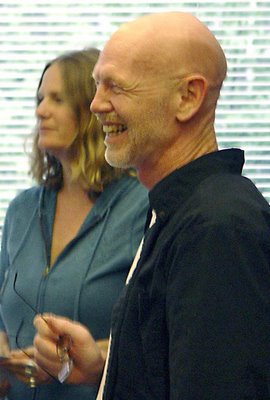 lidia yuknavitch & r. m. berry planning
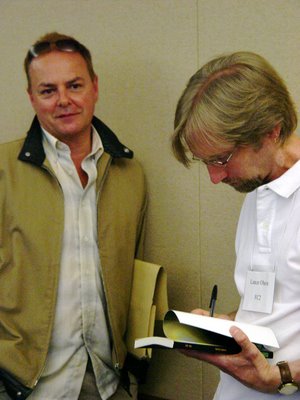 lance olsen signing
& author kris saknussemm imagining
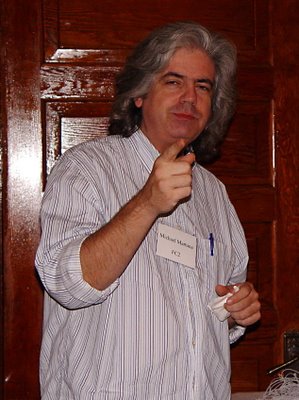 michael martone threatening
 susan steinberg & others partying
at an open mic
 madhatter review editor carol novack (right)
& laura enjoying
 chiasmus press authors
andy mingo & trevor dodge
looking self-conscious
At the core of the get-together were five workshops. Lidia Yuknavitch led "Five Easy Pieces: How to Form, Deform, and Reform Narrative Using the Fictional Fragment" that posed the question: "What happens if we turn away from the idea that narrative form must be unified in traditional ways?" Susan Steinberg taught "Writing Obsession, Writing As If Obsessed" that explored "the ways in which various modern and contemporary authors effectively writing obsession/obsessively consider the inextricable relationship of form and content, paying particular attention to (often unconsciously chosen) rhetorical and experimental devices: repetition, recursion, ranting, listing, among many others." R. M. Berry's "What Is Writing?" grew "out of the idea that the principle mark of radically innovative writing is its somehow posing the question of its own nature and existence." Michael Martone led a workshop on appropriation entitled "Nixon Remix," and I led one entitled "Fiction as Possibility Space" that asked participants to think and rethink the metaphors workshops usually employ when talking about writing fiction.
The faculty read from their work on campus the second evening, while around 9:00 p.m. each night everyone descended on a different local bar, thanks to Garrett Strickland and the Phase One Reading Series, for an open mic and sampling of avant-garde music. Each afternoon offered participants, among other possibilities, a Multimedia Exhibition Room featuring experimental films, hypertexts, and collage-texts by Andi Olsen, Tim Guthrie, Trevor Dodge, Andy Mingo, myself, and others. A great panel on the past, present, and future of small-press publishing (with FC2, Chiasmus, Clear Cut, Future Tense, & the Ink & Paper Group) rounded things out.
Courtesy of Andi Olsen, here are a few photos from The Event:
 lidia yuknavitch & r. m. berry planning
 lance olsen signing
& author kris saknussemm imagining
 michael martone threatening
 susan steinberg & others partying
at an open mic
 madhatter review editor carol novack (right)
& laura enjoying
 chiasmus press authors
andy mingo & trevor dodge
looking self-conscious
01 August 2006
Jeder Engel ist Shrecklich
Profane Waste—Photographs by Dana Hoey and Essay by Gretchen Rubin. Gregory R. Miller Books, 2006. An appreciation more than a review.
I love art books. Oversized, glossy, shiny and smelling of that expensive color ink. I love Hoey’s photographs as well. Glossy, luxurious, decadent in that smart, Dangerous Liaisons way. It’s Hoey’s photograph of the woman burning the $100 bill that makes the cover of Peter: An (A)Historical Romance. I learned that it was a real $100 bill.
I’m working on an essay called “Jeder Engel ist Shrecklich: Dana Hoey’s Terrible Pictures.” The angel I have in mind is from Bernini’s “Ecstasy of St. Teresa.” (This sculpture is reproduced on the cover of Jacques Lacan’s Seminar XX: Encore and forms the basis of his discussion of feminine sexual pleasure in “Dieu et la Jouissance de la Femme”). What is curious about the sculpture is the disparity between the angel’s facial expression and the saint’s. While the mystic’s face reflects the described (and by now comprehensible) ambivalence between ecstasy and pain, sexuality and spirituality, the angel’s face is much more difficult to read, as it seems a combination of radically incompatible and transgressive emotions—among them bemusement, empathy, pleasure, beneficence, superiority and even disdain. The angel knows what he is doing: his smirk, his posture, the way he holds his spear lightly between his middle finger and thumb, everything speaks of an accomplished, almost Sadean manipulator.
The book’s essay (by Gretchen Rubin, author of something called Power Money Fame Sex: A User's Guide) delimits ordinary waste from profane waste, and then goes on to explore three “species” of profane waste: “Heedless,” “Defiant” and “Denying.” The essay is mildly interesting in a sort of chatty, anecdotal, intellectual name dropping (but not too intellectual) way. But the real interest is in the photographs. Hoey’s pictures, her frozen images, are at once static and narrative. They ask questions in time. Questions centered around the idea of futility, waste, transgression. We see a blind woman facing a sculpture with her back toward a beautiful view. We see a pig rooting around a trash can full of dollar bills, a young woman at table with a pile of cooked ribs, a cemetery statue adorned with gold jewelry, a pregnant smoker on horseback. These are pictures not only of waste, but of guilt. Another theoretician of the angelic, Walter Benjamin, has written, “It is not accident that Atget’s photographs have been likened to those of a crime scene. . . Isn’t it the task of the photographer—descendent of the augers and haruspices—to revel guilt and point out the guilty in his pictures? (‘Little History of Photography’).”

Hoey, like Bresson (I’m watching a lot of Bresson these days to see if he’s successful) tries to make the image real. Through narration, or the combination of the image with narration. Flusser explains it this way:
“Basically, therefore, photographers wish to produce states of things that have never existed before; they pursue these states, not out there in the world, since for them the world is only a pretext for the states of things that are to be produced, but amongst the possibilities contained within the camera’s program. . . It is not the world out there that is real, nor is the concept within the camera’s program—only the photograph is real” (Toward a Philosophy of Photography 84).
Use-value is important to some of what we’ve been discussing. Waste, in a sense, can exist outside or beyond ‘work,’ ‘value’ and ‘culture.’
The book is elegant. It’s not a waste.
More images by Dana Hoey can be found here.
31 July 2006
Can you Blurb my Blog?
“NOW WHAT explodes the blogosphere like a runaway comet attacking the dinosaurs at the dawn of mammal time. It’s an otherworldly rocket ride through the terrain of innovative publishing—a spinal tap for the dull consumerist spinal cord—an all-encompassing Whitman-esque embrace, that, like the godfather of American poetry—takes everything in and leaves nothing to chance. NOW WHAT is the heir to H.L. Mencken, Martin Luther, and Soupy Sales. Slip on a hand puppet, nail your complaints to the door, and enjoy this endlessly delightful show.”
***
I was struck by a recent discussion in the most recent American Book Review (27.5) between Joe Tabbi and R.M. Berry, regarding Tabbi’s review of Berry’s great novel Frank. There is much to the exchange between the two authors, but one point involves Tabbi’s worry that innovative authors and publishers sometimes claim a secret knowledge of the world, beyond the perception of the average reader; one implication is that such claims may be a type of marketing hyperbole.
I wonder if those on this blog, contributors and readers, have any thoughts about book blurbs. You know, those little parcels of often-outrageous praise we solicit and write for the back covers of new books.
Do blurbs tells us anything useful about a text or a writer—or, like many letters of recommendation in higher education—are there only differing degrees of extreme plaudits? Do any of you have evidence that authors have not read books to which they contribute blurbs? What are you blurbing habits? [BONUS: Can you write the best possible NOW WHAT blurb?] There's an entire publicity system at work that we have yet to discuss.
Of course, feel free to respond anonymously. And it is rare, if not unheard of, to be asked to blurb anonymously.
Davis
***
I was struck by a recent discussion in the most recent American Book Review (27.5) between Joe Tabbi and R.M. Berry, regarding Tabbi’s review of Berry’s great novel Frank. There is much to the exchange between the two authors, but one point involves Tabbi’s worry that innovative authors and publishers sometimes claim a secret knowledge of the world, beyond the perception of the average reader; one implication is that such claims may be a type of marketing hyperbole.
I wonder if those on this blog, contributors and readers, have any thoughts about book blurbs. You know, those little parcels of often-outrageous praise we solicit and write for the back covers of new books.
Do blurbs tells us anything useful about a text or a writer—or, like many letters of recommendation in higher education—are there only differing degrees of extreme plaudits? Do any of you have evidence that authors have not read books to which they contribute blurbs? What are you blurbing habits? [BONUS: Can you write the best possible NOW WHAT blurb?] There's an entire publicity system at work that we have yet to discuss.
Of course, feel free to respond anonymously. And it is rare, if not unheard of, to be asked to blurb anonymously.
Davis
25 July 2006
Kathy Acker's Life & Work
This isn’t the review of a small-press book that Ted has challenged us to post (which I hope to be doing soon), but a recommendation pf a book on Kathy Acker that I've recently had the pleasure of reading. Lust for Life: On the Writing of Kathy Acker, ed. Amy Scholder, Carla Harryman, and Avital Ronell (Verso: London, 2006), collects eight papers that were presented in November, 2002 at a symposium on Acker at Fales Library at NYU. Will Kathy Acker’s work live on after her death? In About Writing: Seven Essays, Four Letters, and Five Interviews, Samuel R. Delany notes that the making & perpetuation of a literary reputation entails numerous factors, which are indexed by what he calls “markers.” Among these markers, the development of a body of literary criticism of the writer’s work ranks high. Obviously, when a wide spectrum of scholars and critics pay serious attention to a writer, other scholars and critics, previously unfamiliar with the work, will be drawn to write about it, too. But perhaps less obviously, criticism of writers who are considered “difficult” or “alternative” serves an even more important function, that of making the work intelligible to those who would otherwise dismiss it as unreadable or meaningless, of stretching the limits of mainstream literary discourse to accommodate work that was previously marginal.
Accordingly, in her preface to Lust for Life, Amy Scholder writes:
The eight essays complement one another. The first, “Kathy Acker,” by Peter Wollen, provides an intellectual biography of Acker’s writing life. He notes that although most people assume that Burroughs was the greatest influence on Acker’s work, the context in which she first “read Burroughs had already been set by the cultural formation that she had received in San Diego”—where she followed Herbert Marcuse from Brandeis & came to know David Antin (who told her “Don’t be afraid to copy it out”), Eleanor Antin (who “provided a role model for Acker as a female performer and avant-gardist”), and Jerome Rothenberg.
Wollen cites Sarah Crane’s observation (in The Transformation of the Avant-Garde) that
This observation resonates with the more personal account Avital Ronell offers in the next essay, “Kathy Goes to Hell: On the Irresolvable Stupidity of Acker’s Death,” which Ronell characterizes as a eulogy that attempts to “scan the resistant complexities of an unreadable friendship” (15). Ronell not only talks about Acker’s work, but also about their friendship (including Ronell’s wish for her to be friends with another close friend, Jacques Derrida) and her continuing bereavement five years after Acker’s death. Ronell is the first of the essayists to give us some idea of what it would have been like to have had a friendship with Acker. In doing so, she elaborates on what, for her, a “good friendship” is or is not:
The most painful, irreducible fact for Ronell is the “stupidity” of Acker’s death:
Carla Harryman’s essay, “Acker Un-formed,” was, for me, the most illuminating piece in the book. She warns of “the traps Acker’s novels lay for anyone who tries to write about them” that chiefly arise from they way in which Acker’s characters function in her fiction.
Harryman focuses particularly on what she calls the “architecture, or anti-architecture” of Acker’s later novels, noting: “The overlays of edifice and openness are related in her later works to childhood as both an institution and as unformed states of being that allow the text/world to be revealed and learned rather than known.” (38) And she points out that Acker’s novels recite stories the way children do.
Robert Gluck’s “The Greatness of Kathy Acker” relates the anguish he feels when reading Acker’s fiction, “in which a marauding narrative continually shifts the ground of authority, subverting faith in the ‘suspension of disbelief’ or guided daydream that describes most fiction.” (47) In the end, he says, “judgment itself is worn down and falls away in favor of a kind of astonishment.”(49) Gluck places Acker’s work in a larger context of literary aesthetics, then concludes, “Kathy Acker had the highest ambitions: to reorient literature in a true relation to the present and to crack that moment wide open.”
Barrett Watten zooms out, to place Acker’s work in a larger, historical context. He begins by regretting that although Foucault was a devotee of avant-garde texts early in his career and made use of what he calls their “negativity,” he apparently ceased to read such texts in the early 1970s. Watten asks: What if Foucault had read Kathy Acker’s novels? If he had, Watten hypothesizes,
Fleshing out this delightful flight of speculative fancy, Watten offers a fascinating reading of Acker’s early work against a “chronology of the rise and destruction of the Symbionese Liberation Army,” which, he says, “provides a ready-to-hand index to the period, easily discernible in both the form and content of Acker’s writing.”(67)
The sixth essay, Laurence A. Rickels’ “Devil Father Mine,” interested me the least, probably because its style is heavily allusive. “The writing Acker summons demonologically must be reclaimed from projection. The secondariness or reactivity of projection in the wake or place of first contact…turns around in this process into new writing—original screen text—along lines long associated with the Devil.”(78-79)
Nayland Blake’s “Kathy Acker:‘Because I Want to Live Forever in Wonder’” tells the story of the author’s early infatuation with Acker’s work, his disappointment when Acker wrote an essay for the catalog of the author’s gallery show in 1990, his subsequent friendship with Acker, & his rereading the essay after Acker’s death & seeing that Acker had indeed “captured much of what I have become as an artist.” As for Acker’s work, he offers this distillation:
Leslie Dick concludes the volume with “Seventeen Paragraphs on Kathy Acker,” which resonates with most of the previous seven essays. She notes that “Acker rewrote her texts eight times: once for sound, once for meaning, once for ‘beauty,’ once for structure, once in the mirror for performativity, etc…” She says, “Kathy’s generosity to unpublished writers was legendary. In the end we feel out. It was inevitable. Nevertheless, I won’t forget her generosity to me.”(113) & she, too, tries to get at the heart of Acker’s writing:
As such books should do, it made me want to read the novels by Acker I haven’t yet read & reread the ones that are marked indelibly in my memory. & that, of course, is its point.
Accordingly, in her preface to Lust for Life, Amy Scholder writes:
The sophistication, prescience, and innovation of Acker’s work make it prime material for scholarly interpretation and academic study. My hope is that with this collection of essays, we set the stage for further inquiry into Acker’s project, and that general readers, students, and scholars take note of the myriad ways to penetrate and interact with this vibrant work.(viii)
The eight essays complement one another. The first, “Kathy Acker,” by Peter Wollen, provides an intellectual biography of Acker’s writing life. He notes that although most people assume that Burroughs was the greatest influence on Acker’s work, the context in which she first “read Burroughs had already been set by the cultural formation that she had received in San Diego”—where she followed Herbert Marcuse from Brandeis & came to know David Antin (who told her “Don’t be afraid to copy it out”), Eleanor Antin (who “provided a role model for Acker as a female performer and avant-gardist”), and Jerome Rothenberg.
In this context, she found in Burroughs a prose writer who “was dealing with how politics and language came together…Burroughs was the only prose writer I could find who was a conceptualist, oh he’s very much of a conceptualist.” Burroughs’s cut-up technique provided Acker not only with a methodology but also an example of how a literary technique could be given a political twist as a mode of resistance, envisaged as a way of subverting the control system inherent in verbal discourse, expanding the possibilities of writing, ceaselessly creating the new out of the old.(4)
Wollen cites Sarah Crane’s observation (in The Transformation of the Avant-Garde) that
because novels sell at a much lower price than paintings or other artworks, the market for literature is therefore much greater and commercial success comes from volume of sales. For visual artists, on the other hand, it comes from selling, for a high unit price, to an elite of collectors and museums who are guided in their opinions and tastes by currents they pick up from within the art world itself. As a result, rich and successful artists are often militantly avant-garde, whereas best-selling writers tend to write “in the tradition of the realistic novel” and avant-garde writers cannot realistically hope for much commercial success.”(7)
This observation resonates with the more personal account Avital Ronell offers in the next essay, “Kathy Goes to Hell: On the Irresolvable Stupidity of Acker’s Death,” which Ronell characterizes as a eulogy that attempts to “scan the resistant complexities of an unreadable friendship” (15). Ronell not only talks about Acker’s work, but also about their friendship (including Ronell’s wish for her to be friends with another close friend, Jacques Derrida) and her continuing bereavement five years after Acker’s death. Ronell is the first of the essayists to give us some idea of what it would have been like to have had a friendship with Acker. In doing so, she elaborates on what, for her, a “good friendship” is or is not:
It is imperative that good friendship be unbound from the yoke of understanding—who would be so deluded as to claim to understand the friend? Who would demean the beloved friend by finding her transparent or readily intelligible? Good friendship demands a strong measure of rupture in reciprocity or equality, as well as the interruption of all fusion or confusion between you and me. Born of disproportion, it is evidenced, claims Nietzsche, when you respect the other more than yourself… The good friendship, borne [sic] of disidentification, enables you to see your friend.(28)
The most painful, irreducible fact for Ronell is the “stupidity” of Acker’s death:
She remained unsheltered, teaching more or less as an adjunct [at UC-Santa Barbara], bereft of the benefits that would have pulled her out of her medical crisis. I will never get over the fact that Acker had to suffer the refusal of medical benefits. Like many Americans, she was uninsured. No one or no institution should get away with the degradation that was visited upon her, determining her fate.”(15)
Carla Harryman’s essay, “Acker Un-formed,” was, for me, the most illuminating piece in the book. She warns of “the traps Acker’s novels lay for anyone who tries to write about them” that chiefly arise from they way in which Acker’s characters function in her fiction.
The reader of an Acker work suspends her own interpretive coherence; self-identity in reading multiplies, expands, pixelates, contracts, is undone: the reader becomes to herself a multisensory/sensibility of the text, a further anarchic layer of the text and/or obstruction. Reading further crowds the text. “I” am interference.(36)
Harryman focuses particularly on what she calls the “architecture, or anti-architecture” of Acker’s later novels, noting: “The overlays of edifice and openness are related in her later works to childhood as both an institution and as unformed states of being that allow the text/world to be revealed and learned rather than known.” (38) And she points out that Acker’s novels recite stories the way children do.
Power of choice, power to do adult things, to give birth, to destroy things, to chatter about death and love without repression, and to find love outside the family are part of the dialogues and narratives that children make up when they play house and play with dolls…Refined diction along with words and phrases learned from fairy tales and movies are mixed with unsophisticated phrases. This is the language of the child’s mingled knowledge and wishes.”(42)
Robert Gluck’s “The Greatness of Kathy Acker” relates the anguish he feels when reading Acker’s fiction, “in which a marauding narrative continually shifts the ground of authority, subverting faith in the ‘suspension of disbelief’ or guided daydream that describes most fiction.” (47) In the end, he says, “judgment itself is worn down and falls away in favor of a kind of astonishment.”(49) Gluck places Acker’s work in a larger context of literary aesthetics, then concludes, “Kathy Acker had the highest ambitions: to reorient literature in a true relation to the present and to crack that moment wide open.”
Barrett Watten zooms out, to place Acker’s work in a larger, historical context. He begins by regretting that although Foucault was a devotee of avant-garde texts early in his career and made use of what he calls their “negativity,” he apparently ceased to read such texts in the early 1970s. Watten asks: What if Foucault had read Kathy Acker’s novels? If he had, Watten hypothesizes,
its genealogy would in his view not originate with the propriety of Pamela’s virtue but descend from the criminality and sexuality of Moll Flanders. Triangulating Acker’s work between Moll Flanders and Pierre Riviere allows one to disclose her formal motives, which are to undo and reinvent the novel as an inversion of the historical crisis of its negative, excessive origins.(58-59)
Fleshing out this delightful flight of speculative fancy, Watten offers a fascinating reading of Acker’s early work against a “chronology of the rise and destruction of the Symbionese Liberation Army,” which, he says, “provides a ready-to-hand index to the period, easily discernible in both the form and content of Acker’s writing.”(67)
The sixth essay, Laurence A. Rickels’ “Devil Father Mine,” interested me the least, probably because its style is heavily allusive. “The writing Acker summons demonologically must be reclaimed from projection. The secondariness or reactivity of projection in the wake or place of first contact…turns around in this process into new writing—original screen text—along lines long associated with the Devil.”(78-79)
Nayland Blake’s “Kathy Acker:‘Because I Want to Live Forever in Wonder’” tells the story of the author’s early infatuation with Acker’s work, his disappointment when Acker wrote an essay for the catalog of the author’s gallery show in 1990, his subsequent friendship with Acker, & his rereading the essay after Acker’s death & seeing that Acker had indeed “captured much of what I have become as an artist.” As for Acker’s work, he offers this distillation:
What marks Acker as an artist of her generation is the way she combined formal editing strategies that had previously been used to produce and effect of intellectual distance with content of overwhelming intimacy.(104)
Leslie Dick concludes the volume with “Seventeen Paragraphs on Kathy Acker,” which resonates with most of the previous seven essays. She notes that “Acker rewrote her texts eight times: once for sound, once for meaning, once for ‘beauty,’ once for structure, once in the mirror for performativity, etc…” She says, “Kathy’s generosity to unpublished writers was legendary. In the end we feel out. It was inevitable. Nevertheless, I won’t forget her generosity to me.”(113) & she, too, tries to get at the heart of Acker’s writing:
The relation of words and things, writing and life, is a relation that never quite matches—its asymptotic, as Lacan says, the je and the moi (asymptotic always sounds to me like asymptomatic, like chlamydia, but anyway)—and it is in that gap between words and things, in that rupture, that desire lies. Put bluntly, need is a material reality, like hunger or love, and demand the speech act that repeats that need in words. In the difference between them, a difference that can never be evaded, given the infinitely incommensurable mismatch of things and words, bodies and ideas, in the difference between need and demand, in that impossible subtraction, desire cmes into being. Kathy Acker’s work is located there.
Kathy got at that space partly by refusing the distinction between art and life, words and things, by mixing it up to the point where every text undoes the proper and proprietary boundaries between the author and her very own text. This presumed author, singular in its authority, dissolves in Kathy’s writing, vanishing into a rapid sequence of possible others…Kathy shoved it all together… In the collision, in this mix, the space between words and things starts to open up, to come apart, to break down into something else: into a text of desire, always marked by the shadow of the lost object.(113-114)
As such books should do, it made me want to read the novels by Acker I haven’t yet read & reread the ones that are marked indelibly in my memory. & that, of course, is its point.
August Challenge
One of the things that prompted Lance and I to begin this blog a couple months ago was the paucity of reviews of new small press fiction titles. But, to date, there have been very few of these, aside from short mentions of and allusions to titles/authors.
Let's see what we can do about changing this. A challenge:
During August, let's have everyone on this list do at least one review of a recent-ish small press fiction title, preferably by an author who is not a good friend of the blogger (this world being so small oftentimes, it may be impossible to avoid any acquaintance whatever; nevertheless, it seems to me that this project's success will be predicated on reviewers feeling that they are free, if they desire, to do a less-than-enthusiastic review, if such is called for).
Let me also say this, as a small press publisher myself: anyone desiring review copies of Starcherone books should feel free to get in touch with me to request such. But then I will expect you to WRITE THE REVIEW (and reserve the right to call you out if you don't). Email me at ted@starcherone.com.
Let's see what we can do about changing this. A challenge:
During August, let's have everyone on this list do at least one review of a recent-ish small press fiction title, preferably by an author who is not a good friend of the blogger (this world being so small oftentimes, it may be impossible to avoid any acquaintance whatever; nevertheless, it seems to me that this project's success will be predicated on reviewers feeling that they are free, if they desire, to do a less-than-enthusiastic review, if such is called for).
Let me also say this, as a small press publisher myself: anyone desiring review copies of Starcherone books should feel free to get in touch with me to request such. But then I will expect you to WRITE THE REVIEW (and reserve the right to call you out if you don't). Email me at ted@starcherone.com.
19 July 2006
meta-blogging
 Who are bloggers?
 According to the results of a survey of nearly 5000 internet users released today by the PEW Internet & American Life Project, there aren't all that many surprises in answer to the question. But there are a few.
In an effort to continue our thinking about the digital beyond—and specifically the possibilities for alternative prose writers and publishers there—here are some of the highlights from the report:
- 8% of internet users, or about 12 million American adults, keep a blog; 39% of internet users, or about 57 million American adults, read blogs.
- 37% of bloggers cite "my life and experiences" as a primary topic of their blog; in other words, we may have something like a digital analogy for the unthinking and narcissistic narrativity of most pedestrian and parochial memoirs here—only without even an attempt at editing.
- 11% of bloggers cite politics and government as the main subject of their blog. Entertainment-related topics were the next most popular blog-type, with 7% of bloggers, followed by sports (6%), general news and current events (5%—isn't that extraordinary?), business (5%), technology (4%), religion, spirituality or faith (2%), a specific hobby or a health problem or illness (each comprising 1% of bloggers—among which irrational numbers, somewhere between underwater basket weaving and leprosy, I'm afraid, Now What would find a place).
- The most distinguishing characteristic of bloggers is their youth. More than half (54%) of bloggers are under the age of 30.
- Like the internet population in general, bloggers are evenly divided between men and women, and more than half live in the suburbs.
- Bloggers are less likely to be white than the general internet population. 60% percent of bloggers are, while 11% are African American, 19% are English-speaking Hispanic and 10% identify as some other race. By contrast, 74% of internet users are white, 9% are African American, 11% are English-speaking Hispanic and 6% identify as some other race.
- Despite the public nature of creating a blog, most bloggers view it as a personal pursuit. 52% of bloggers say they blog mostly for themselves, not for an audience—but then why, I wonder, don't they simply keep diaries?
- One in ten bloggers spends ten or more hours per week on his or her blog; most spend about two hours.
- 52% of bloggers say they do so mainly to "express themselves creatively."
- Only 34% believe the blog is a form of journalism, and only 56% of bloggers attempt to verify "facts" they include in their posts. Duck and cover: thought and argument have given way to bloviation and bluster.
16 July 2006
current projects
 While one of the few constraints we Now What contributors work under is the Law of No Self-Aggrandizement, I thought every now and then it might be both fun and illuminating to hear what we're up to in our aesthetic lives, and so:
What publishing or writing project are you engaged in right now that holds your greatest interest and attention?
Subscribe to:
Comments (Atom)