N.B. For those who stumble on this post, its contents respond to Kass Fleisher's recent post "Art|Politics|Beauty|Power," where, at the end, she writes...
"other than that, can we just have a moratorium on the list thing? unless we can manage, say, Top Ten Reasons Not to Fart in an Elevator...etc...."
And so,
*****
10. Because while farting is often strangely appreciated (although often unacknowledged) by the sender, cracking wind in front of others can be taken as an insult.
9. Unlike an escalator, where people and their ideas move mostly in a linear manner, from point A to point B (unless one gets her shoelaces caught in the mechanism), an elevator is an enclosed space where riders assiduously avoid each other’s bodies.
8. For what may be beautiful to one rider (the sender), in the presence of others may be taken with horror—as in the terror of the Kantian sublime.
7. Because beauty and truth in writing, while eloquent and meaningful and etc, become shot full of shit once someone cuts the elevator cable and a boxful of strangers plunge to their deaths. And when this happens, of course, the ventilation stops working.
6. When Willy Wonka launches the great glass elevator into the sky, above his candy empire, the last thing he wants is to be reminded that Charlie stole “fizzy lifting drinks.”
5. Because with 99 ways to tells the same story, how many of those aren’t visual? Letting it all out after a plate of beans would simply confuse the issue through another sensory dimension.
4. If power were a discussion to be had over a sophisticated intellectual dinner atop a high-rise building, the gaseous passage of such contents through the bowels in a downward moving elevator at the close of the meal would surely never be mistaken, by those guests not privy to the previous conversation, for a suitable dessert.
3. Humankind has never produced a working elevator; rather, the government “produces” elevator shots in Area 51, and thus, the act in question is technically impossible.
2. In 1853, when American inventor Elisa Otis invented the brake that would stop an elevator with failed cable from falling unfettered (see # 7, anyway), public confidence in the devices increased—and thus, the modern skyscraper rose over the typhoid-sodden streets of Chicago New York London Paris. Had Otis focused on flatulence, instead, as his primary concern, because you didn’t know enough to keep a tight lid on things, well, then, we’d have never reached the astounding heights of present-day narrative (for where would our publishers house themselves?).
1. In other words, elevators, of course, don’t exist when we write about them, anymore than truth, beauty, originality, genius, authorship, or the other methane-filled constellations of fickle word winds swirling—a vortex of reeking syllables—through the lost shafts of the descending colon.
0. Even so, all in good fun, you may smell something untoward emanating from your motherboard.
11 June 2006


10 June 2006
matt madden : 99 ways to tell a story
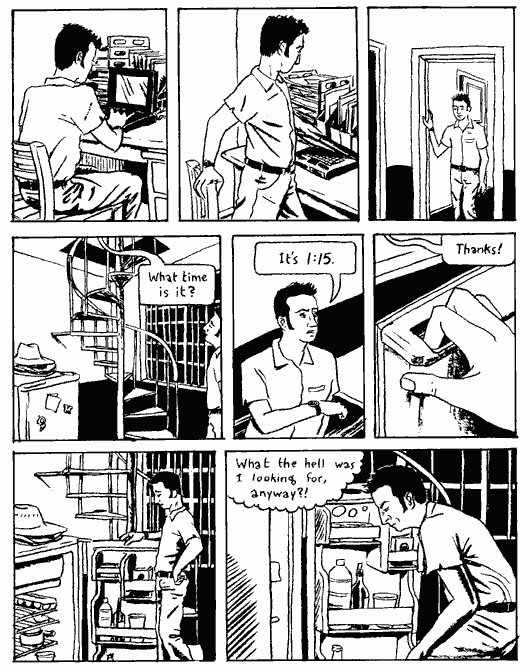
In 1947, Raymond Queneau—mathematician, poet, fiction writer, and member of the Oulipo group dedicated to using formal constraints imposed on one's own work as a method of generating creativity—published Exercises in Style. He took a simple story and told it in 99 different styles: as a letter, a sonnet, a moral lesson about The Youth of Today, etc. The narrative itself is wholly unremarkable: a young man gets on a crowded bus, complains about being jostled, and then sits down when a seat becomes available; later, the narrator sees the man who jostled him in another part of town talking to a friend.
In 99 Ways to Tell a Story (Chamberlain Brothers, 2005), Matt Madden performs a kind of homage to Queneau by doing much the same thing, only in comix. The narrative itself is, if possible, even more unremarkable than the original nonstory story: a man who has been working at a computer stands, closes his laptop, and walks to the refrigerator; his partner asks him what time it is from upstairs; he responds 1:15; then he bends in front of the fridge, looking puzzled, wondering "What the hell was I looking for, anyway?" Madden retells that narrative in a variety of comic-book styles, from a variety of points of view, in a variety of different settings, from a variety of different angles, with a variety of different characters, without one of the two leads, without the refrigerator, as a paranoid religious tract, as an existentialist parable, and so on.
The outcome is fascinating, stimulating, and a micro-education in both narrativity and the history of comix. Its mechanism of production is the simultaneous use and abuse the past, and its aesthetic impulse harmonizes well with what some of us back in the mid-nineties referred to as the Avant-Pop, a mode of telling that amibivalently accomodates pop culture while using many of its assumptions of comfort, predictability, and spectacularization against itself.
One of my litmus tests for a "successful" text is that it makes me want to go out and write. Madden's accomplishes that like few I've come across recently. And, to tie back into our earlier discussion of pedagogy and the difficult imagination, I'm guessing it might have a vibrant life in the classroom as well.
09 June 2006
Art|Politics|Beauty|Power
let me do a couple of things here:
first, lance said in his post that American Book Review is “in crisis,” and i thought i should let yall know that “crisis” isn’t quite the term at this point. “flux” would be more like it, and if what i was TOLD is happening does happen (so this is qualified), the situation may even be somewhat improved. illinois state had removed its long-time funding for a full-time, professional managing editor, which meant that the 2 people on the editorial wing (joe amato and me) and the 2 people on the production wing (tara reeser and sarah haberstich) were tasked not only with the expected duties but also details like...”um, has anyone checked the mail in the past month?” it didn’t work. (no shit? really?). if the editorial wing does move to another institution, it would seem that that new institution will restore that funding and position, which would allow the ed staff and prod staff to do what they’re best at. the person who has been proposed as the editorial point person for the journal in its new home is a very capable guy, and if this all goes through i think ABR will be in good hands.
if anyone has anything more up-to-date on this deal, please chime out. i’m no longer entirely...um...informed. hah.
so that’s done! (check.)
next: dear blonde (although only her hairdresser knows for sure...), i loved your post. (i’d say it left me ecstatic but that would be too...TOO.) lovingly, i’ll point out that this was my favorite section (perhaps b/c i have a short attention span...):
>Why can’t making art be the politics of making art?
>What’s the problem with creative and passionate dissent?
>Is it useful to ask ourselves questions about being, even if it might draw criticism or open us up to being accused of jacking-off?
one thing striking about your post is that it’s primarily composed of questions, which i find much more comfortable than monologues, this latter being what most of our posts have been. lance’s tyler gowan excerpt sounds a resonant tone for “us” (this tribe, whatever we are...)----how do we respond, as intellectuals and artists (or artists and intellectuals---this latter would be my personal ordering) to the fact that the public has gone to sleep? the masses slumber as we jack off, i guess---all of us in bed, then? (i don’t cum via dissensus---in times of conflict, most women’s capillaries shrink up, which is why a lot of women aren’t very into make-up sex...but hey, if that does it for others, why disrupt it?)
art is always the politics of making art, but apparently any insistence to that effect sounds to most of our citizens like a very shrill alarm clock. if we don’t control our readers, how do we respond to the fact that they just hit the snooze button and roll over?
i have a pretty bad jones for the russians myself; i’ve often been told i should “move on”...get “up to date”...but i still find them far better at discussing power than most thinkers, bar foucault, etc. here’s a shklovsky snippet from his memoir:
"So we see that Gorky is made of disbelief and piety, with irony for cement.
Irony in life is like eloquence in literature: it can tie everything together.
It makes a substitute for tragedy."
ouch! shit!
and so, ted! i love arguing with you, so let’s have it (note: there will be no sex afterward). keeping the power problem in mind, i’m thinking that what i loved greatly about poststructuralism was the suggestion that we could keep 2 ideas in our heads at one time. you wrote that altho...
>innovation is a path to the beautiful, it is beauty itself which is the goal, to my mind. Where I become doctrinaire about innovation is where I see conventionality hampering an artist's ascent to the beautiful....
do we as a group have a problem with the notion of innovation for the sake of innovation? (i’ll assume yes.) does our “tribe” have troubles with folks hoping to join b/c they have some notion of wanting to be an artistic rebel---just to be an artistic rebel? little of this has much to do with addressing power (to my mind). we have a habit of setting ourselves up as existing (“being,” blonde said, echoing heidegger maybe, ironically?) In Opposition.... many of us are old enough to flash to james dean and the anti-hero hero etc etc. but what plagues is, In Opposition To What?
my concern with beauty is that i want to do beauty (yes, i’ve failed, sue me) even as i’m conscious of beauty as a construct and as a commodity, a thing that can be romanticized right along with james dean, who ultimately served as (many things but also) a fabulous billboard for cigarettes.
sure; i want beauty as much as the next guy: the elegant turn of phrase, the well-turned ankle. i just want to maintain also the awareness of how violent those sorts of “turns” can turn out to be (and violence isn’t always bad in this context). the artist’s ascent is already hampered, yes? or perhaps we could say that the artist’s ascent will be a struggle against the powers of gravity, the baggage on her back, cigarette smoking, etc.
is it possible that one of us may be able to compose the utterly unexploitable piece of art? if “beauty,” and all its commodity-driven problems, is a good-size ascent, could unexploitability become...K2?
because, listen, al-zarqawi is dead. so is the pregnant woman (and her driver and, as many anti-abortion republicans have *interestingly* failed to point out, HER FETUS); and, you know, we’re still committing my-lai’s (anyone else shocked by this?).
seems to me there’s plenty that needs doing culturally, much of which has to do with abuse of power, and whether we want it to or not, or notice it happening or not, our work is going to do work. beauty does work. i can’t control my reader, but maybe i can attempt to ascend the slope that has to do with (at minimum) half-assed attempts to...attempt. to direct. against.
i mean, i’m obsessed with truth, but i can’t help but trouble “truth.” this is ok, right?
lance: check out drew gardner’s Petroleum Hat. great poems, brutal, smart, funny as fuck.
other than that, can we just have a moratorium on the list thing? unless we can manage, say, Top Ten Reasons Not to Fart in an Elevator...etc....
kass
first, lance said in his post that American Book Review is “in crisis,” and i thought i should let yall know that “crisis” isn’t quite the term at this point. “flux” would be more like it, and if what i was TOLD is happening does happen (so this is qualified), the situation may even be somewhat improved. illinois state had removed its long-time funding for a full-time, professional managing editor, which meant that the 2 people on the editorial wing (joe amato and me) and the 2 people on the production wing (tara reeser and sarah haberstich) were tasked not only with the expected duties but also details like...”um, has anyone checked the mail in the past month?” it didn’t work. (no shit? really?). if the editorial wing does move to another institution, it would seem that that new institution will restore that funding and position, which would allow the ed staff and prod staff to do what they’re best at. the person who has been proposed as the editorial point person for the journal in its new home is a very capable guy, and if this all goes through i think ABR will be in good hands.
if anyone has anything more up-to-date on this deal, please chime out. i’m no longer entirely...um...informed. hah.
so that’s done! (check.)
next: dear blonde (although only her hairdresser knows for sure...), i loved your post. (i’d say it left me ecstatic but that would be too...TOO.) lovingly, i’ll point out that this was my favorite section (perhaps b/c i have a short attention span...):
>Why can’t making art be the politics of making art?
>What’s the problem with creative and passionate dissent?
>Is it useful to ask ourselves questions about being, even if it might draw criticism or open us up to being accused of jacking-off?
one thing striking about your post is that it’s primarily composed of questions, which i find much more comfortable than monologues, this latter being what most of our posts have been. lance’s tyler gowan excerpt sounds a resonant tone for “us” (this tribe, whatever we are...)----how do we respond, as intellectuals and artists (or artists and intellectuals---this latter would be my personal ordering) to the fact that the public has gone to sleep? the masses slumber as we jack off, i guess---all of us in bed, then? (i don’t cum via dissensus---in times of conflict, most women’s capillaries shrink up, which is why a lot of women aren’t very into make-up sex...but hey, if that does it for others, why disrupt it?)
art is always the politics of making art, but apparently any insistence to that effect sounds to most of our citizens like a very shrill alarm clock. if we don’t control our readers, how do we respond to the fact that they just hit the snooze button and roll over?
i have a pretty bad jones for the russians myself; i’ve often been told i should “move on”...get “up to date”...but i still find them far better at discussing power than most thinkers, bar foucault, etc. here’s a shklovsky snippet from his memoir:
"So we see that Gorky is made of disbelief and piety, with irony for cement.
Irony in life is like eloquence in literature: it can tie everything together.
It makes a substitute for tragedy."
ouch! shit!
and so, ted! i love arguing with you, so let’s have it (note: there will be no sex afterward). keeping the power problem in mind, i’m thinking that what i loved greatly about poststructuralism was the suggestion that we could keep 2 ideas in our heads at one time. you wrote that altho...
>innovation is a path to the beautiful, it is beauty itself which is the goal, to my mind. Where I become doctrinaire about innovation is where I see conventionality hampering an artist's ascent to the beautiful....
do we as a group have a problem with the notion of innovation for the sake of innovation? (i’ll assume yes.) does our “tribe” have troubles with folks hoping to join b/c they have some notion of wanting to be an artistic rebel---just to be an artistic rebel? little of this has much to do with addressing power (to my mind). we have a habit of setting ourselves up as existing (“being,” blonde said, echoing heidegger maybe, ironically?) In Opposition.... many of us are old enough to flash to james dean and the anti-hero hero etc etc. but what plagues is, In Opposition To What?
my concern with beauty is that i want to do beauty (yes, i’ve failed, sue me) even as i’m conscious of beauty as a construct and as a commodity, a thing that can be romanticized right along with james dean, who ultimately served as (many things but also) a fabulous billboard for cigarettes.
sure; i want beauty as much as the next guy: the elegant turn of phrase, the well-turned ankle. i just want to maintain also the awareness of how violent those sorts of “turns” can turn out to be (and violence isn’t always bad in this context). the artist’s ascent is already hampered, yes? or perhaps we could say that the artist’s ascent will be a struggle against the powers of gravity, the baggage on her back, cigarette smoking, etc.
is it possible that one of us may be able to compose the utterly unexploitable piece of art? if “beauty,” and all its commodity-driven problems, is a good-size ascent, could unexploitability become...K2?
because, listen, al-zarqawi is dead. so is the pregnant woman (and her driver and, as many anti-abortion republicans have *interestingly* failed to point out, HER FETUS); and, you know, we’re still committing my-lai’s (anyone else shocked by this?).
seems to me there’s plenty that needs doing culturally, much of which has to do with abuse of power, and whether we want it to or not, or notice it happening or not, our work is going to do work. beauty does work. i can’t control my reader, but maybe i can attempt to ascend the slope that has to do with (at minimum) half-assed attempts to...attempt. to direct. against.
i mean, i’m obsessed with truth, but i can’t help but trouble “truth.” this is ok, right?
lance: check out drew gardner’s Petroleum Hat. great poems, brutal, smart, funny as fuck.
other than that, can we just have a moratorium on the list thing? unless we can manage, say, Top Ten Reasons Not to Fart in an Elevator...etc....
kass
A Call for Submissions
Emboldened by the fc2 sukenick award posting, I would like to invite all offbeat-onbeat writers, particularly of the female variety, to submit to Mad Hatters' Review, as our reading period for Issue 6 is officially due to close on the 14th (at midnight wherever you are). My staff and I are attempting to make our online journal a haven for offstream ("innovative") writers. We welcome book reviews, interviews, "non-fiction," short shorts, longer shorts, poetry, prose poetry, drama, multimedia projects, collaborative projects, and what we call whatnots (the indefinable glorious delicious outrageous). I've said "of the female variety" because we're getting many submissions from offstream male writers, but very very few from women. This is an issue for a future discussion, I'm sure.
I've been working on a schpeal (sp?) about the role and importance of online journals in promoting and disseminating fresh, sociopolitically aware/sophisticated and non-commercial writings. My own journal is only one of an increasing number.
I've been working on a schpeal (sp?) about the role and importance of online journals in promoting and disseminating fresh, sociopolitically aware/sophisticated and non-commercial writings. My own journal is only one of an increasing number.
07 June 2006
ronald sukenick innovative fiction prize
Beginning this fall, the Ronald Sukenick Innovative Fiction Prize will be awarded annually by FC2 to an outstanding book-length manuscript of formally innovative fiction. Hosted by the University of Notre Dame Creative Writing Department, the contest is open to all writers who have not previously published with FC2.
Contest entries will be accepted bewteen September 1, 2006, and December 1, 2006. The winner will be announced May 2007.
Full manuscripts, accompanied by a check for the reading fee of $20, should be sent to:
Ronald Sukenick Innovative Fiction Prize
c/o Steve Tomasula
The Notre Dame Review
840 Flanner Hall
University of Notre Dame
Notre Dame, IN 46556-5639
c/o Steve Tomasula
The Notre Dame Review
840 Flanner Hall
University of Notre Dame
Notre Dame, IN 46556-5639
Final selection of Sukenick Prize winners will be made by the FC2 Board of Directors: Lance Olsen, Lidia Yuknavitch, Michael Martone, Noy Holland, Susan Steinberg, and R. M. Berry. Selection criteria will be consistent with FC2’s stated mission to publish “fiction considered by America’s largest publishers too challenging, innovative, or heterodox for the commercial milieu,” including works of “high quality and exceptional ambition whose style, subject matter, or form pushes the limits of American publishing and reshapes our literary culture.”
The Sukenick Prize includes a $500 advance on royalties and publication of the winning manuscript by FC2, an imprint of the University of Alabama Press. In the unlikely event that no suitable manuscript is found among entries in a given year, FC2 reserves the right to award no prize.
For contest updates and full information on FC2’s mission, history, aesthetic commitments, authors, events, and books, please visit the press's website.
06 June 2006
Tsipi Keller's Jackpot
The most recent novel I’ve read is Jackpot (2004) by Tsipi Keller, the first of what is intended to be a trilogy (the second book is just out, both by Spuyten Duyvil). I’d give it a B-plus, but then that’s because I’m a teacher and that kind of evaluation comes easily to me. And any good educator should define criteria. B-plus in my gradebook suggests good effort, but just short of highest achievement.
Maggie is a single, late-twenty-something New York clerk who hates her boss and is bored with her life. She has a friend, Robin, who always seems to have more fun than Maggie does (Robin’s page 10 brag about a vacation, “I fucked my brains out,” haunts Maggie the entire novel). She also has an older work-colleague, Susan, who is more stable and sensible. Against Susan’s advice, Maggie goes with Robin on vacation to Paradise Island.
Well, Maggie shows Robin a thing or two about fucking and brains once she gets to Paradise Island. Or rather, Robin immediately shoving off on a companion’s yacht, abandoning Maggie, Maggie shows herself. It’s like The Damnation of Theron Ware, to cite a novel from a completely different context and century: a naif gets a whiff of something much too heady and then outdoes her original influence to such an extreme as to show complete misunderstanding of the nuances of selective transgression, horrifying everyone, including ultimately the protagonist herself.
The movement of the book is clean and delivers on a very deft narrative strategy – the heroine’s descent is unexpected even though, when we look backward, all the signs were there. There was her ex-husband’s ridiculous accusation that she was an alcoholic, for instance. The early exposition seems innocent, and then, ka-blam, you’re in a cesspool of vomited-up Bahama Mamas and men who are only remembered as vague spectres from the previous night, even when they appeared in teams.
This is where Jackpot might have been a more courageous novel, to my mind. The descent is perhaps too clean. I found myself thinking of J. M. Coetzee’s Disgrace – there, the descent is painstaking, delivered in excruciating, never-anaesthetized increments. Maggie’s blackouts in Jackpot, at the gaming tables and the nightly journeys afterwards to her now solely occupied hotel room, are a little too blurry for the reader to register the full horror of what is being represented. The novel comes in at a little under 200 pages. Maybe it needed to be 250 and to linger in anterooms on the way down to hell.
But maybe we’re not in hell yet, for Keller has the next novel in the sequence, Retelling, just out. Full disclosure: I also have a book with Spuyten Duyvil this summer; Keller and I are “stablemates”.
Given that, you’d think I would have given her at least an A-minus....
Maggie is a single, late-twenty-something New York clerk who hates her boss and is bored with her life. She has a friend, Robin, who always seems to have more fun than Maggie does (Robin’s page 10 brag about a vacation, “I fucked my brains out,” haunts Maggie the entire novel). She also has an older work-colleague, Susan, who is more stable and sensible. Against Susan’s advice, Maggie goes with Robin on vacation to Paradise Island.
Well, Maggie shows Robin a thing or two about fucking and brains once she gets to Paradise Island. Or rather, Robin immediately shoving off on a companion’s yacht, abandoning Maggie, Maggie shows herself. It’s like The Damnation of Theron Ware, to cite a novel from a completely different context and century: a naif gets a whiff of something much too heady and then outdoes her original influence to such an extreme as to show complete misunderstanding of the nuances of selective transgression, horrifying everyone, including ultimately the protagonist herself.
The movement of the book is clean and delivers on a very deft narrative strategy – the heroine’s descent is unexpected even though, when we look backward, all the signs were there. There was her ex-husband’s ridiculous accusation that she was an alcoholic, for instance. The early exposition seems innocent, and then, ka-blam, you’re in a cesspool of vomited-up Bahama Mamas and men who are only remembered as vague spectres from the previous night, even when they appeared in teams.
This is where Jackpot might have been a more courageous novel, to my mind. The descent is perhaps too clean. I found myself thinking of J. M. Coetzee’s Disgrace – there, the descent is painstaking, delivered in excruciating, never-anaesthetized increments. Maggie’s blackouts in Jackpot, at the gaming tables and the nightly journeys afterwards to her now solely occupied hotel room, are a little too blurry for the reader to register the full horror of what is being represented. The novel comes in at a little under 200 pages. Maybe it needed to be 250 and to linger in anterooms on the way down to hell.
But maybe we’re not in hell yet, for Keller has the next novel in the sequence, Retelling, just out. Full disclosure: I also have a book with Spuyten Duyvil this summer; Keller and I are “stablemates”.
Given that, you’d think I would have given her at least an A-minus....
03 June 2006
r.i.p. : review outlets & indie bookstores
 Since today marks the one-month anniversary of Now What's launch, I'd like to start off by thanking a thousand times our contributors, commenters, and readers for what has begun to develop, at least from my perspective, into an engaging, energetic, rhizomatic conversation, as well as an intriguing, important, and downright addictive experiment. In his blog Samizdat, Robert Archambeau describes us as "a grubby left-bank cafe of the twenties, only available right on your lap-top, in a bring-your-own-absinthe environment." That sounds about right to me.
In a recent post, Davis Schneiderman wondered aloud if we had any figures on those who in one way or another are participating here. The answer, thanks to Site Meter, is yes. Now What has had 2,672 visitors so far, with an average of 112 a day. Each visit lasts, on average, four minutes and eleven seconds. Not only have people dropped by from around the U.S., but also Bulgaria, France, Sweden, Denmark, the Netherlands, Poland, the U.K., Spain, Australia, Germany, Canada, and elsewhere around the world.
What I take away from those stats is this: there really is an extended tribe of readers, writers, and publishers Out There interested in the notion of perpetuating alternative prose as a space of resistance and celebration. That's a good thing, since the outlets for announcing and thinking about such projects are few and becoming fewer. At the Small Press Festival hosted at the University of Colorado in April by Jeffrey Deshell and Elizabeth Robinson, Ted Pelton and I found ourselves on a panel bemoaning the loss of traditional review channels for experimental fiction. As those of you who subscribe will have noticed, The New York Times Book Review, hardly a friend of the innovative, writes about fewer novels and short story collections of any kind than ever before. The American Book Review, one of the most ardent supporters of alternative writing in all its forms, is in crisis. In the hardcopy world, that leaves the inimitable Rain Taxi and a small handful of others.
In the digital world, however, it's a slightly different story. Excellent blogs—a good number of the best noted to the right of this post—are helping get the word out via an updated version of word-of-mouth. I don't know how many readers each actually has, but I suspect many fewer than those in the meat world.
Another dark sign for adventurous prose is the gradual folding of America's great indie bookstores. In a recent article in Slate on the subject, Tyler Gowan announced the closing of Berkeley's famous Cody's. The infiltration of chain bookstores into local shopping malls in the sixties and seventies began the slow erosion of the culture of literacy, inclusion of the odd, and sense of community fostered by the indies. Worse—and get this—there is only one buyer of fiction for the whole Barnes & Noble empire. Think about what that means for alternative publishers bringing out alternative prose. FC2, for instance, considers itself wildly lucky if B&N will carry even a few of its titles, but said titles remain on their shelves for less than a season before any unbought are returned.
Gowan goes on to argue, both provocatively and depressingly:
The real change in the book market is not the big guy vs. the little guy, or chain vs. indie stores. Rather, it's the reader's greater impatience, a symptom of our amazing literary (and televisual) plenitude. In the modern world we are more pressed for time, and we face a greater diversity of cultural choices. It was easy to finish Tolstoy's War and Peace when there were few other books around and it was hard to find them. Today, finishing it means forgoing many other options at our fingertips. As a result, we tend to consume ideas in smaller bits, a proposition that (in another context) economists labeled the "Alchian and Allen theorem." Long, serious novels are less culturally central than they were 100 years ago. Blogs are on the rise, and most readers prefer the ones with the shorter posts. Our greater access to books also means that each book has less time to prove itself. A small percentage of the books published account for a large share of the profits, thus setting off a race to track reader demand. Many customers want very recent best-sellers, often so they can feel they are reading something trendy, something other people are talking about.
And so, as Now What continues to become whatever it will become, if it becomes anything at all, let me make a suggestion: that its contributors and commenters post—in addition to whatever else strikes their fancy—reviewlettes of books they love in order to let others know about them. Let's try to stay away from title dropping, since that doesn't illuminate much for those who haven't read said title.
It's sometimes easier and/or more interesting to talk around novels and short fiction collections, formulate those reductionistic lists The New York Times Book Review seems bent on hawking, or remain afloat in a perpetual theoretical drift, but it's equally if not more important work to embrace praxis and help pass the word. Think, too, about doing a short interview with or profile of an experimental author or publisher and posting it here. Think of other ways of telling readers about books no one else will tell them about. And, naturally, always support your local indie bookstore—if there are any left in your neighborhood (the nearest to me is more than two-hundred miles away).
If I'm sounding especially pragmatic today, well, you caught me.
02 June 2006
That NYTBR Best List revisited again: The Rest of the Best
CRITICAL MASS: The Rest of the Best
CRITICAL MASS
the blog of the national book critics circle board of directors
Wednesday, May 31, 2006
The Rest of the Best
As you may have heard -- unless you are, for example, living in a steamer trunk -- the New York Times Book Review recently polled 125 writers in order to determine "the best work of American fiction of the past twenty-five years." When the Times presented the results of its survey, only books receiving multiple votes were listed. Since we're book critics (and therefore not too hung up on numbers), it seemed to us that the difference between getting one vote and getting two was ... not much. So we set out to find the books that received a single nomination, thinking that readers might be interested in the complete list.Thanks to the kind cooperation of many judges, as well as the deep inboxes of several of our Board members, here's the first installment of ... The Rest of the Best.*
- Wonder Boys, by Michael Chabon (nominated by: Edmund White)- The Amazing Adventures of Kavalier & Clay, by Michael Chabon (nominated by: anonymous)- Little, Big, by John Crowley (nominated by: David Orr)- The Hours, by Michael Cunningham (nominated by: Roxana Robinson)- Carpenter's Gothic, by William Gaddis (nominated by: Cynthia Ozick)- The Cider House Rules, by John Irving (nominated by: John Irving)- Ironweed, by William Kennedy (nominated by: anonymous)- Collected Stories, by Grace Paley (nominated by: Rick Moody)- On Glory's Course, by James Purdy (nominated by: Paula Fox)- Collected Stories by Isaac Bashevis Singer (Library of America Edition edition - 3 volumes) (nominated by: Norman Rush)- Aberration of Starlight, by Gilbert Sorrentino (nominated by: Geoffrey O'Brien)- Dinner at the Homesick Restaurant, by Anne Tyler (nominated by: anonymous)- 60 Stories, by Donald Barthelme (nomination listed in NY Times Podcast)- The Corrections, by Jonathan Franzen (nomation listed in NY Times)In addition to compiling this list, we've asked judges for commentary on why they chose they books they chose. Some chose to remain anonymous -- others didn't. Like John Irving:"I voted for myself," Irving told us, "for "The Cider House Rules" -- suspecting that, otherwise, I might not receive a single vote. We all know presidents vote for themselves, and they do far more harm than writers do. I confess to being underwhelmed by most of the books (and authors) receiving multiple votes, with the notable exceptions of the four novels by John Updike, and the six by Philip Roth. Clearly the TBR should have admitted that it asked the wrong question; the most admired writers of the past 25 years are Updike and Roth, and it's no surprise to me that among all the writers receiving multiple votes, Updike and Roth have the most readers. In fact, I just wrote Roth a letter, in which I said that, if the poll in the TBR had been a fight, he would have won by a TKO in the first round."* We're still collecting information from several participants in the NYT survey. Over the coming days, we'll be updating this list -- (see rest of article & commentaries).
CRITICAL MASS
the blog of the national book critics circle board of directors
Wednesday, May 31, 2006
The Rest of the Best
As you may have heard -- unless you are, for example, living in a steamer trunk -- the New York Times Book Review recently polled 125 writers in order to determine "the best work of American fiction of the past twenty-five years." When the Times presented the results of its survey, only books receiving multiple votes were listed. Since we're book critics (and therefore not too hung up on numbers), it seemed to us that the difference between getting one vote and getting two was ... not much. So we set out to find the books that received a single nomination, thinking that readers might be interested in the complete list.Thanks to the kind cooperation of many judges, as well as the deep inboxes of several of our Board members, here's the first installment of ... The Rest of the Best.*
- Wonder Boys, by Michael Chabon (nominated by: Edmund White)- The Amazing Adventures of Kavalier & Clay, by Michael Chabon (nominated by: anonymous)- Little, Big, by John Crowley (nominated by: David Orr)- The Hours, by Michael Cunningham (nominated by: Roxana Robinson)- Carpenter's Gothic, by William Gaddis (nominated by: Cynthia Ozick)- The Cider House Rules, by John Irving (nominated by: John Irving)- Ironweed, by William Kennedy (nominated by: anonymous)- Collected Stories, by Grace Paley (nominated by: Rick Moody)- On Glory's Course, by James Purdy (nominated by: Paula Fox)- Collected Stories by Isaac Bashevis Singer (Library of America Edition edition - 3 volumes) (nominated by: Norman Rush)- Aberration of Starlight, by Gilbert Sorrentino (nominated by: Geoffrey O'Brien)- Dinner at the Homesick Restaurant, by Anne Tyler (nominated by: anonymous)- 60 Stories, by Donald Barthelme (nomination listed in NY Times Podcast)- The Corrections, by Jonathan Franzen (nomation listed in NY Times)In addition to compiling this list, we've asked judges for commentary on why they chose they books they chose. Some chose to remain anonymous -- others didn't. Like John Irving:"I voted for myself," Irving told us, "for "The Cider House Rules" -- suspecting that, otherwise, I might not receive a single vote. We all know presidents vote for themselves, and they do far more harm than writers do. I confess to being underwhelmed by most of the books (and authors) receiving multiple votes, with the notable exceptions of the four novels by John Updike, and the six by Philip Roth. Clearly the TBR should have admitted that it asked the wrong question; the most admired writers of the past 25 years are Updike and Roth, and it's no surprise to me that among all the writers receiving multiple votes, Updike and Roth have the most readers. In fact, I just wrote Roth a letter, in which I said that, if the poll in the TBR had been a fight, he would have won by a TKO in the first round."* We're still collecting information from several participants in the NYT survey. Over the coming days, we'll be updating this list -- (see rest of article & commentaries).
01 June 2006
A few items of possible interest:
In the spirit of Carol's post abut MHR...
1) Some thoughts on this blog from poet and all-around cool cat Bob Archambeau, at his Samizdat blog.
2) An interview/conversation I conducted with Lance Olsen at the cooler-than-cool indie mag EconoCulture.
3 Spuyten Duuyvil fiction reading, Chicago, this Sunday, June 4:
Davis Schneiderman and Tod Thilleman, at Myopic Books, 1564 N. Milwaukee Avenue, 7 pm.
1) Some thoughts on this blog from poet and all-around cool cat Bob Archambeau, at his Samizdat blog.
2) An interview/conversation I conducted with Lance Olsen at the cooler-than-cool indie mag EconoCulture.
3 Spuyten Duuyvil fiction reading, Chicago, this Sunday, June 4:
Davis Schneiderman and Tod Thilleman, at Myopic Books, 1564 N. Milwaukee Avenue, 7 pm.
30 May 2006
from physics, through sentences, to ecstasy (without organization or apology, but warmly)
Why does it matter that ideas we seize in the present have made appearances in the past—through other mouths, minds, hearts? Does that mean we shouldn’t keep thinking them alive and reshaping them? Energy never dies. It just changes forms.
Does it matter that this space is heteroglossic and even carnivalesque (my man bakhtin)—many headed, many voiced, no main character, no identifiable telos, no consistent logic, a buncha interruptive sentences and languages and histories and theories and questions and possibilities crashing into each other or cozying up like lovers—or is this the chaos of matter itself?
Is there more to genres and sentences than we think, stuff we keep forgetting? Can genres and sentences teach us something about social change?
What if we viewed genres metaphorically as "the drive belts between the history of language and the history of society" (more m.m. bakhtin)? What if shifts and transformations in genre conventions are “both indexical of social change and contribute accumulatively to social change?”
Why do we need or want to unify anything we are saying or doing here, if it is miraculously opening up a space where the social, the literary, and the body (for me) are making intimate and creative exchanges (still riding the back of m.m.)?
Why do we pretend we have any real power over students or readers, when what is at stake is the possible space of human relationship? I’m speaking of the difference between the market’s reach to buyers and consumers (even in education) and the possibility space of intimate human connection (fast in danger of being subsumed).
Is resistance to power something we all have to call by the same name, or funnel into the same strategy?
If I say “words of creepy shit-head zombies” instead of “language of the oppressor,” does that make my words less powerful? If I say “my government makes me want to rearrange a fucking face” instead of “we must endeavor to de-center and expose hegemonic authority,” does that make me sound unintelligent? If academia would have me change my language and move it away from my body and its disturbances, what does that mean?
Why can’t making art be the politics of making art?
What’s the problem with creative and passionate dissent?
Is it useful to ask ourselves questions about being, even if it might draw criticism or open us up to being accused of jacking-off?
Do we want to know each other’s histories? Why or why not?
If I am in love with the things that the people here say, whether or not I ever agree with them, can’t that in itself be a creative practice which busts up and through the things we complain about? Can my willingness to be in that relationship lovingly be a form of hope, a peek of insight beyond the fog of the present, the possibility of artists and writers and thinkers interrupting the flow of economy and war? Can I say lovingly in a discussion like this? Love and beyond, into the ecstatic.
What can ecstatic mean?
If I keep reinserting the body into the discussion, putting it dangerously close to sentences, narrative, will it matter?
Why can’t passionate thinking and writing be understood as ecstatic states? The root understanding of the word ecstasy — ‘to stand outside’ —comes to us in those moments when we dive so deeply into the act of thinking and writing that everything else falls away.
Right here—in this space--I get to be in a chronotrope. Time-space--“the spatio-temporal matrix which governs the base condition of all narratives and other linguistic acts” (m.m. b. again). Right here I get to risk the ecstatic state.
Tribally yours.
Does it matter that this space is heteroglossic and even carnivalesque (my man bakhtin)—many headed, many voiced, no main character, no identifiable telos, no consistent logic, a buncha interruptive sentences and languages and histories and theories and questions and possibilities crashing into each other or cozying up like lovers—or is this the chaos of matter itself?
Is there more to genres and sentences than we think, stuff we keep forgetting? Can genres and sentences teach us something about social change?
What if we viewed genres metaphorically as "the drive belts between the history of language and the history of society" (more m.m. bakhtin)? What if shifts and transformations in genre conventions are “both indexical of social change and contribute accumulatively to social change?”
Why do we need or want to unify anything we are saying or doing here, if it is miraculously opening up a space where the social, the literary, and the body (for me) are making intimate and creative exchanges (still riding the back of m.m.)?
Why do we pretend we have any real power over students or readers, when what is at stake is the possible space of human relationship? I’m speaking of the difference between the market’s reach to buyers and consumers (even in education) and the possibility space of intimate human connection (fast in danger of being subsumed).
Is resistance to power something we all have to call by the same name, or funnel into the same strategy?
If I say “words of creepy shit-head zombies” instead of “language of the oppressor,” does that make my words less powerful? If I say “my government makes me want to rearrange a fucking face” instead of “we must endeavor to de-center and expose hegemonic authority,” does that make me sound unintelligent? If academia would have me change my language and move it away from my body and its disturbances, what does that mean?
Why can’t making art be the politics of making art?
What’s the problem with creative and passionate dissent?
Is it useful to ask ourselves questions about being, even if it might draw criticism or open us up to being accused of jacking-off?
Do we want to know each other’s histories? Why or why not?
If I am in love with the things that the people here say, whether or not I ever agree with them, can’t that in itself be a creative practice which busts up and through the things we complain about? Can my willingness to be in that relationship lovingly be a form of hope, a peek of insight beyond the fog of the present, the possibility of artists and writers and thinkers interrupting the flow of economy and war? Can I say lovingly in a discussion like this? Love and beyond, into the ecstatic.
What can ecstatic mean?
If I keep reinserting the body into the discussion, putting it dangerously close to sentences, narrative, will it matter?
Why can’t passionate thinking and writing be understood as ecstatic states? The root understanding of the word ecstasy — ‘to stand outside’ —comes to us in those moments when we dive so deeply into the act of thinking and writing that everything else falls away.
Right here—in this space--I get to be in a chronotrope. Time-space--“the spatio-temporal matrix which governs the base condition of all narratives and other linguistic acts” (m.m. b. again). Right here I get to risk the ecstatic state.
Tribally yours.
29 May 2006
Readings and such
While I'm trying to think up something remarkable and insightful to say about eccentric, gifted new wave groupettes vs old guard elitist, boring & mundane groupettes vs proud, charming, irritating & eccentric individualists vs "tribes" vs "kibbutzes" vs conscious collectives vs unconscious collectives vs task vs process vs chlorinated swimmings pools, socioeconomicpolitical stratispheres, homogenous & incompatible hemispheres, offbeat universities in the Midwest, subway systems, sentences & narratives & the relevance of my cultural roots in old Russia & my Electrac attachment to my past father, I'd like to follow Mark Wallace in announcing a reading in NYC. It's on Thursday this at the KGB Bar, East Village, 7 - 9 pm. Tis the second in the Mad Hatters' Review Poetry, Prose & Anything Goes Reading Series, and features Edwin Torres (the "experimental" theatrical/performance poet) and lyrical "innovative"/"avant-garde" prose-narrative writer Dawn Raffel. We will also present an actor reading selections from our journal, issues 1 through 5, a live saxophonist playing original abstract music, & for a reasonable price, signed posters depicting a torture victim of The Homeland Security Dept. of the US of Ameerica (our issue 5 cover art). Admission is free For details, please proceed to MHR.
Thanks for listening!
Carol
Thanks for listening!
Carol
We’re ready for our close up, Mr. DeMille
[Thanks to all for the scintillating and complex views, and for the several glimpes into the classroom. I’m always happy to hear what my colleagues are up to…]
What’s that old Hollywood saying...something like, if you want to send a message, go to Western Union…? And we all love moving pictures.
Not sure, as per Lance Olsen’s (I'm using last names for readers) recent post, what unifies any of the people on this blog—except that fact that we are on the blog. Follow?
An I.Q. test is a test of how well you take an I.Q. test, and if so, then the GREs are a test of well, you guessed it, how well you take the GREs. And, a dissertation becomes a test (word “test” used broadly) of how well you comport to the various institutional rules that govern what constitutes a dissertation in your particular field, at your particular moment, with your particular committee etc. Roll over, Pierre Bourdieu, and dig these rhythm and blues.
In other words, I’m with Kass on focusing on “power.” Of course, Kass Fleisher and I had the same dissertation director at SUNY Binghamton (now called Binghamton University, in its privatized phase), although we were a few years apart. I can’t pin this down for sure, but knowing the Bingo scene, Kass and I were probably relative anomalies from the still to some degree John Gardner -influenced zeitgeist going on that-a-way.
[I deliberately do not want to be John Gardner…can’t ride a motorcycle, not much of a hard drinker, etc, and found The Art of Fiction to be real snoozer.]
Lance’s point about affiliation in an important one. We may not all be academics, or small press/journal editors, or even however-you-want-to-define-it “innovative” writers, but we are still, of course, on this blog. We’re all passing this test of how well we write on a blog rather well, it seems. But, how’d we get here?
Invitation from Lance and Ted Pelton perhaps (?), who, I believe, both came up with the idea while at a Colorado writing festival with Jeffrey DeShell. Maybe the seed emerged at an earlier meeting, AWP in Austin, the &NOW Festival at Lake Forest College? A number of us are alums of a short-lived list serve from the late 90s (Prosaics…was it called?), which was kind of like this blog, but not quite so public. [Like multicolored legos, we’ve got plenty more connections I won’t bother to enunciate here.]
If it ain’t writing until it’s read (as Doug Rice notes), then perhaps there is the public internet aspect to muse upon…? Is there anybody out there? Clearly, a few, maybe more. Do we have the visitor stats for the blog thus far? But otherwise, perhaps we are still engaged very much in a tribal enterprise. Seems to me, though, that tribes are often eradicated, marginalized, or, if things carry on long enough, given points on lucrative casinos.
Watch the ball bouncing over the roulette wheel; ignore the keno zombies staring cold and catatonic over the empires of the senseless.
I’d be very interested to know about affinities this group shares, about articulations, even tentative, that can offer a way to point toward some collective interrogation of the contemporary writing landscape.
For my part, I’ll venture a very tentative hypothesis that what makes members of a group like this coalesce is some collective recognition, albeit drawn from myriad different experiences, of what makes art signal difference from whatever definition of traditional/mainstream/narrative/sentence-based/etc stuff it is not.
We may not, and should not, all agree of any of the specifics of how this occurs, but to shoot back to an earlier idea (Bourdieu’s)—we are to some degree acculturated into our likings, and for some (and here’s a problem), such aesthetics are markers of “privilege” (education, exposure, leisure time). A trap in the radical possibilities of our broadly defined aesthetic? Production for producers? Rewarded with symbolic capital (academic jobs…) for not engaging in a certain type of self-promotional capitalist game? Pick a card, any card.
Let me throw out another possibility for what our stuff is not—for the most part, we don’t control the means of widespread distribution for our work. Even our most financially successful enterprises can’t compete with most of the cookbooks Joe Amato probably reads.
I dropped out of the Culinary Institute of American at 17, and since have never made a béchamel again.
What’s that old Hollywood saying...something like, if you want to send a message, go to Western Union…? And we all love moving pictures.
Not sure, as per Lance Olsen’s (I'm using last names for readers) recent post, what unifies any of the people on this blog—except that fact that we are on the blog. Follow?
An I.Q. test is a test of how well you take an I.Q. test, and if so, then the GREs are a test of well, you guessed it, how well you take the GREs. And, a dissertation becomes a test (word “test” used broadly) of how well you comport to the various institutional rules that govern what constitutes a dissertation in your particular field, at your particular moment, with your particular committee etc. Roll over, Pierre Bourdieu, and dig these rhythm and blues.
In other words, I’m with Kass on focusing on “power.” Of course, Kass Fleisher and I had the same dissertation director at SUNY Binghamton (now called Binghamton University, in its privatized phase), although we were a few years apart. I can’t pin this down for sure, but knowing the Bingo scene, Kass and I were probably relative anomalies from the still to some degree John Gardner -influenced zeitgeist going on that-a-way.
[I deliberately do not want to be John Gardner…can’t ride a motorcycle, not much of a hard drinker, etc, and found The Art of Fiction to be real snoozer.]
Lance’s point about affiliation in an important one. We may not all be academics, or small press/journal editors, or even however-you-want-to-define-it “innovative” writers, but we are still, of course, on this blog. We’re all passing this test of how well we write on a blog rather well, it seems. But, how’d we get here?
Invitation from Lance and Ted Pelton perhaps (?), who, I believe, both came up with the idea while at a Colorado writing festival with Jeffrey DeShell. Maybe the seed emerged at an earlier meeting, AWP in Austin, the &NOW Festival at Lake Forest College? A number of us are alums of a short-lived list serve from the late 90s (Prosaics…was it called?), which was kind of like this blog, but not quite so public. [Like multicolored legos, we’ve got plenty more connections I won’t bother to enunciate here.]
If it ain’t writing until it’s read (as Doug Rice notes), then perhaps there is the public internet aspect to muse upon…? Is there anybody out there? Clearly, a few, maybe more. Do we have the visitor stats for the blog thus far? But otherwise, perhaps we are still engaged very much in a tribal enterprise. Seems to me, though, that tribes are often eradicated, marginalized, or, if things carry on long enough, given points on lucrative casinos.
Watch the ball bouncing over the roulette wheel; ignore the keno zombies staring cold and catatonic over the empires of the senseless.
I’d be very interested to know about affinities this group shares, about articulations, even tentative, that can offer a way to point toward some collective interrogation of the contemporary writing landscape.
For my part, I’ll venture a very tentative hypothesis that what makes members of a group like this coalesce is some collective recognition, albeit drawn from myriad different experiences, of what makes art signal difference from whatever definition of traditional/mainstream/narrative/sentence-based/etc stuff it is not.
We may not, and should not, all agree of any of the specifics of how this occurs, but to shoot back to an earlier idea (Bourdieu’s)—we are to some degree acculturated into our likings, and for some (and here’s a problem), such aesthetics are markers of “privilege” (education, exposure, leisure time). A trap in the radical possibilities of our broadly defined aesthetic? Production for producers? Rewarded with symbolic capital (academic jobs…) for not engaging in a certain type of self-promotional capitalist game? Pick a card, any card.
Let me throw out another possibility for what our stuff is not—for the most part, we don’t control the means of widespread distribution for our work. Even our most financially successful enterprises can’t compete with most of the cookbooks Joe Amato probably reads.
I dropped out of the Culinary Institute of American at 17, and since have never made a béchamel again.
28 May 2006
tribal identity : tentativeness
What is it, if anything, that unites the works or perspectives of those participating in this blog and beyond in the world of "alternative" writing?
Initially, the answer strikes me as not much to nothing. Some of us don't like the word "experimentation," others "postmodern," others "avant-garde," others still the very notion of the "alternative." Some embrace the rhetorical pyrotechnics of theory; some eschew it. Some want to talk about the economics of writing; others find such discussions dull. Some foreground language and minimize narrative; others don't. Some get antsy around conversations concerning genre. For some, it's "all writing" (except, apparently, nonfiction, which is something to be scorned); for others, such assertations are proof of the lack of precision and rigor. The very books that some cherish, others find failures.
To make matters more tricky still, writers/artists in general are iconoclasts by nature (and, yes, I use the term loosely) who don't like to belong to things, don't like to be associated with trends and movements, since such chimera seem to minimize their individuality and originality (as if these traits are the ones that make artists artists). Yet, of course, all of us writers/artists do belong to things. Some of us "belong" to universities or colleges. Some "belong" to presses or magazines. All of us "belong" to the category "writers" and "contributors to this blog." All of us, for better or worse, "belong" to the politics of the present.
But simply because what we have in common may be complex to pin down and even more complex to articulate shouldn't by my lights be a cause for making a difficulty into an impossibility.
I've been thinking about the notion of the tribal lately in an effort to begin to begin to make sense of these continuities in the midst of myriad divergences. The dictionary definition works thus: A unit of sociopolitical organization consisting of a number of families, clans, or other groups who share a common ancestry and culture and among whom leadership is typically neither formalized nor permanent.
I find appealing the notion of many families and clans being part of something that is both them and not them. The notion of shared ancestry and culture. The notion of impermanent, unformalized leadership or center.
If we start there, and proceed tentatively, then the following are some questions that bloom:
- Why make an effort to search for common ground?
- What sort of sociopolitical (or, perhaps in this case, aesthetico-political) organization(s) are we?
- Can we/should we in fact enumerate some of the common ancestry and culture we share? That is, what are our histories? Who are we?
- The dangers of such enumerations are obvious, it seems to me, in this age of difference and deferredness, but what are the opportunities and benefits?
- If the metaphor of the tribal doesn't seem illuminating, are there others that might function more effectively for helping us contemplate who we are and what we're doing?
Speed is all about forgetfulness. I'd like this to be a small space of reminding.
27 May 2006
Memorial Day Weekend
I can't pick up on most of the great stuff here - great simply that it is happening - but I will quickly post something before I leave town for weekend (holiday Memorializing a time before we became the new Soviet Union...).
Buffalo last week had a birthday party for Robert Creeley who would have been 80 last Saturday had he made it. (Miles Davis's 80th then followed later in the week, which I thought was sweet beyond words.) In the long day and a half celebration of this occasion, there's a couple of things I wrote down, from the film Creeley by Bruce Jackson - a couple of Creeley statements which seemed to me useful:
"Words make very powerful grids of determinant meaning."
and
"Words don't care about the truth."
I bring these statements in first as a final salvo in the "non-fiction" thread way far above. Even the slightest engagement with language should convince one of its slipperiness and disabuse one of the simple dream of pure representation. And so my problem with the realists, the creative non-fictionists, and the political mythologists (in Roland Barthes' sense of the term) of our time is this: they lie. As Barthes said long ago, Mythology (readerly writing) is the end of Writing, that is, it shuts down imagination, installs a narrative (a politics, a reading, a "Truth") that ends free-play of imagination, and with it actual literature. In the marketers' desire for a fiction whose sales they can predict and in the political leader's desire for a pliable people are the same abusive readerly "Mythological" uses of language, and the things they stamp out are real participatory democracy and literature.
Painting all this with a very wide brush indeed.
Other lines that come to mind, that I've been thinking about lately (& that have haunted mne for years):
Let those who use words cheap, who use us cheap
Take themselves out of the way
Let them not talk of what is good for the city
-Charles Olson, Maximus Letter 3
The "city" for Olson being a construction of future political and artistic organization - the "book to come" of our potential social & imaginary organization. Let them use words intelligently & sensitively and all else will follow.
Call me naive, but I also believe this. I don't think it's accidental that when Orwell gave us his portraits of totalitarianism, he focused so heavily on how language was employed as the basic component of social engineering, abuse, and mind-fucking: "Four legs good, two legs better" -> "work shall set you free" -> "support the troops": we have seen this many times, to many degrees, in many contexts. Reading/deconstructing are tools resembling what Woody Guthrie long-ago painted on his guitar: "This machine kills fascists."
So, pedagogy: I try NOT to give exercises to writing students that are heavy on doctrine; rather, I try to construct situations where they be forced to consider the formation of writing-art in language.
One of my favorite exercises is to go with students to the zoo (across the street from my college) and tell them to find an animal they've never heard of before and write a story/prose-experiment about it. (This is a mid-semester intro-workshop exercise, after they've seen some & hopefully retained some things but hopefully while they are still open to experiment - they do close down, too frequently.)
The crucial other part of the exercise is that each paragraph's first letter has to ultimately spell out the name of the animal, as an anagram. This gets them thinking about their words, where they break and how they use paragraphs, and how long the story is -- that texts are artificial constructions, and may have to end in a hurry if you're up to the V in cerval.
In this spirit it was great to hear about Christian Bok's book, of which I didn't know. It reminds me of those old Walter Abish books so formative for me back in the (yes-Kass-I-remember-them-too) 1980s, Alphabetical Africa, Minds Meet, and In the Future Perfect. But here again, poetry - Lee Ann Brown's Polyverse is also full of such experiments. Someone back there quoted Andy Rooney about the pretentiousness of poetry; yes, it can be and often is. I generally prefer reading fiction myself,too. But this too: if you are happy with the narrative assumptions of Andy Rooney, by all means, keep avoiding reading poetry. These questions, on average, are much more likely to arise among poets than in the general run of prosewirters. I think this group is on to more than that.
I also run a second track in my fiction writing classes where we read stories when there's nothing to workshop, and I use an anthology for that purpose. I use a handful of classic and new pieces -- "A Very Old Man with Enormous Wings," "A Cask of Amontillado," "Monkey Garden" (Cisneros) -- usually I use Story and its Writer, supplemented with something avant-garde, or handouts, the first chapter of Notable American Woman ("Bury Your Head"). Paragraph Magazine is good -- about 40 single para. stories to read, imitate, joust with, That magazine, available from a Oat City press in Rhode Island (see http://conan.ids.net/~oatcity/Paragraph.html). Or, yes, STARCHERONE BOOKS has that PP/FF thing....
The classic "Exquisite Corpse" exercise too always yields great images and sentences that I'll then challenge students to accept the logic of, and write coherent (or incoherent) narratives around.
All this to say I am really itchy when I hear someone say students have to be indoctrinated or formed or recruited in a doctrinaire way. I think that if you present them with object lessons and simply try to get them to ask the questions that make the other kind of writing (that doesn't think about the role of language) impossible, then you move them toward a more interesting art and a more open politics.
And, yes, Kass, Ron Sukenick does also ask all of these questions. There are many roads.
Buffalo last week had a birthday party for Robert Creeley who would have been 80 last Saturday had he made it. (Miles Davis's 80th then followed later in the week, which I thought was sweet beyond words.) In the long day and a half celebration of this occasion, there's a couple of things I wrote down, from the film Creeley by Bruce Jackson - a couple of Creeley statements which seemed to me useful:
"Words make very powerful grids of determinant meaning."
and
"Words don't care about the truth."
I bring these statements in first as a final salvo in the "non-fiction" thread way far above. Even the slightest engagement with language should convince one of its slipperiness and disabuse one of the simple dream of pure representation. And so my problem with the realists, the creative non-fictionists, and the political mythologists (in Roland Barthes' sense of the term) of our time is this: they lie. As Barthes said long ago, Mythology (readerly writing) is the end of Writing, that is, it shuts down imagination, installs a narrative (a politics, a reading, a "Truth") that ends free-play of imagination, and with it actual literature. In the marketers' desire for a fiction whose sales they can predict and in the political leader's desire for a pliable people are the same abusive readerly "Mythological" uses of language, and the things they stamp out are real participatory democracy and literature.
Painting all this with a very wide brush indeed.
Other lines that come to mind, that I've been thinking about lately (& that have haunted mne for years):
Let those who use words cheap, who use us cheap
Take themselves out of the way
Let them not talk of what is good for the city
-Charles Olson, Maximus Letter 3
The "city" for Olson being a construction of future political and artistic organization - the "book to come" of our potential social & imaginary organization. Let them use words intelligently & sensitively and all else will follow.
Call me naive, but I also believe this. I don't think it's accidental that when Orwell gave us his portraits of totalitarianism, he focused so heavily on how language was employed as the basic component of social engineering, abuse, and mind-fucking: "Four legs good, two legs better" -> "work shall set you free" -> "support the troops": we have seen this many times, to many degrees, in many contexts. Reading/deconstructing are tools resembling what Woody Guthrie long-ago painted on his guitar: "This machine kills fascists."
So, pedagogy: I try NOT to give exercises to writing students that are heavy on doctrine; rather, I try to construct situations where they be forced to consider the formation of writing-art in language.
One of my favorite exercises is to go with students to the zoo (across the street from my college) and tell them to find an animal they've never heard of before and write a story/prose-experiment about it. (This is a mid-semester intro-workshop exercise, after they've seen some & hopefully retained some things but hopefully while they are still open to experiment - they do close down, too frequently.)
The crucial other part of the exercise is that each paragraph's first letter has to ultimately spell out the name of the animal, as an anagram. This gets them thinking about their words, where they break and how they use paragraphs, and how long the story is -- that texts are artificial constructions, and may have to end in a hurry if you're up to the V in cerval.
In this spirit it was great to hear about Christian Bok's book, of which I didn't know. It reminds me of those old Walter Abish books so formative for me back in the (yes-Kass-I-remember-them-too) 1980s, Alphabetical Africa, Minds Meet, and In the Future Perfect. But here again, poetry - Lee Ann Brown's Polyverse is also full of such experiments. Someone back there quoted Andy Rooney about the pretentiousness of poetry; yes, it can be and often is. I generally prefer reading fiction myself,too. But this too: if you are happy with the narrative assumptions of Andy Rooney, by all means, keep avoiding reading poetry. These questions, on average, are much more likely to arise among poets than in the general run of prosewirters. I think this group is on to more than that.
I also run a second track in my fiction writing classes where we read stories when there's nothing to workshop, and I use an anthology for that purpose. I use a handful of classic and new pieces -- "A Very Old Man with Enormous Wings," "A Cask of Amontillado," "Monkey Garden" (Cisneros) -- usually I use Story and its Writer, supplemented with something avant-garde, or handouts, the first chapter of Notable American Woman ("Bury Your Head"). Paragraph Magazine is good -- about 40 single para. stories to read, imitate, joust with, That magazine, available from a Oat City press in Rhode Island (see http://conan.ids.net/~oatcity/Paragraph.html). Or, yes, STARCHERONE BOOKS has that PP/FF thing....
The classic "Exquisite Corpse" exercise too always yields great images and sentences that I'll then challenge students to accept the logic of, and write coherent (or incoherent) narratives around.
All this to say I am really itchy when I hear someone say students have to be indoctrinated or formed or recruited in a doctrinaire way. I think that if you present them with object lessons and simply try to get them to ask the questions that make the other kind of writing (that doesn't think about the role of language) impossible, then you move them toward a more interesting art and a more open politics.
And, yes, Kass, Ron Sukenick does also ask all of these questions. There are many roads.
26 May 2006
Eunoia, Yes.
I've been looking for a place amidst the terrific sparks flying about to squeeze a word or two out of my sleep-deprived, impoverished word cloth/skull, and Carol's friendly post on Eunoia was it.
A marvelous book, Bok's book: smart, funny! strange. And, go figure, a huge seller in Canada. My copy, purchased a couple years ago, was the 15th printing. Perhaps others of you know the story better than I do -- but apparently what helped Eunoia catch on was interest from synesthetes (a society thereof), who found their senses going all deliciously bonkers when they would hit the different vowel-rich sections. Bok (I apologize for not knowing how to do the umlaut here) writes interestingly on writing Eunoia in the anthology Biting the Error (worth a long look, incidentally) -- describes how in part it was a way of wrastling with the Oulipo and the often, as he saw it (and it can certainly be true) bland (I paraphrase/misremember/muck up) results of their wild systems (I love the Oulipo to death, but it's definitely true that there are many works that are more, hmm, appealing in concept. Anyone else have that sense?). If you can get hold of the Coach House edition, do so -- it's printed on lovely paper, has a great cover and crisp, elegant font. I'm curious to see what Soft Skull does with it. Incidentally, Eunoia sits bizarrely close to Europeana (check it out, Kass -- I think you would dig it) in my mind, mostly for quirky personal reasons, but also as a striking gesture that manages to feel sui generis even as it positions itself in a traceable lineage. And then of course there are all those letters the two titles share...
A marvelous book, Bok's book: smart, funny! strange. And, go figure, a huge seller in Canada. My copy, purchased a couple years ago, was the 15th printing. Perhaps others of you know the story better than I do -- but apparently what helped Eunoia catch on was interest from synesthetes (a society thereof), who found their senses going all deliciously bonkers when they would hit the different vowel-rich sections. Bok (I apologize for not knowing how to do the umlaut here) writes interestingly on writing Eunoia in the anthology Biting the Error (worth a long look, incidentally) -- describes how in part it was a way of wrastling with the Oulipo and the often, as he saw it (and it can certainly be true) bland (I paraphrase/misremember/muck up) results of their wild systems (I love the Oulipo to death, but it's definitely true that there are many works that are more, hmm, appealing in concept. Anyone else have that sense?). If you can get hold of the Coach House edition, do so -- it's printed on lovely paper, has a great cover and crisp, elegant font. I'm curious to see what Soft Skull does with it. Incidentally, Eunoia sits bizarrely close to Europeana (check it out, Kass -- I think you would dig it) in my mind, mostly for quirky personal reasons, but also as a striking gesture that manages to feel sui generis even as it positions itself in a traceable lineage. And then of course there are all those letters the two titles share...
Subscribe to:
Comments (Atom)